

 SHARE:
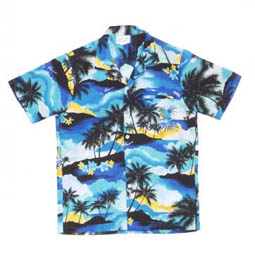
"So why do you dress up like a 70s porn star anyway?"
I don't mind when people ask. I've been wearing polyethylene naphthalate shirts for years, since high school.
The feeling of a polyester shirt against the skin, someone wrote, is akin to wearing a wetsuit smeared with plastic lard. That sounds about right.
The positive ionic charge of polyester makes dirt cling more fiercely to the fabric than it does to soap. Embarrassing odours become trapped in the fabric and no amount of washing will ever remove them, the acrid smell eventually leaving you no choice but to throw out the shirt or risk social isolation.
Beyond that, the risks rise even higher. The minute polyester comes in contact with flame it will shrink, burn and melt slowly into a hard, black, bead-like material that will fuse with skin.
None of which bothers me.
When I wear polyester I never have to worry about someone walking into the room wearing the same thing. I won't have to feel guilty that I am part of the clothing standards (and manufacturing practices) of The Gap. I can claim this one vestige of individuality.
Inside the booming retro biz
When vintage wear made its comeback in the mid-nineties, it offered people like me a powerful alternative to the brand name craze. Vintage stores soon dotted every city centre. I could go to "70s night" at the local club to party it up with blue leisure suits, black Afros, Atari, and roller skates. I could watch Studio 54, Velvet Goldmine, or the 70s Show to find out that the 70s were the grooviest decade ever, man. Soon I could only marvel at the irony that this anti-trend had itself become trendy, sold out to "The Man."
The 19 vintage clothing stores that have cropped up in Vancouver in the last couple of years offer the retro look for 20 to 30 bucks. Value Village now has almost 200 stores in Canada, the U.S. and Australia. Supply and demand has taken over.
These days vintage pickers scour recycling plants around the Lower Mainland for polyester shirts about to be unraveled for their fabric and shipped to the Third World. One of them is Skylar Stock, who vintage picks for Kawabata-Ya, a hip reworked vintage store in Vancouver's West End.
Stock says he's been doing vintage picking eight hours a day, five days a week for about ten years. He does it by working alongside clothing recycling plant workers at undisclosed locations in Richmond, or Maple Ridge, or Vancouver. I try but fail to get the locations out of him. It's a secret.
The factories are at it non-stop, sorting 1000 pound bales of clothes into more than 300 different categories of textiles, from ripped jeans to sequined gloves. Those bales have been cast off by places like Value Village, Big Brothers, church societies, or when the little ma and pa store next door doesn't have room for the 300 wool jackets from last winter's line.
What makes the grade is re-packaged in hundred-pound bales and thrown into a semi container. Once it's full, the factory will sell the container to clients overseas.
As for Stock, he tells me he's looking for the clothes that are a great look and can be resold. The right polyester shirt can net him up to 20 dollars. "Whatever I like I take," he says.
Stock recently found a bonnet dating back to the 19th century. He thinks he'll "probably give it to a museum."
'Smart' tech for disco shirts
Someday there may be a museum for polyester, too. At the moment the look seems to be once again becoming passé. But consider the future as glimpsed by Montreal-based science fiction writer Glen Grant. He sees a golden age coming for laboratory produced disco shirts.
Grant expects the ultimate dance club "smart fabric" to be interwoven with computer circuitry flashing colour and light in sync with the body's rhythms, its sound panels tied into the club's sound system, putting you literally inside the music. Your shirt could go opaque or translucent, depending on your mood, inhibitions, and respect for local custom. And smart fabrics would be home to thousands of micro-robots creeping along the fabric in a never-ending battle with wear and tear, Grant says.
Prototype smart fabrics are already here. Dr. Margaret Orth is cofounder of a company called International Fashion Machines. Her firm is working on a technology called "electronic plaid." The fabric contains electronic wires and tiny capsules of a special thermochromatic ink that gets darker or lighter as they are heated or cooled. As the wrinkles get ironed out of the special fabric, it could be used in shoes, jewelry, or handbags with designs that change colors, all to get your attention.
"The [fabric] is a reflection of what happens when the physical world around us becomes malleable through software," Orth says from her office in Boston. "When that happens you can change parts of the physical world, control aspects of it, control the aesthetics, or the shape in certain ways. There's just so much interest in that kind of stuff."
While getting her Ph.D. at the Massachusetts Institute of Technology Media Lab, Orth met colleagues who'd had been exploring hi-tech fabrics for some time. "They really liked me because I dress in kind of wild and crazy clothing, and a lot of thrift store stuff," says Orth, a gal after my own heart.
Now, by experimenting with combining electronic yarns and woven circuits, she is trying to figure out how to, say, run a video on fabric. But don't look for movies playing on people's backs any time soon, Orth says. She has not, for example, figured out how to deal with body heat, which interferes with the circuitry.
When she does iron out the wrinkles, though, "People are going to love it," Orth enthuses. "Wouldn't you love it? Don't you want to put your tie on and have it say 'Hi' occasionally? Or something else interesting? Wouldn't that be fabulous?"
Just an old fashioned guy
I have to admit it all sounds pretty cool. Then I look down at my polyester shirt, complete with brown checkerboard pattern and new sweat stains that will never really come out, and I realize that I want nothing to do with this smart fabric stuff. Because I really don't want to wear a shirt that is more perfect than I am. Instead of smart shirts, I want to clothe myself in "dumb shirts." Shirts that rip and smell bad and could permanently disfigure me. Shirts forever free of nanites.
Last summer I came across the first polyester shirt I ever purchased. It had a light blue cityscape pattern printed on a white background, slowly fading to yellow. It smelled of mildew and its tails had ripped, giving me the opportunity to pull a thread and slowly unravel the shirt if I so desired.
I decided to put it on. Something about it just felt right, something about a shirt so dumb, it's cool.
Kevin Groves [email protected] is a journalist in Vancouver. ![[Tyee]](/design-article.thetyee.ca/ui/img/yellowblob.png)











Tyee Commenting Guidelines
Comments that violate guidelines risk being deleted, and violations may result in a temporary or permanent user ban. Maintain the spirit of good conversation to stay in the discussion.
*Please note The Tyee is not a forum for spreading misinformation about COVID-19, denying its existence or minimizing its risk to public health.
Do:
Do not: