

 SHARE:
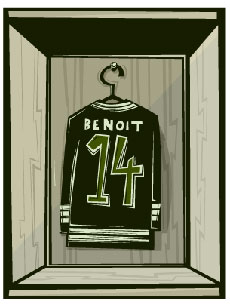
Bobby was explaining the hockey code of conduct he tried to live by but his mind kept wondering.
Concentrate. Stop thinking about love and how damn beautiful she is. Maybe taking Viagra wouldn’t be so bad.
The giddiness made him feel fourteen again.
“Bobby!”
He took a moment to collect his thoughts, but then made the mistake of gazing at her radiance.
Incredible. What’s going on?
He took a deep breath and then another. He rearranged himself in his chair.
“What’s my code of conduct that I’ve lived by in hockey?” he repeated. He avoided looking at her, in order to concentrate.
“First, and I guess most important, hockey is a team game, so I’ve always tried to live by something old Moe, the trainer back in Moose Jaw, once told me: ‘Everybody on the team has a different role to play, but nobody is more important than anyone else.’”
“Sounds awfully subversive,” said Frida, her eyes twinkling mischievously as she sipped her wine.
“You’ve got to act like a team to be a team, that’s what I was always taught. I’ve seen what happens when guys start thinking that they’re better or more important than their teammates. Prima donnas kill team spirit. I know, I’ve been one.”
“So, you don’t believe in royalty or oligarchy? You believe in treating people equally,” Frida said.
“Ya sure, I guess. Of course I do.”
“So, you believe in democracy,” said Frida as she lifted her glass of wine in a toast. “To democracy.”
“But a team isn’t a democracy. Everyone has to listen to the coach and do what he says, whether they agree with it or not.”
“So you believe in dictatorship?”
“In a sense, yes.”
“Which sense?”
Bobby gobbled down the remains of a spring roll to give himself some time to think.
“The coach isn’t really a dictator because any player can leave the team and the coach only has the right to make decisions about things regarding the team and if the coach isn’t winning, then the players have the right to get rid of the coach.”
“If you elected the coach, it would be like an anarcho-syndicalist collective.”
Bobby stared at her, not comprehending a word she had just said.
“And the coach has to treat everyone equally?” said Frida, trying to get back to helping Bobby.
“In a sense, yes.”
“Which sense?”
This was an easier question to answer.
“The coach has to treat everyone with equal amounts of respect,” said Bobby. “The coach might give 30 minutes per game of ice time to one guy and five minutes to another and in that sense things aren’t equal. But for a team to be a team, the coach and everyone on it must equally value the contribution of the guy who plays five minutes as the guy who plays 30.”
“Sounds sort of like communism,” said Frida. “‘From each according to her ability to each according to his need.’”
“I don’t have a problem with guys getting paid whatever the market will bear,” said Bobby.
“Sounds sort of like capitalism,” said Frida.
“But I don’t believe money can make a guy play better. You’ve got to play because you love the game.”
“Sounds sort of like a new age religion,” said Frida.
“Are you making fun of me?” said Bobby.
“No,” said Frida, giggling. “Or maybe I am. I’m just trying to help you figure out what to call what you believe in.”
“I told you,” said Bobby.
“Told me what?” said Frida, who had drunk more than half the bottle of wine herself.
“I don’t have a philosophy,” he said, “except for hockey.”
“Au contraire,” said Frida. “You have them all: democracy, capitalism, communism, socialism, humanism, anarchism, Christianity, Buddhism.”
“All? None? What’s the difference?” said Bobby.
“Nihilism,” said Frida. “Keep talking and I’m sure we’ll find elements of every philosophy known to humankind. Your problem isn’t a lack of philosophy.”
“No?” said Bobby.
“No.”
“Then what is my problem?” Bobby felt penetrated by those eyes again.
“You’ve got every philosophy wrapped up in that hockey code,” Frida said. “You’ve just got to choose what you want to emphasize. I can give you books that will help you with that.”
Bobby knew that wasn’t what she wanted to say.
“What is my problem?” he repeated.
Frida sighed. She emptied her glass and looked towards the bottle, as if she wanted more, but Bobby beat her to the wine.
“Tell me,” he said, holding the bottle just out of her reach. “What is my problem?”
Frida stood up and walked towards Bobby. She grabbed the bottle, but rather than pouring more wine into her glass, she emptied it into his glass.
“Your problem is that you do not understand and accept your place in the world. Your problem is that you got your sense of self-worth from your athletic ability but you don’t have that anymore and you’re struggling to find something else to give your life meaning. Your problem is that you’re pushing 50 and you still don’t know what you want to do when you grow up. And your problem is that you think your problem is unique.”
Frida stared at him. At first it was a look that Bobby thought was one of ‘ah ha,’ perhaps a product of resentment built up over decades, or since he sexually snubbed her, but the look, or Bobby’s perception of it, quickly changed to conciliation and even genuine concern.
Bobby felt a mixture of anger, disappointment, admiration and lust. He knew which feeling he would prefer to act upon, but he also knew the time was still wrong. What if he couldn’t get it up again? All he could think to say was: “What are you? What do you believe in?”
She stared at him for a few seconds, before reacting.
“I haven’t been asked that in a long time,” Frida said. “Once upon a time it was an important subject.”
“When?” asked Bobby.
“When I was a lot younger,” she answered. “My mother was Trotskyist and then an anarcho-syndicalist and then an anarchist. I was exposed to pretty much every left-wing ism in existence. My mother would have these dinners and people would debate. When we were in Mexico she had friends who knew Trotsky. At her dinners in Vancouver I met George Woodcock and Noam Chomsky.”
There was that name again. Bobby pretended he knew what the hell she was talking about, just as he had done with his son. He had looked up Chomsky on the Internet and knew he was a famous left-wing writer with a lot of books, but that was about it.
“Left-wing people from all over the world stayed here to visit my mother,” said Frida.
“Your husband was political too?” said Bobby.
“Oh, he was member of the MIR, a Marxist-Leninist he would have said. But, in many ways, he didn’t really have clearly defined politics. He had gotten involved as a student during Allende’s time in Chile when the MIR was very busy. I don’t think Marcello ever spent a lot of time really figuring out what he believed. I think there was as much anarchist or hippy in him as Marxist-Leninist.”
Bobby felt a jealous surge because of the nostalgia in her voice.
“Did you break up over politics?” he said.
Frida shook her head. “We broke up because it was a marriage of convenience and the relationship was no longer convenient.”
“For him?” said Bobby. “Or for you?”
She stared again for a moment, before speaking.
“If you’re asking, did he leave me just like you did, then the answer is yes,” she said. “And to finish the story, he was fun and interesting, but I never loved him.”
To overcome the awkwardness, Bobby changed the subject.
“You still haven’t told me what you are, politically,” he said.
“Somewhere between an anarchist and a socialist I guess. I like the anarchist spirit but I believe in good government,” she said.
“Anarchist? What is that?” said Bobby. “That’s what my son calls himself and that’s what Brad said our team was becoming: anarchists on ice.”
“I could think of worse things,” said Frida.
“I am so clueless about politics,” said Bobby. “I mean, I could tell you everything you ever wanted to know about curved sticks versus straight or dump and chase versus carrying the puck across the blueline, but anarchism or Marxist-Lemonist? I don’t have a clue.”
Frida’s burst of laughter surprised, then hurt him.
“What? said Bobby.
“You said Marxist-Lemonist,” she said. “Leninist. After Lenin, the first leader of the Russian Communist Party.”
“My point exactly,” he said. “I’m stupid about this stuff.”
“Not stupid,” said Frida. “Ignorant.”
She smiled.
“Thanks,” he said, then an idea landed in his brain like a hat thrown from the stands upon the occasion of his third goal in a game.
Bobby smiled.
“You don’t know the lingo, that’s all.”
“I embarrassed you at dinner last week when Sylvia asked me what I thought about participatory economics.”
“No.”
“I didn’t know who Noam Chomsky was.”
“So?”
“I want to learn how to fit in with your friends. Why don’t you teach me?”
The request caught her off guard.
“I promise to be a good student.”
“Bobby…”
“Listen to me, please. I want to fit in your life. How to act, what to think, what to believe.”
“Bobby…”
“You remember the movie My Fair Lady? Rex Harrison teaches Audrey Hepburn how to be a proper English lady? I want you to teach me how to be a sensitive, feminist, anarchist-socialist, whatever guy. I want to be somebody different. I can do it, I know I can.”
Bobby could not read Frida’s look. Consternation? Annoyance? Anger?
“I need your help. It’s not so much to ask. Help me become a new man. Help the hockey dinosaur evolve into a new creature that can survive life away from the primordial rink. What have you got to lose? And think what you might gain.”
“What do you want from me, Bobby?”
“I want you to imagine your perfect man. How would he act, think, what would he believe, everything. Then tell me and help me become him.”
Was that a smirk?
“Consider it an experiment. Maybe you can even get a grant.”
She smiled.
“You can write a book about it,” he continued aggressively. “Whether I succeed or fail, the story would sell.”
“Sounds like a potential pop psychology best seller all right.”
Did she mean that was a good thing or a bad thing?
“You’ll do it?”
“I don’t know.
“Please?”
“I’ll think about it.”
“Please?”
Frida looked at him for a moment and then left the living room. A couple of minutes later she returned from the adjoining office and handed Bobby a stack of books with titles like “Marx for Beginners,” “Freud for Beginners” and “Anarchism for Beginners.”
“Read these and then we’ll talk about it,” she said.
“These are cartoons?” Bobby said as he skimmed the pages of the top book called ‘John Stuart Mills for Beginners’.”
“These are good introductions to a lot of subjects,” said Frida. “If you want to go more in depth on any subject, you’re welcome to any book from my mother’s library. I’ll buy you everything Noam Chomsky has ever written.”
“Thanks,” Bobby said. “I guess I should get going. Let me help clean up.”
“No,” said Frida. “You want some of the leftovers?”
Bobby shook his head. He turned away, but then immediately thought better of it.
“But I’ll come back tomorrow and help you eat them,” he said, more as a question than a statement.
His level of contentment grew as a smile spread across her face.
“I’d like that,” Frida said. “I’ll call you when I get home.”
Bobby felt excited and alert despite weeks of insomnia. He did not feel good, but he certainly felt better as he sat in his two-year-old Nissan Maxima and stared at Frida’s house.
The living room light went off. Then the kitchen light and a light came on the second floor.
He had actually spent an entire evening with a woman, with no transmission of body fluids. He had talked about emotions, feelings, politics, philosophy and he had actually enjoyed it. Weird.
Would he ever have sex again? Real sex, with a real woman?
Did he care one way or the other? He had no desire. Not for sex. Not for anything.
Lies. He deeply and desperately wanted something. He desired desire. He desired to become someone who could be desired.
Next Chapter: Monday
The Meaning of Hockey runs three times a week for 16 weeks exclusively on The Tyee. To offer advice, to criticize or to reserve your printed copy of The Meaning of Hockey email [email protected] ![[Tyee]](/design-article.thetyee.ca/ui/img/yellowblob.png)







Tyee Commenting Guidelines
Comments that violate guidelines risk being deleted, and violations may result in a temporary or permanent user ban. Maintain the spirit of good conversation to stay in the discussion.
*Please note The Tyee is not a forum for spreading misinformation about COVID-19, denying its existence or minimizing its risk to public health.
Do:
Do not: