


 SHARE:
[Editor’s note: This story contains descriptions of sexual misconduct involving minors and young adults.]
It’s a messy moment in media and pop culture.
New information about the Epstein files surfaced this week, but one would be forgiven for missing it on account of the slop dominating our feeds.
This is an era rife with misinformation that is a hotbed for all kinds of hate, from anti-trans rhetoric related to the recent Tumbler Ridge school shooting to the anti-immigration views broadcasted on social media by a BC Conservative staffer. That young man is not alone in his perspectives; in the weeks leading up to the 2024 provincial election, Tyee reporter Jen St. Denis found that the social media accounts belonging to several BC Conservative candidates contained far-right jokes and posts.
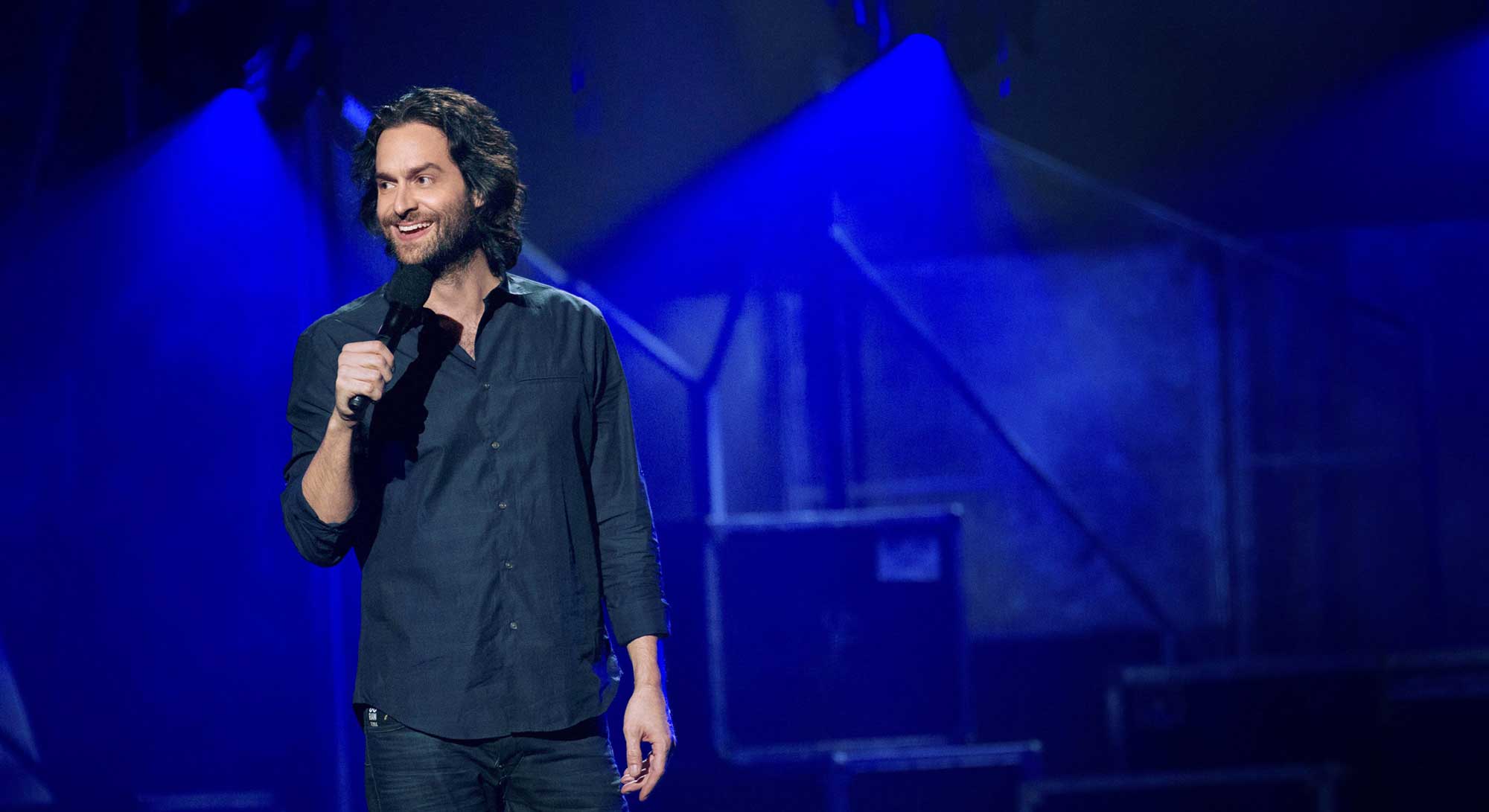
By this logic, it makes some sense that the first of two March 14 performances by controversial stand-up comedian Chris D’Elia is nearly sold out at the 668-seat Vancouver Playhouse. He is booked for a second show, which has more available seats, later that night at 9:30 p.m.
Vancouver marks the first North American stop of D’Elia’s 2026 international tour that starts Feb. 28 at the 2,896-seat Palais Theatre in Melbourne, Australia. Following his Vancouver shows, he will perform at the 853-seat Kelowna Community Theatre in Kelowna, B.C., before touring across the United States. His final listed live show to date is in Portugal, at the Cinema Sāo Jorge with almost 2,000 seats, at the end of August.
D’Elia’s tour this year marks a return to form, sort of. The 45-year-old is back in the public eye after a period of dormancy following the events of June 2020, when many women went public with allegations of sexual misconduct and sexual harassment involving D’Elia that took place online and in person in the early- to late-2010s.
It might be easy to denounce D’Elia’s work with the simple knowledge of the allegations that many women have made about his sexual improprieties, notably how he allegedly held power over several by creating a coercive dynamic in which he allegedly exerted control over the granular events of their daily lives, including their clothing choices, time spent with friends and interactions with other men.
But in this, the darkest timeline, D’Elia’s sexual misconduct allegations are just the tip of a dense, sad iceberg.
The enduring global market for his work paints a bleak portrait of a time in politics and pop culture when everyday fascism and a new right fuelled in part by the “manosphere” have become increasingly mainstream.
A litany of indiscretions
D’Elia’s alleged improprieties have been widely reported because they left a wide-ranging footprint in the form of direct messages, text messages, emails and digital videos. They involved him messaging high school students and young women on social media, chats he escalated from flirtatious to sexually aggressive. He also allegedly exposed himself without consent to multiple women over several years.
On several occasions, he asked minors for nude photos and to meet him in person.
Five women described such experiences to LA Times reporter Amy Kaufman in June 2020.
Ten women shared graphic details of their interactions to Rolling Stone reporter Cheyenne Roundtree in May 2023.
One sued him in 2021, alleging she was 17 when she met D’Elia on social media. She later withdrew the lawsuit.
D’Elia and his legal team denied the allegations when they became public in June 2020.
His talent agents, manager and touring agent stopped working with him immediately.
Netflix also dropped D’Elia from a planned show featuring him.
Comedy Central, Amazon Prime Video and Hulu pulled an episode of the sitcom Workaholics from their streaming services that involved D’Elia playing a child abuser.
The multimedia streaming giant Spotify still carries an album based on D’Elia’s 2013 televised comedy special, White Male. Black Comic. But in spring 2021 it quietly deleted four podcast episodes of The Joe Rogan Experience featuring interviews with the comedian.
The early pandemic years were intense for many, and clearly D’Elia was no exception.
“All this stuff happened at the same time,” he told a live audience at the State Theatre in Minneapolis in April 2023. “COVID. I was cancelled. Had my first son. This is all crazy that this happened at the same time, right. So I took time. I stayed home for a year.”
D’Elia uploaded a video recording of the Minneapolis show as a one-hour comedy special called “Grow or Die” to YouTube in March 2025. The video is also a featured item on his professional website, perhaps as part of his effort to respond, in part, to the allegations that led his to getting “cancelled.”
D’Elia told the Minneapolis crowd that he spent that year at home working on himself by going to therapy and parenting his child.
“I can’t get cancelled again,” he said. “Dude, if I got cancelled again, at that point, I’d have to be like, fuck it, I’m trans, and run someone over.”
He then mimed the act of running someone over with a car, a reference to Caitlyn Jenner’s 2015 car crash that killed another driver in California. “Sorry! I’m a woman!” The audience laughs.
“I know this is uncomfortable to talk about,” D’Elia continued. “But fuck it, this is how I talk now, okay, I have nothing to lose… that’s the thing, you can’t shame somebody into being better. You can’t shame someone into being the way that you think that they should be. You can’t do that.”
D’Elia’s edgelord comedy, his whiny bargaining and his tendency to oscillate quickly between sincerity and aggression will be familiar to any woman, heaven help her, who has tried to meet a man on a dating app. His is a confusing brand of entertainment that doesn’t neatly check the boxes of textbook conservatism; in his 2013 comedy special White Male. Black Comic., one of his jokes frames him as a supporter of gay men, to thunderous applause, while making jokes at their expense.
In “Grow or Die,” he replaces professional accountability with personal vulnerability. He speaks extensively about his time in therapy and how it facilitated a journey of self-discovery.
“If you want somebody to be better, you have to let them try,” he said.
He might indeed be trying. “Grow or Die” sees D’Elia speaking openly about the nuances of new fatherhood and mental health, among other topics. Yet he scaffolds several of his jokes so they afford him the opportunity to say a homophobic slur and an ableist slur several times.
Between the jokes, D’Elia is candid about his anger issues, his desire for acceptance and fear of rejection, his depression and obsessive-compulsive disorder in a set that also involves mocking “old Asian dudes.”
He opens the set by telling the audience his young son is white, a joke that sets up a conceit for him to distance himself from hypothetical white nationalist audience members and those who stormed the capitol.
But it’s all a slippery slope.
Unfiltered appeal
“It can all feel like something of a system breakdown in his telling,” New York Times correspondent Matt Flegenheimer wrote in a 2021 profile of the podcaster Joe Rogan.
“At once a testament to the trust deficit plaguing mainstream institutions and the durable allure of convincing people they are listening to something subversive and undiluted.”
Flegenheimer could well have been describing D’Elia, who has 2.3 million followers on Instagram, 1.1 million followers on Facebook and some 334,000 subscribers on YouTube. His style of comedic delivery is that of the unfiltered everyman with the familiar gristle of gen X and the puerility of millennials, a study in contrasts that he embodies as he straddles both generations.
Within a three-minute span of stand-up material, D’Elia can appear by turns charming and subversive, normie and crossing the line. He carries himself with a hip-hop adjacent, slacker posture that may recall the fellow students of those who attended high school in North America in the 1990s, as D’Elia did.
His relatability might hold appeal to those seeking levity in the form of a boundary-pushing break from the strictures of the daily grind. It can be relieving, perhaps affirming, to watch a guy say what he wants, or say what you’re thinking, in front of a cheering crowd.
In the YouTube comments section of the “Grow or Die” video, D’Elia doubles down on the self-reflection that he peddles in his set.
“This was the most difficult hour of stand up I’ve ever done,” he wrote in a pinned post. “I’m more proud of it than any other special I’ve filmed so far.”
Fans responded appreciatively. “Thank you Chris. In tears waiting to go back to my therapist. You just helped me unlock a load of shit. You are the man!” one wrote.
“Just watched you Saturday in Portland with my parents,” wrote another. “Funniest stand up I’ve ever seen. And now we get this? What a blessing. Thank you and God bless you and your beautiful family. Life Rips.”
The experience of watching “Grow or Die” reminded me of Brock Colyar’s account of the social lives of young conservative Americans during the advent of Trump’s second presidency for New York Magazine.
“Conservatism — as a cultural force, not just a political condition — is back in a real way for the first time since the 1980s,” Colyar wrote.
“It was disconcerting how often a normal conversation with one of these so-called normal people could cannonball from politics and policy into, at the very least, a not-so-PC joke and, at worst, something hateful.”
In both “Grow or Die” and the 2013 comedy special White Male. Black Comic., D’Elia ping-pongs wildly from unfiltered if predictable social commentary to outright misogyny and racism.
In White Male. Black Comic., he mocks Black men, Asian women and women in general. Riffing off an extended joke about how he thinks drunk women behave more wildly than drunk men, he sells a line of merch called “Drunk Girls” on his website.
This is Colyar’s conservatism as cultural force. Its nihilism could be shocking, but in a sea of red-pilled posturing that is as disturbing as it is absurd, D’Elia’s work, for all its bluster, falls flat. When every joke punches down, there’s nowhere to move.
The experience of watching him do stand-up makes me think of what it might be like to bump into the worst people I knew in high school while running errands in present day. We might talk for a while. But I’d harvest the flowers of adulthood by choosing to turn away. And then do everything in my power to be the opposite of what they are. ![[Tyee]](/design-article.thetyee.ca/ui/img/yellowblob.png)
Read more: Gender + Sexuality, Media







Tyee Commenting Guidelines
Please note that email notifications for replies are not currently working due to a software issue which may be resolved in a future update.
Comments that violate guidelines risk being deleted, and violations may result in a temporary or permanent user ban. Maintain the spirit of good conversation to stay in the discussion and be patient with moderators. Comments are reviewed regularly but not in real time.
Do:
Do not: