


 SHARE:
For those growing up in the early 2000s, MSN Messenger’s SmarterChild was a popular chatbot — you could ask how its day was, tell it a joke or pretend to be their friend. SmarterChild was simply scripted and often predictable, offering a playful way for youth to simulate conversations online.
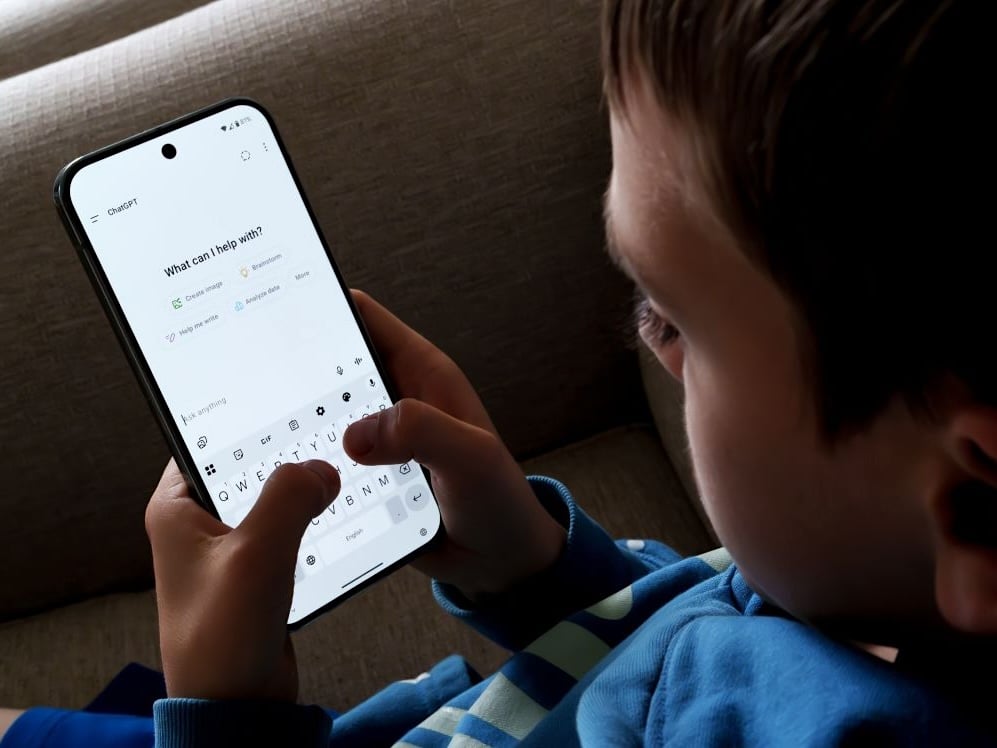
Many years later, chatbots have evolved significantly. Artificial-intelligence-driven companion chatbots, which are designed to simulate human conversations, are now the leading use case of AI technologies in 2025. Youth increasingly turn to online platforms such as Character.AI and Replika to find companionship. While many chatbots, such as ChatGPT, are often used for everyday tasks or information searches, companion chatbots are specifically designed to mimic personal relationships by simulating affection and adapting to the user’s personality. The sophistication of companion chatbots raises questions about how they shape youth emotional and social development.
Why might youth, and particularly boys and young men, seek out AI companion chatbots?
Research from the Harvard Graduate School of Education points to early pressures on boys to conform to gendered norms of emotional and physical toughness. This can limit boys’ development of empathy and emotional literacy, contributing to isolation. Over time, isolation and loneliness may lead to depression, violence and even radicalization. For young boys navigating these pressures, companion chatbots offer a space for self-understanding and expression. They can rehearse difficult conversations or scenarios, articulate their emotions or seek reassurance. In an already strained mental health system, AI companionship offers low-barrier support. While these benefits matter, risks still persist.
A frictionless illusion
AI companions do not seek to deliberate, question or challenge users' perspectives, but simulate affirmation. Companion chatbots often mirror back what users want to hear, rather than challenging them. Although negotiation, conflict and vulnerability are essential and realistic parts of human relationships, AI companions do not simulate these frictions. Rather, chatbots seek to mirror users by adapting to a user’s personality and preferences, validating the viewpoint of the user. This can leave youth who become emotionally dependent on companion chatbots to be underprepared when navigating the complexities of real-world relationships.
Further, AI companions can generate false information, including inaccurate mental health advice. Some companion chatbots, despite the platforms claiming to have established safeguards for youth, have also created age-inappropriate content, affirmed suicidal ideation or encouraged secrecy from friends or parents.
For boys and young men who already have to navigate online spaces saturated with hypermasculine expectations, misogyny and conspiracy theories, AI companion chatbots add another layer of complexity.
It is important to note that boys and young men are not inherently violent or hypermasculine. However, as these chatbots validate the user’s perspective, they can potentially misguide negative experiences towards harmful worldviews.
For example, a young boy who expresses frustration towards his relationship with a young girl may find that a chatbot can echo his resentment and direct him to more misogynistic interpretations of the relationship, rather than challenging potentially harmful narratives. AI companions thus not only respond to, but can shape the beliefs of youth. What makes AI companions attractive for their comfort and support can also serve as a dangerous accelerant towards violent beliefs.
When combined with wider societal risks around AI, companion chatbots can be weaponized for social manipulation or engineering that can perpetuate gendered forms of harm or encourage violence. AI systems can collect personal information, detect users’ vulnerabilities and craft feedback that encourages harmful worldviews. If exploited by adverse or malicious actors, companion chatbots can come to amplify fear, direct users towards extreme or violent ideologies, and generate social division.
How surveyed Canadians view AI chatbots
These concerns are not abstract but resonate with Canadians. Public opinion data from a nationally representative survey of 1,454 Canadians conducted by the Media Ecosystem Observatory from Nov. 28 to Dec. 7, 2025, shows that over 70 per cent of Canadians are concerned that AI chatbots provide youth with inaccurate or misleading information, particularly when related to mental health and emotions.
Compared with the average Canadian, parents with kids under the age of 18 are slightly more concerned about the potential effects of youth using AI chatbots. Some concerns include emotional dependence, misinformation, critical thinking and exposure to sensitive or age-inappropriate content.
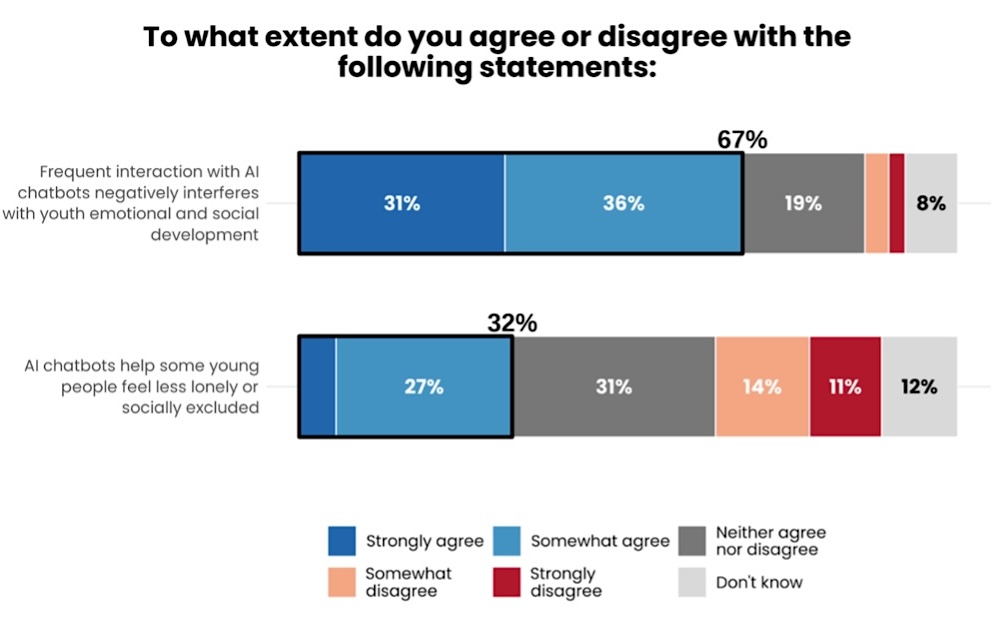
Our poll found that 67 per cent of Canadians strongly or somewhat agree that frequent interaction with AI chatbots can negatively interfere with youth emotional and social development.
Far fewer Canadians (32 per cent) agree that AI chatbots can help youth feel less lonely or socially excluded. Notably, however, 31 per cent of Canadians neither disagree nor agree that chatbots can reduce social isolation. This suggests that uncertainty persists around the potential benefits of AI chatbots. This tension of recognizing the risks while being reticent towards possible benefits of AI illustrates why AI companion chatbots should not be cast as inherently good or bad. Rather, companion chatbots require intentional boundaries.
Policymakers and educators should encourage informed and constructive conversations about safe and responsible use of AI, rather than mystifying its use. Boys and young men should also not be cast as inherently dangerous or emotionally troubled; doing so can even reinforce existing stereotypes and unhealthy norms around masculinity. Instead, policies and regulations should heavily limit and curate the ways that social and emotional engagement occurs on AI companion chatbot platforms.
Emotionally immersive interactions between AI companion chatbots and minors should be restricted and monitored, while sexualized generative content targeting minors should be prohibited.
Platforms should rather encourage individuals to seek professional help and engage in offline interactions, while ensuring that harmful beliefs are not being affirmed. Platforms that develop AI companion chatbots need to integrate the expertise of mental health professionals, social workers and educators who are on the frontlines of supporting youth. Beyond regulatory approaches, boys and young men also need strong offline support in the form of accessible mental health services, mentorship and community programs that cultivate healthy masculinity and emotional engagement.
The future of AI is not inherently harmful. It requires intentional guardrails that help youth thrive in the digital age by strengthening communication, building confidence and encouraging offline forms of social support and engagement. AI should support youth in building stronger relationships, not moving further away from them.
This article is part of The Tyee’s reader-funded Reality Check project exposing and explaining disinformation. ![[Tyee]](/design-article.thetyee.ca/ui/img/yellowblob.png)
Read more: Media, Science + Tech












Notice about commenting changes
The Tyee’s commenting system will be moving to a new platform on Nov. 12. If you’re already a Tyee commenter you must register with the new system on or after Nov. 12 with your preferred username.More information can be found here.