

 SHARE:
Ken Johnstone made a point of attending the annual Ironworkers bridge memorial on each anniversary of its deadly collapse. He was a humble man who would stand quietly at the back.
Like many in Vancouver, Johnstone couldn’t forget June 17, 1958. What sounded like an explosion sent two spans of the partially constructed bridge plunging into Burrard Inlet, taking 18 lives. One rescuer died days later.
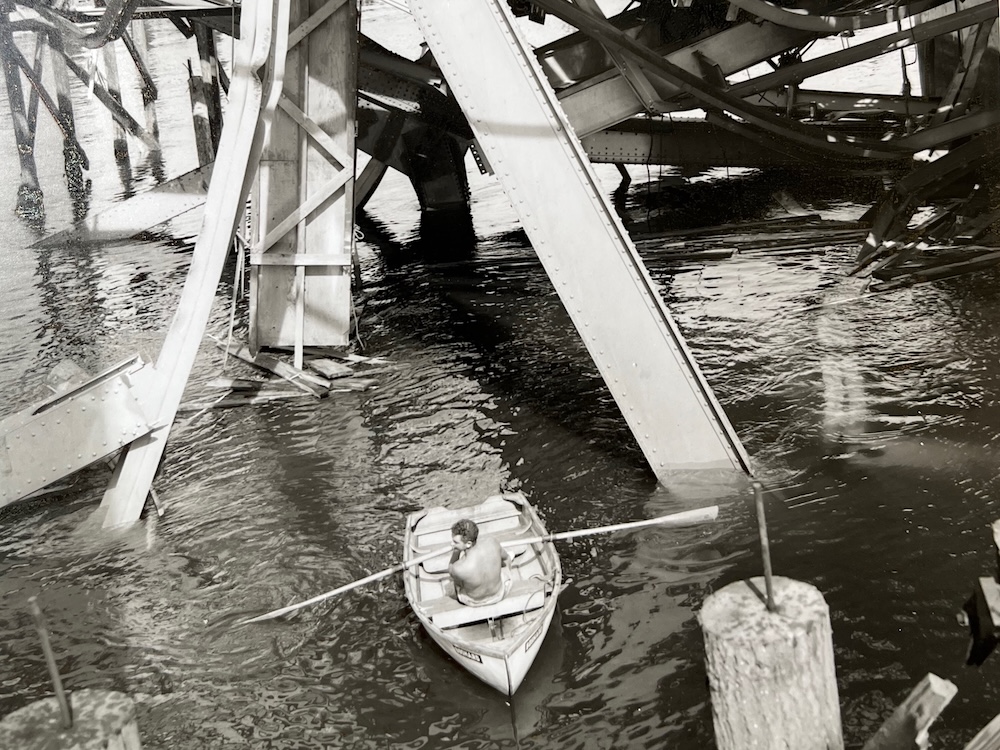
That sunny Tuesday afternoon, 23-year-old Johnstone was at work in a small rowboat underneath the bridge. His job was to watch out for the painting crew above in case someone fell in the water and needed to be rescued.
When 12,000 tons of steel hit the water, massive waves smashed into the tiny boat. Wearing only a pair of shorts, Johnstone clung to two oars, fighting feverishly to keep the boat afloat. He later recalled the eerie sound of red-hot rivets hitting the cold salt water.
He saw much worse. Once he steadied the skiff, Johnstone set to work helping to recover the bodies of the dead. He saved three lives that day, plus his own.
In the extensive media coverage that followed the tragedy, Johnstone’s name is mentioned only once. Joe Broshard, the painting contractor, praised Ken Johnstone for being “directly responsible for saving three men.” Elsewhere he is identified only as “the boatman.”
That could be because Johnstone didn’t stick around after the disaster; he took off for Brandon, Manitoba, where he worked for Manitoba Hydro for many years as a millwright.
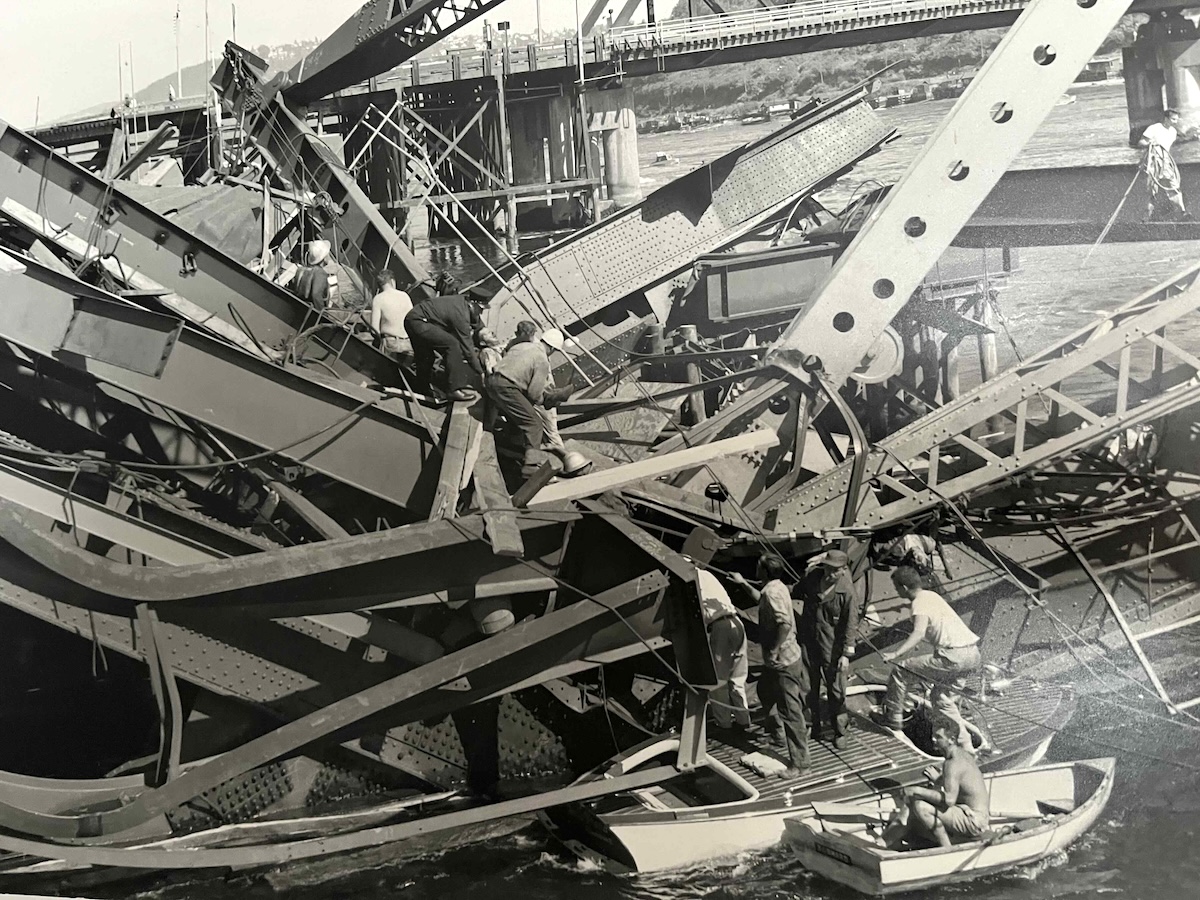
He seldom spoke of that horrible day. In the 1970s Johnstone came back to Vancouver and established a new life. None of his friends knew much about his connection to the Second Narrows’ collapse until much later. He would sometimes mention it, but dismissed any probing questions. “It was nothing,” he insisted. “That's what they paid me for. That was my job. That's what I was there to do.”
A close friend once tracked down some photos of the aftermath of the collapse that showed Johnstone in his rowboat near the mangled steel and surprised him with copies as a birthday gift. “He was kind of shocked. I don't think he realized there were photographs of him.”
Ken Johnstone was born in Scotland in 1935 and was adopted by the midwife who delivered him. She gave him her surname. His biological parents were unmarried professionals, something considered sinful at the time. His father visited him a few times, but that soon stopped. The trauma followed Johnstone through his life.
He came to Canada and made his way to Vancouver where he got the job that put him underneath the bridge in 1958. He remained single his entire life. He was a talented self-taught artist, who read voraciously and could deliver off-the-cuff lectures on most any topic.
Ken Johnstone died in 2021 at the Brock Fahrni Pavilion in Vancouver, three weeks after his 86th birthday.
Until the end, he promised his best friend that he would sit down for a proper interview, tell his story and receive some attention.
“Next year,” Ken always replied. ![[Tyee]](/design-article.thetyee.ca/ui/img/yellowblob.png)
Read more: Labour + Industry

Tyee Commenting Guidelines
Please note that email notifications for replies are not currently working due to a software issue which may be resolved in a future update.
Comments that violate guidelines risk being deleted, and violations may result in a temporary or permanent user ban. Maintain the spirit of good conversation to stay in the discussion and be patient with moderators. Comments are reviewed regularly but not in real time.
Do:
Do not: