

 SHARE:
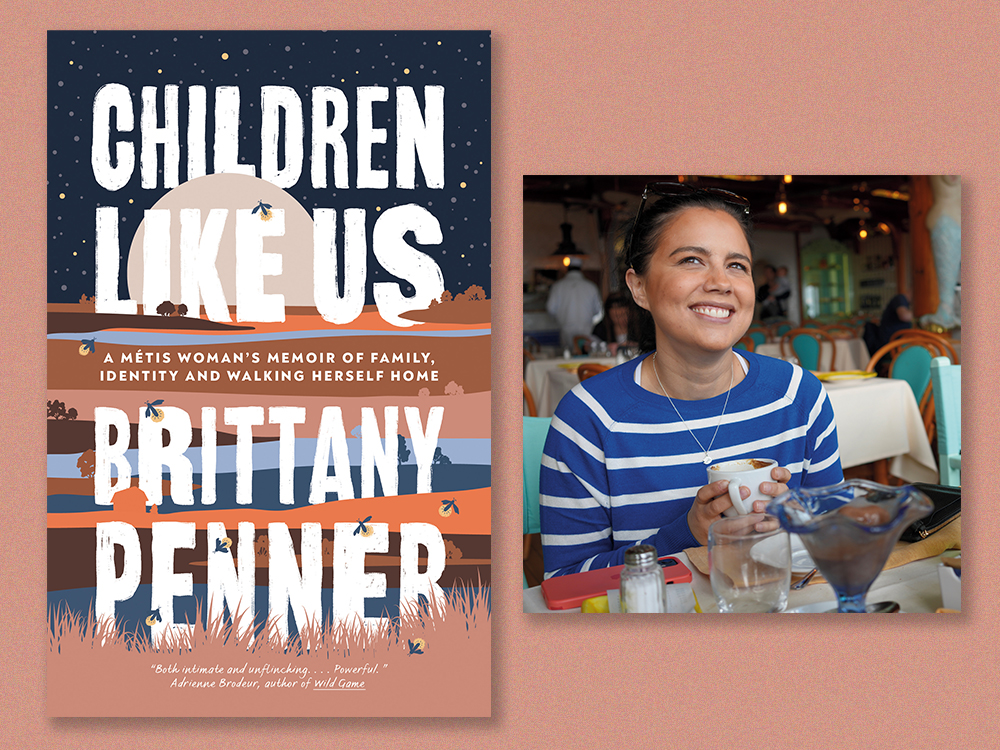
[Editor’s note: Brittany Penner was adopted by a white Mennonite family at birth in 1989, at the tail end of the ’60s Scoop. In ‘Children Like Us: A Métis Woman’s Memoir of Family, Identity and Walking Herself Home,’ she recounts her upbringing on the Prairies as her parents foster other Indigenous children, whom Penner regards as siblings. As they come and go through her childhood home, she is left wondering when she might leave, too. In this excerpt, two of Penner’s siblings, James and Marion, return to her childhood home for the summer.]
June 30, 1993; photograph
It’s my fourth birthday and Mom has invited some aunties and uncles and cousins to our house to celebrate. I’m sitting at the head of the table, where Dad otherwise always sits, with a colourful Care Bear cake Mom bought from Penner Foods perched in front of me.
James stands to my left with his arm draped over my shoulder. His smile will always be the first thing I notice whenever I see a photo of him. Marion is smiling too, but only slightly — she has always been the shy one of us three. She’s resting her chin on the table, eyes wide at the cake. She still struggles to finish each meal, and Dad still refuses to let her leave the table until her plate is clear — but just as Dad always has room for chips after dinner, she always has room for dessert.
Several of my dad’s biological siblings are here. George is also here, along with his brother and their foster siblings and a few of our other cousins too. This photo is like so many other moments in my childhood: an entire family of white adults situated at the periphery of the room, and Native children at the centre. There is not a single white child here. And not a single Native adult.
My parents don’t explain why James and Marion come to live with us again this summer. This is just how it is. We live the kinds of lives where we are with our families and then we are not and then we are back with them again.
James and Marion and I are all part-Native. I don’t understand why my brother and sister are returned to their biological families while I remain with Mom and Dad. It’s just another in a string of unsolvable mysteries. Like how God is real but we cannot see him. Or how Jesus lived and died and then lived again. All these things — they just are. And why do you have so many questions anyway, Mom always wants to know.
James is a little different from how I remember him. He’s less affectionate, less open. It’s like a door to one of the playrooms in his heart has closed and he’s grown up in the time we’ve spent apart.
He and Marion — who seems mostly the same to me, apart from her hair, which has grown longer — are sharing bunk beds in their old room again. Marion has the top bunk, as before. Mom dresses Marion and me as twins once again. James resumes wearing his favourite pair of coveralls, excited to see that they still fit him — although the skin of his ankles has begun to peek out.
Dad is in a better mood when James is around, and our family feels more whole than it’s felt for a while. It’s almost like nothing has changed. Even though everything has changed. I’ve had 10 other siblings since they were with us. And I’m older now. Smarter. I understand that they’re not staying forever.
For all my siblings who’ve come and gone
“Now I lay me down to sleep, I pray the Lord my soul to keep,” I say, my r’s more like w’s, my fingers folded diligently over one another. I pray for all my siblings who’ve come and gone. For James and Marion’s parents. For Grandma and Grandpa and George. For Baba. And I thank Jesus for my cat Tabby, who sleeps next to me every night.
I’ve begun fearing the day I’ll be taken away. What I’m most afraid of is being separated from Tabby. I can’t imagine falling asleep without her, waking up without her. I wonder, if I show Jesus how thankful I am for her, if he might make sure I don’t ever have to leave. I drift off to sleep slowly, Tabby’s head resting on my forearm.
A creak on the stairs wakes us up. I tell Tabby not to leave the bed, then I tiptoe toward my half-closed bedroom door. Mom is standing at the top of the stairs, across the hallway.
“He’s doing it again,” she whispers to Dad. Dad is leaning against their bedroom door frame a few feet from her, rubbing the ginger stubble on his chin. His face looks concerned or irritated or tired. I can’t quite make it out.
“Well, go get him,” he says.
I can hear James downstairs in the kitchen, whimpering like he’s hurt. It’s not the first time this has happened since James and Marion moved back in with us. It’s not even the first time this week.
“He’s calling for her,” Mom says.
“Well, go!” Dad says. Now he’s annoyed — this I can tell.
These nightly wanderings were never something James did when he lived with us the first time. Now, when he’s not sleepwalking and calling out for his mom, I hear him crying in his bed before I fall asleep. I don’t understand what’s happened.
I step back from my door and slide back into bed next to Tabby. “You’re such a good girl,” I whisper. I fall back asleep once I hear Mom return to her bedroom after tucking James under his covers again. The house is quiet and we’re all where we should be.
Visiting my siblings’ father
Our grey Honda Accord hums down the Trans-Canada Highway, the wheat fields long harvested, the sun blanketed by grey clouds, as we travel an hour and 15 minutes to visit the home of James and Marion’s parents in Winnipeg. Usually, my siblings visit their families without me while I spend the day at Baba’s, but today is not a scheduled visitation day.
No matter the length of the drive, car rides always put me to sleep, and I awake at the sound of James slamming the car door shut. I rub my eyes and see that Marion is still beside me in the back seat. When I jump out of the vehicle, a November gust surrounds me, sharp and fresh.
Inside my siblings’ two-storey townhouse, the air thickens — it’s like wading through swamp water. James and Marion run out of sight into the kitchen; I hear a chair dragging against the linoleum floor, then a chip bag opening. The living room is dimly lit and the curtains are drawn. Cigarette smoke crawls slowly toward me, reminding me of being at Baba’s.
James and Marion’s father is sitting in a recliner across from the television, ashtray on his knee. My parents and I visited here a few times after my siblings left, and, twice, their father drove out to our farm. He’s always greeted me with a hearty “Heya, Brit, how are ya,” but today is different. Today there is no greeting for any of us, not even his children.
Mom is silent, a rarity for her, as she seats herself on a couch near the recliner. Dad leans against the staircase, near my siblings’ father. I always marvel at the difference in size between their father and mine. Their dad is at least six feet tall, with broad shoulders and shoulder-length brown hair. He always dresses in a beat-up flannel shirt that smells like smoke and gasoline.
Dad is at least half a foot shorter, narrow from shoulders to hips, and smells like wood shavings. Although he’s not a large man, I’m always surprised to see Dad looking small in comparison to anyone. He will never seem small to me.
“She had her boyfriend beat me up last night,” their father says. “He came at me with a bat.”
I understand that he’s talking about James and Marion’s mother. “Boyfriend”... I guess they’re not together anymore. Maybe that’s why my siblings have come to stay with us again?
I listen closely to every word he says to my parents, who seem to have forgotten that I’m in the room too. I inspect his face through the darkness and I can see a mixture of purple and red swelling beneath his gold-rimmed aviators. His upper lip is almost the same colour as the maroon lipliner Mom uses to overline her lips. He has cuts across his nose and across his right eye. The patchwork of tattoos on his forearms always reminds me of the quilts my grandmother sews, but the cuts and bruising on his arms are so dark I can barely see the designs today. He’s the most battered human I have ever seen.
James calls my name from the kitchen. “We’re going to the playground!” he yells. I look to the adults, who are still speaking, before I walk out to join my brother. James throws open the back door and we race to reach the big tire swing, which reminds me of the one my father has hung for us at home.
New siblings for Christmas
It’s not long until James and Marion leave us again. I can’t explain how I know that this time is final — they won’t be back again. Somehow, I just know.
A few weeks later, I’m told that new siblings are coming soon. A brother and sister just in time for Christmas. A miracle, it must be. I’m so excited that every night after I’m tucked into bed, I ask Mom how many sleeps are left until they’re with us.
I keep asking until the day they finally arrive, after which another line of questioning takes hold of my mind — one I’ve obsessed over before. “But when, Mom? When? When will it happen? When am I going to be taken away?”
I become so preoccupied by it that Mom soon grows annoyed with me. Annoyed of endlessly having to reassure me — of explaining that No, Brittany, you will not get taken, and Yes, Brittany, you are here to stay.
Eventually, she stops repeating herself. I do not stop asking.
Excerpted from ‘Children Like Us: A Métis Woman's Memoir of Family, Identity and Walking Herself Home’ by Brittany Penner. Copyright © 2025 Brittany Penner. Published by Doubleday Canada. Reproduced by arrangement with the publisher. All rights reserved. ![[Tyee]](/design-article.thetyee.ca/ui/img/yellowblob.png)
Read more: Indigenous, Books




Tyee Commenting Guidelines
Please note that email notifications for replies are not currently working due to a software issue which may be resolved in a future update.
Comments that violate guidelines risk being deleted, and violations may result in a temporary or permanent user ban. Maintain the spirit of good conversation to stay in the discussion and be patient with moderators. Comments are reviewed regularly but not in real time.
Do:
Do not: