


 SHARE:
“The big trouble with dumb bastards is that they are too dumb to believe there is such a thing as being smart.” — Kurt Vonnegut
In 1976 the U.S. carried out several nuclear tests in Nevada, Apple manufactured its first eight-bit personal computer, the Sex Pistols released “Anarchy in the U.K.” and Carlo Cipolla published The Basic Laws of Human Stupidity.
Cipolla, a gifted historian, clearly made the most significant contribution. His book explained the bafflingly deplorable state of modern life.
Stupidity, warned Cipolla, wields more power than any organized gang or industrial military complex and seems to be a constant force in history.
In other words, the non-stupid should never underestimate the role of stupidity in world events.
Cipolla was an Italian scholar with a sense of humour. He wrote pithy books on economics, human population growth, the importance of wool, pepper and wine in medieval times, and the Black Death. All of that historic research helped Cipolla to detect and elucidate the five basic laws of stupidity.
Those laws, it seems to this jaundiced journalist, can help shed light on much of the mayhem whirling around us like constant Canadian wildfire smoke.
At first, I regarded Cipolla’s thesis as wildly reductionist. But rereading his book has made me something of a convert. I can’t disagree that experts have paid far too much attention to the role of intelligence and progress in shaping civilization. As Cipolla rightfully asks, why do we ignore the enormous power of daftness and dumbness in human affairs?
Heck, if more non-stupid people understood his five laws of stupidity, they might “neutralize one of the most powerful dark forces that hinder the growth of human welfare and happiness.”
Here Cipolla and I part ways because, to me, banishing stupidity seems about as probable as easy living on Mars.
Nevertheless, let us begin with the first law and it’s a whopper.
“Everyone underestimates the number of stupid individuals among us.”
In my reporting and writing I have been guilty of this oversight repeatedly. There is a corollary here: most people tend to overestimate the number of intelligent people running things, too.
So straighten up and come to your senses, wrote Cipolla. The stupid are among us and most likely ruining your day. Stupid people are like plastic in the ocean or microplastics in the bloodstream: you can’t really escape them. “Day after day, with unceasing monotony, one is harassed in one’s activities by stupid individuals who appear suddenly and unexpectedly in the most inconvenient places and at the most improbable moments,” observed Cipolla.
Who can argue with that?
Cipolla’s second law is not as rock solid as the first, and I will explain why in a moment. It posits that stupidity is a trait all by itself — like being born red-headed or big-boned.
“The probability that a certain person is stupid is independent of any other characteristic of that person.”
Cipolla firmly believed “that stupidity is an indiscriminate privilege of all human groups and is uniformly distributed according to a constant proportion.” And I suspect he is right about that.
In other words, “one finds the same percentage of stupid people whether one is considering very large groups or dealing with very small ones.” Their colour, size, wealth, IQ, class and fashion sense really don’t matter. Ratchet your way to the top of Silicon Valley’s techno-elite and you will be faced with the same percentage of stupid people in your life. As a consequence one clever scribe has even written a book titled Why Smart People Can Be So Stupid — credit no doubt due to Cipolla’s earlier treatise.
But here I think that even the great Cipolla has erred by blaming nature for so many mindless people. To be sure, nature can reliably scare up a lot of stupid people, but so can the engineering of technocrats. A lot of studies have documented that the technological world is making everyday life more monotonous, fragile and predictable. The thing about monocultures is they tend to be nurseries for making a lot of stupid people.
Study after study, researchers have documented how digital gadgets have made people anxious, hapless or depressed. Smartphones, computers and AI have not made our democracies smarter or happier. In fact, they have made them dumber. As a result, many people can’t find their way home, read the weather, talk to the opposite sex, boil an egg or remember their passwords.
Cipolla’s third law addresses the crux of the matter by carefully defining what stupidity is.
“A stupid person is a person who causes losses to another person or to a group of persons while himself deriving no gain and even possibly incurring losses.”
And yet stupidity finds willing inhabitants because it protects people from awareness or from facing unpleasant realities. Ignorance is bliss, delusion is wisdom, and all that idiocy.
Being stupid means you never have to apologize or take a moment and talk about consequences. Stupid people never have to recognize the limits of their stupidity, let alone the borders of their intelligence. As a result, notes Cipolla, non-stupid people lose money, health, time, energy and cheerfulness to “the improbable action of some preposterous creature who has nothing to gain and indeed gains nothing from causing us embarrassment, difficulties or harm.”
Worse, nobody knows or can truly explain why the stupid do what they do. “In fact there is no explanation — or better, there is only one explanation: the person in question is stupid.”
The fourth law attends to collateral damage the stupid cause to all around them. As they bumble along in arrogant blindness…
“Non-stupid people always underestimate the damaging power of stupid individuals.”
Many intelligent people, citing the ever-refined design of education, policy, software, you name it, imagine they can outwit the stupid or manipulate boobies and thereby contain their toxic doings. Cipolla reminds that, instead, “one cannot foresee all the stupid’s actions and reactions, and before long one will be pulverized by the unpredictable moves of the stupid partner.”
Note the latent power ascribed to the stupid in this formulation. So, stupidity should not be confused with helplessness.
The helpless make up an identifiable group altogether. Their condition is different from that of the stupid. There are probably as many helpless people as stupid ones on the planet. In fact, according to Cipolla, humanity comes in four basic flavours: intelligent, stupid, helpless and bandit. The ratio of bandits, smarties and the abused is always changing while the number of stupid remains constant, as does bad politics.
But where were we?
Let’s move straight to Cipolla’s fifth law, which is probably the best known.
“A stupid person is the most dangerous person.”
This is so because, as Cipolla elaborates: “Stupid people cause losses to other people with no counterpart of gains on their own account. Thus, the society as a whole is impoverished.”
And so stupid people are more dangerous than bandits, warns Cipolla. Bandits will leave you penniless or naked on the street. They are, after all, in the business of wealth transfer. But a stupid person isn’t interested in any kind of transfer, wealth or otherwise. They make mayhem without even recognizing the damage they have caused. Nor will they take any responsibility for their actions.
People who read these pages will not be shocked to hear me say I believe we live in a time of social decline masked as one of glorious technological advancement. And that the slide downhill is picking up dizzying speed.
What resonates for me is Cipolla’s observation that in societies doing poorly, “The stupid members of the society are allowed by the other members to become more active and take more actions.” This affords the stupid contingent much more sway.
History shows that countries or civilizations moving uphill have “an unusually high fraction of non-stupid people that keep the fraction of stupid people at bay.” That development ensures some solid gains for most or all.
But as the good times disappear one notices among those in power “an alarming proliferation of the bandits with overtones of stupidity and a lot more helpless people.” According to Cipolla, that’s never a good combination.
It all ends, of course, in a bad place that bears some uncomfortable resemblance to our current predicament. “Such change in the composition of the non-stupid population inevitably strengthens the destructive power of the stupid fraction and makes decline a certainty. And the country goes to Hell.”
To prevent that kind of future foretold by Cipolla, the U.S. writer Kurt Vonnegut, long a scholar of stupidity, offered a simple prescription in 1988.
In his open letter to the ladies and gentlemen of 2088 whom Vonnegut imagined would be sipping stupid orange drinks by their stupid computers like stupid astronauts without a home, he offered this advice.
Start listening to nature and stop polluting Earth. Teach your kids how “to inhabit a small planet without helping to kill it.” And “stop thinking science can fix anything if you give it a trillion dollars.”
Elon Musk, by the way, was hardly the first smart stupid person to suggest a good way to spend a trillion dollars might be to colonize space and set up a new civilization on Mars.
Forget about it, wrote Vonnegut.
The notion that our grandchildren will be OK no matter what because they will be able to flee to the Red Planet on a nice gleaming spaceship struck Vonnegut as the epitome of “mean and stupid.”
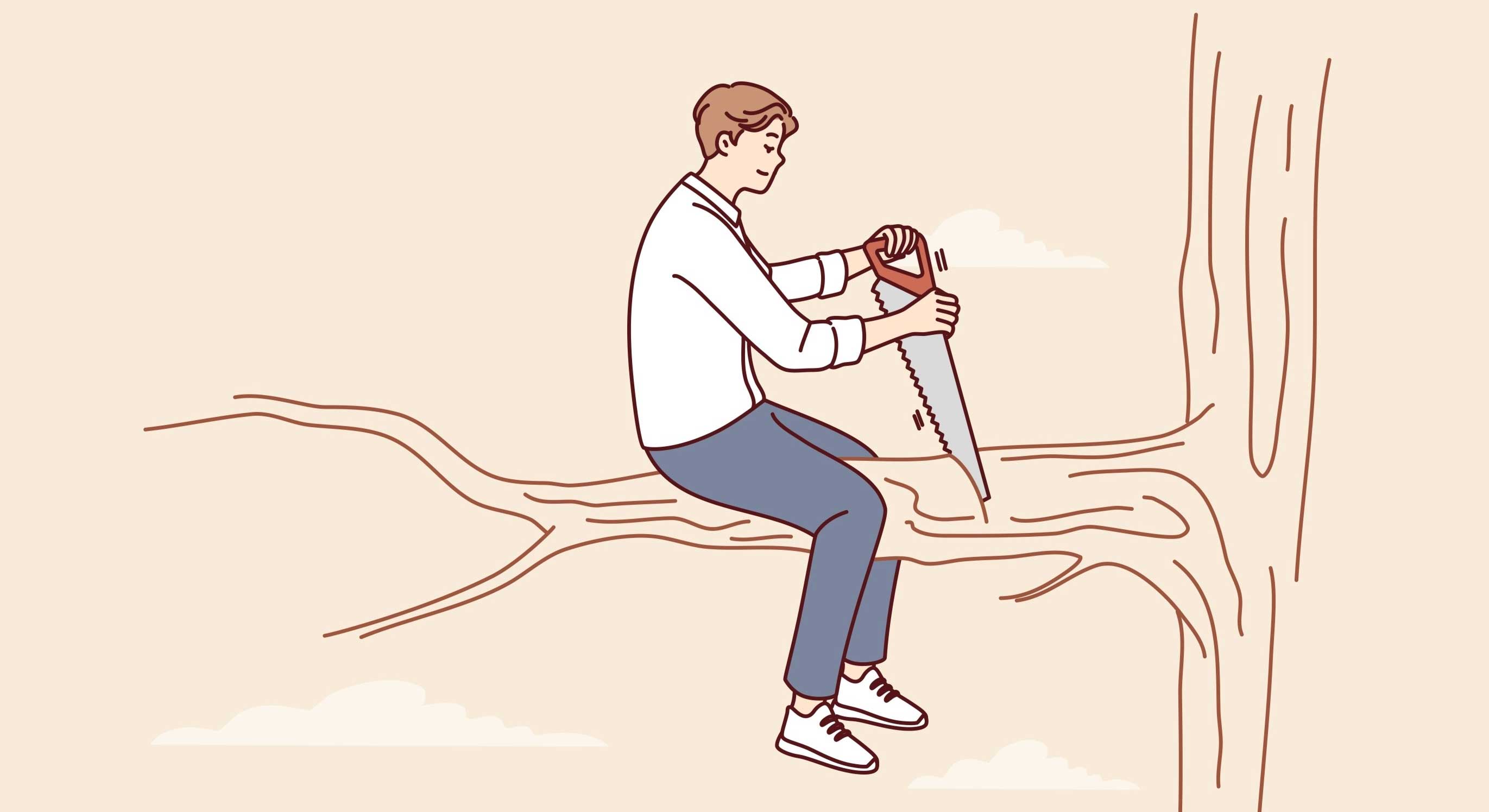
Yet that preposterous idea now dominates the fantasies of our techno-elites, who every day saw a little more into the tree limb on which they and all of humanity nervously perch. With every draw of the blade, they further demonstrate the timeless relevance of Carlo Cipolla’s five basic laws of stupidity. ![[Tyee]](/design-article.thetyee.ca/ui/img/yellowblob.png)
Read more: Politics










Tyee Commenting Guidelines
Please note that email notifications for replies are not currently working due to a software issue which may be resolved in a future update.
Comments that violate guidelines risk being deleted, and violations may result in a temporary or permanent user ban. Maintain the spirit of good conversation to stay in the discussion and be patient with moderators. Comments are reviewed regularly but not in real time.
Do:
Do not: