


 SHARE:
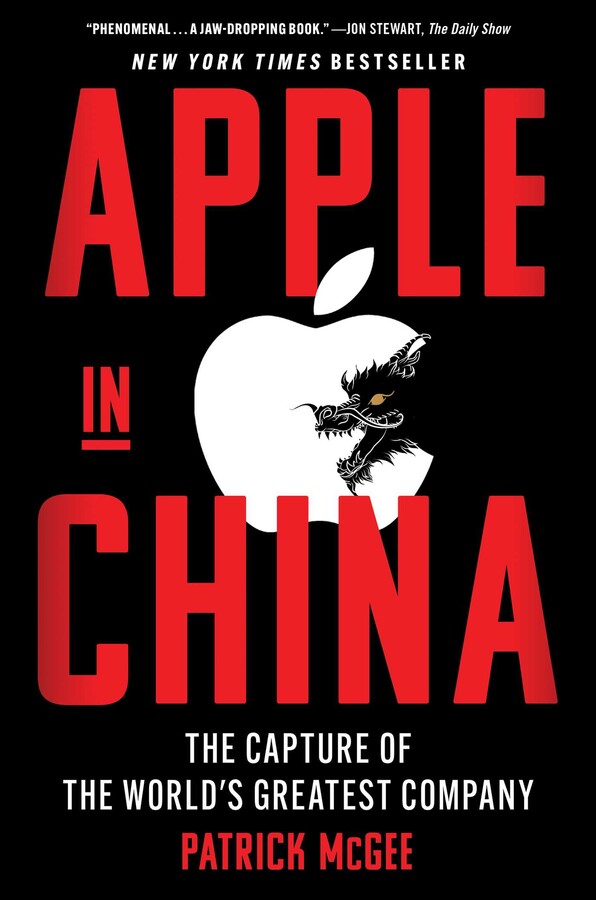
Apple in China: The Capture of the World’s Greatest Company
Patrick McGee
Scribner (2025)
Most corporate histories are vanity projects, with the corporation paying the writer and the publisher. The book is a nice little present for visitors, most of whom will take it home and shelve it unread. If they do read it, they will find a sanitized account of a company’s rise, perhaps with some setbacks and then a brilliant recovery.
Apple in China is not such a book. Author Patrick McGee is a Canadian-born business journalist who’s covered Apple for years. He has many contacts who have worked for Apple or are working there still. He quotes one of them as saying Apple is more secretive than the U.S. military.
Yet McGee managed to interview some 200 people, Apple veterans or still with the company, and they’ve helped him make this book a kind of corporate thriller: a history of a corporation that changed the world, only to find itself trapped. McGee takes us in Apple’s footsteps, seeing how it gained wealth and power at every step until its top executives realized the staircase did not lead to heaven.
The result is a book at least as much about politics as about making or losing money. It also makes clear that Donald Trump’s vision of making iPhones in the United States is simply impossible.
McGee gives us a concise history of Apple’s first two decades, when it wowed the world with the Macintosh’s graphic user interface and ease of use. (I remember creating handouts and a textbook on a loaner Mac in the 1980s. For a teacher who’d been using a mimeograph to make copies, this was an astounding improvement in working conditions.)
As McGee describes it, Apple stalled and went into a slow decline in the 1980s. Steve Jobs was forced out in 1985, and the decline worsened. The new Macintosh computers weren’t selling well, and the company stayed alive thanks to the LaserWriter, which launched desktop publishing.
Burning through CEOs and cash
Jobs went off to found NeXT, which built a computer that ran on a new operating system. And by the mid-1990s Apple had burned through a couple of CEOs and a lot of cash; its competitors were producing PCs with cheap, interchangeable components, while Apple designed and built its own — at considerably greater expense. In 1997, Apple invited Jobs back as a consultant, largely because it needed his NeXTSTEP operating system.
But by 2000 Jobs was Apple’s permanent CEO and putting Apple on track to become the giant corporation it is today.
One critical change was that Apple became a designer of computers, not a builder of them. This had started while Jobs was still away and his successor, Jean-Louis Gassée, hired Sony to build the PowerBook 100 laptop.
“Working from a half-page document of Apple specifications, Sony crammed the innards of a $4,500 Mac desktop into the form factor of a five-pound laptop,” McGee writes. “The whole project went from drawing board to production in just 13 months, wowing Apple. It was priced at $2,300.... The [Apple] teams were astounded by the quality and care of Japanese manufacturing.”
As Japan became too expensive, Apple looked elsewhere. The team designing the Newton, a “personal digital assistant,” turned to Taiwan, which had enjoyed considerable Japanese investment in electronics. The Taiwanese engineers were eager to learn from Apple, going out of their way to buy expensive equipment required by Newton’s design.
The training Apple provided equipped them to take on other projects — and not just for Apple.
As computer manufacturing in the United States became increasingly hard and expensive, offshoring the job to Asia became increasingly easy.
A culture of perfectionism
The return of Jobs also intensified Apple’s culture of perfectionism, often challenged by engineering reality. That culture had nearly ruined the first iMac, which was intended to rescue Apple. The original version, designed by Jony Ive, was simply unbuildable. But Ive recognized his mistakes and changed the design. The revised iMac, with its memorable coloured translucent-plastic shell, succeeded brilliantly.
Significantly, the iMac’s cathode ray tube was built in Korea, making it cheap enough to sell at $1,200 in 1998. But it was also Apple’s biggest sales success, and the problem now was where in the world to build it.
The Korean manufacturer, LG, opened plants in Wales and Mexico, but had cultural problems with its local workers — and with Apple’s demand forecasts for particular colours (tangerine was a failure). A redesign of the iMac made it cheaper, but LG seemed unable to build it at scale.
At that point, McGee tells us, a Taiwanese company called Hon Hai Precision had become a secondary supplier to build the iMac in China. When its CEO, Terry Gou, learned about Apple’s problems with LG, he called with a simple promise: “I can fix this.”
Known internationally as Foxconn, Hon Hai made an irresistible offer to Apple: he could build their computers for very little, in whatever quantity required. CEO Gou was already operating in China, which could offer as many workers as required. They would need training, but they were hard workers. For that matter, Apple engineers were happy to train Foxconn’s.
“Apple was realizing that thousands of labourers cheaply handcrafting Apple hardware on a conveyor-belt production line allowed its designs to be maddeningly intricate, complex, and automation-unfriendly,” wrote McGee.
When Steve Jobs launched the iPhone in June 2007, Foxconn’s Shenzhen plant, just north of Hong Kong, built every unit — an estimated 1.4 million.

Last year, Foxconn built 80 per cent of all iPhone 16s in its Zhengzhou factories — 72 million units.
Foxconn’s market value is an estimated US$79 billion.
Hooked on cheap production
McGee cites an Apple engineer who “describes Gou’s approach as a wily bet to lure in Western companies, getting them hooked on the drug of cheap production, and creating a sticky relationship based on Foxconn’s choice of components.”
Apple flourished in China for years as Foxconn developed a network of suppliers; building millions of computers, iPods, iPads and iPhones was as much a feat of logistics as of design.
After Jobs’ death in October 2011, his successor was a superb logistician, Tim Cook. Engineers from Cupertino routinely flew over the Pacific to see how production was going and to teach yet more engineers to achieve Apple’s zero-defects goal.
But it wasn’t entirely a success story. Foxconn had to put nets up around some of its buildings because its workers were jumping to their deaths.
When Apple began selling iPhones in China, it had to deal with “scalpers” who would give migrant workers enough money to go into an Apple store and buy many iPhones; the scalpers would then resell them at a tidy profit.
In some cases, resellers actually built their own fake Apple stores, which even their sales staff thought were legitimate.
A dose of reality
As McGee tells it, Apple in China got a dose of reality on March 13, 2013, the day after Xi Jinping was inaugurated president. The company came under attack on China Central Television as a foreign firm that treated Chinese customers badly compared with those in the West. When Apple executives tried to defend their policies, other Chinese media joined the fight.
Sales of iPhones in China suddenly dropped, and Apple struggled to make amends. It simply couldn’t afford to lose either its factories or its customers in China.
Since then, McGee tells us, Apple has obeyed Beijing by removing many iPhone apps from its units sold in China, not to mention access to the New York Times and other western media.
Meanwhile, Apple has been under pressure from Donald Trump. In 2017, McGee tells us, Trump bullied Tim Cook into building “three beautiful plants” in the United States to build Mac Pro laptops. But it succeeded only because Apple flew in a lot of Foxconn engineers from China to troubleshoot.
Now back in office, Trump plans to impose monster tariffs on made-in-China products, including iPhones. This may explain why Apple “donated” $1 million to Trump’s second inauguration.
Considering that China-made iPhones have generated $2 trillion in Apple revenue, a million bucks is a trivial bribe.
Apple has moved some of its manufacturing, notably to India. But the supply chain delivering parts to India is still solidly Chinese. Apple has indeed been captured. It has built itself a symbiotic relationship with China; without its customers, its factories, its workers and its Apple-trained engineers, Apple would implode. And it seems incapable of creating a comparable system anywhere else in the world.
The entry of Apple and other tech companies into China was seen at the turn of the century as an encouraging sign: China would get rich, and wealth would make it democratic. By the time Xi Jinping took power, such views looked very naive. Xi was not content to let Apple and other companies crank out gadgets for western markets. He wanted Chinese manufacturers to compete and beat Apple, Microsoft and other leading corporations.
That competition is getting serious. We’ve seen Chinese tech companies like Huawei rise out of nowhere and look for business in Europe and North America. The Meng Wanzhou affair, which so damaged China-Canada relations, may have really been an effort to keep Huawei from dominating North American markets.
And now China has imposed tariffs on Canadian canola oil because we’ve put tariffs on Chinese EVs far cheaper and better built than Elon Musk’s Tesla — because they might also outsell Canadian-built cars, whether internal combustion or EV.
McGee’s book is almost 400 pages long, but it reads like a political thriller. Earlier books on Apple have made Steve Jobs, Jony Ive and Tim Cook into larger-than-life figures. Now we see them dealing with the likes of Donald Trump and Xi Jinping, and the stakes are life or death for the world’s biggest company.
Like a good novelist, McGee builds his story as a series of challenges and responses as Jobs or Cook or some of their engineers face a disaster. Even when we know the outcome, the way they succeed or fail is surprising and often suspenseful, and prepares us for the next challenge.
But Apple’s biggest challenge faces us all. We too have been captured by China, attracted by its low prices for goods and addicted by their quality. We no longer kid ourselves that China will turn into a western-style democracy, but we somehow manage to ignore human rights violations that appall us in countries the West may deem less necessary.
Like Apple, we are caught in a symbiotic relationship that we can’t break off.
So all we can do is grumble while we trade with China, while reflecting that capitalism is most successful under communist management. ![[Tyee]](/design-article.thetyee.ca/ui/img/yellowblob.png)
Read more: Books, Politics, Labour + Industry, Science + Tech










Tyee Commenting Guidelines
Please note that email notifications for replies are not currently working due to a software issue which may be resolved in a future update.
Comments that violate guidelines risk being deleted, and violations may result in a temporary or permanent user ban. Maintain the spirit of good conversation to stay in the discussion and be patient with moderators. Comments are reviewed regularly but not in real time.
Do:
Do not: