

 SHARE:
- The Land Knows Me: A Nature Walk Exploring Indigenous Wisdom
- Epic Ink (2025)
When Leigh Joseph began the long process of completing a PhD in ethnobotany, she had not only academic advisers, but Squamish and Snuneymuxw nation community advisers, too.
“My aunties and other mentors in community have said, ‘It’s great that you’re gathering this knowledge and just remember that responsibility to come home and to share that,’” said Joseph, who defines ethnobotany as the colonial “study of cultural interrelationships between people and plants.”
The result was Joseph’s first book, Held by the Land: A Guide to Indigenous Plants for Wellness, published in 2023.
Part storytelling about her own relationship with plants as a member of the Squamish and Snuneymuxw nations, part local plant field guide, Held by the Land was written with an adult audience in mind.
When Joseph saw that the bestselling Braiding Sweetgrass by Robin Wall Kimmerer, a Potawatomi botanist, had been adapted for a young adult audience, she approached her publisher, Quarto, about doing the same for Held by the Land.
“A lot of my teachers, especially my late Uncle Chum, Ronald Newman, really instilled in me how important it is to include youth whenever we're doing work with plants and reconnecting to knowledge, to uphold them, and give them as much access to cultural knowledge as possible,” said Joseph, whose ancestral name is Styawat.
But conversations with her publisher set Joseph in a different direction, towards writing her own children’s book with similar themes — and plant guide information — as Held by the Land.
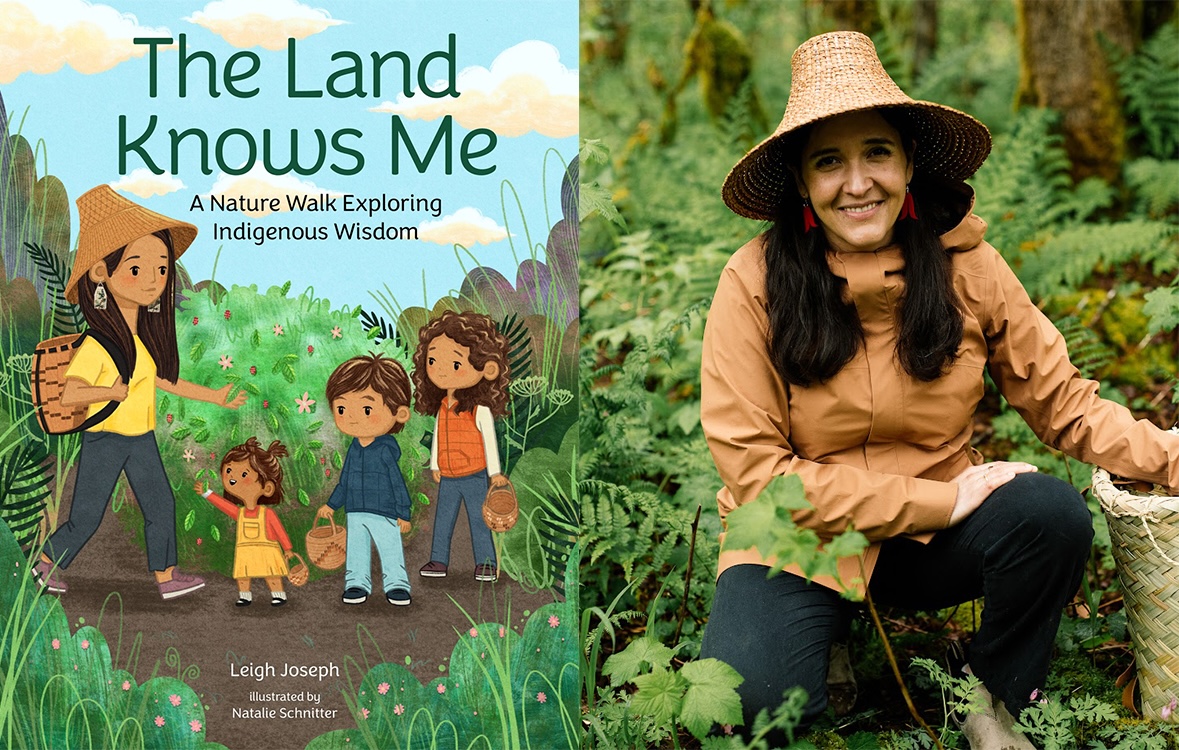
This spring, that work culminated in The Land Knows Me: A Nature Walk Exploring Indigenous Wisdom.
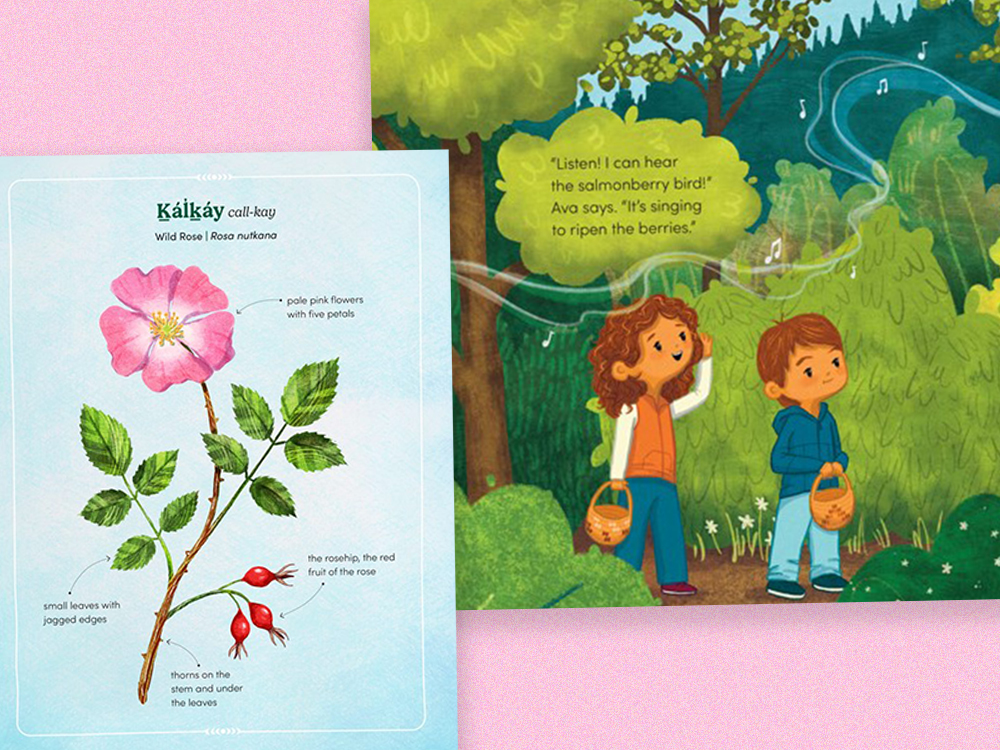
Part story, part field guide, The Land Knows Me takes readers on a cultural plant walk through different parts of Squamish territory with Joseph, her children Ava and Jake*, and her niece Aĺíĺa7, where they identify and introduce themselves to plants and animals like the Yetwán (salmonberry), Schí7i (wild strawberry) and Xwet (Swainson’s thrush).
Sprinkled throughout The Land Knows Me are words in Sḵwx̱wú7mesh Sníchim, or the Squamish language, with a pronunciation guide and English definition at the bottom of each page.
Featuring lush, vibrant illustrations by visual artist Natalie Schnitter, the book includes information about 15 local plants, with harvesting tips, recipes to try and activities for kids and families to do together.
It was written with children aged six to 11 in mind, Joseph said.
Joseph spoke with The Tyee about her history with plants, writing in both Sḵwx̱wú7mesh Sníchim and English, and the importance of Indigenous representation in kids’ books. This interview was edited for length and clarity.
The Tyee: Where does your interest in plants and ethnobotany come from?
Leigh Joseph: When I think about my childhood and some of the visits that my parents would bring me on to Elders in our Snuneymuxw or Nanaimo side of our family, and on the north end of Vancouver Island where I grew up, I had a lot instilled in me that I didn’t reflect on until later in life.
What it meant to be in connection to place through plants, foods and medicines, and also seeing the context of the knowledge that was held in some of my Elders, and learning later in life about their residential school experiences, fuelled in me a drive and desire to reconnect more fully to my Indigenous culture through plant knowledge.
Also as a way to address some of the anger and grief at learning about the experiences of my loved ones and so many other Indigenous people across what’s now known as North America. For me, plants have brought us joy, and are also a focal point for that work. But it’s always in honour of people who've carried that knowledge forward.
Why was it important for you to write a children's book in English and Squamish about plants?
Having my own kids brought a whole different lens to learning about my dad, his parents, my great-aunts and uncles and other people in our community, their experiences at residential school and day school. How that impacted their ability to have the emotional bandwidth to be able to learn on the land together.
There are lots of barriers still for Indigenous people to go out onto their own lands and practise cultural, land-based knowledge and harvesting.
I remember being really emotionally struck when my daughter turned five, just imagining the reality of her being stolen from me at that age, and being completely at a loss at how I would survive that. It brought that kind of deep reflection and hurt.
So when my kids were young, I really wanted them to feel like they belonged on the land, they could take up space, they could have joy, and they could learn.
I see how it feeds their imagination, their curiosity, their confidence, and just knowing what to nourish yourself or nourish someone else with, or put on someone's bug bite or scrape. Those are powerful acts for kids to be involved in.
I hope the book radiates out to other Indigenous families who see themselves reflected, and then more broadly to non-Indigenous families and readers who have an interest in learning from an Indigenous perspective on plants and spending time on the land as a family.
How did you decide which plants to include in The Land Knows Me?
The first filter that we went through was “Let’s not pick anything that can sting you, cause infections with sharp thorns, that walks that line between poison and medicine.” All of those were right out the door.
From there, it was sitting back and thinking about the trail and finding a mix of edible plants and gently medicinal plants. The plants we chose generally are quite easy to identify; have some cool teaching, both ecological and cultural, connected to them; and were most importantly safe for kids and families to learn about.
The Land Knows Me is part story, part textbook, part English-Squamish dictionary, part local plant encyclopedia and part recipe book. Why was it important for you to have all these elements in one book?
This idea of being able to lay down at night and read the story together with your kids, just as easily as you could take the book outside on a trail or in the backyard and learn from.
And then having that interactive piece. I have found with kids, especially, having a little activity to do is where they build their confidence with the subject matter. They feel really proud to know that a wild rose petal is a band-aid, or that you can sprinkle some petals in your water bottle.
And it’s doing something that connects them to the land, but also learning how to do that within a framework of considering what respectful interaction with nature looks like.
There’s a lot of Squamish knowledge in the book. How did you decide what you were comfortable sharing with outsiders?
I always consult a lot with mentors in my community, and that includes family members. Sharing the language and the pronunciations, it’s really important to me, and I worked with the language specialist Sarah Jeffrey, who is actively working on Squamish Nation revitalization.
Weaving those pieces in not only increases Indigenous representation and provides a model for another approach to writing a book that isn’t solely for Squamish people, but honours how powerful it is to speak these words. Because for so long, Squamish people weren't allowed to speak their language.
Those small acts can mean a lot, both to Indigenous readers to see themselves reflected, and to non-Indigenous readers to be able to take the care to consider what it means to struggle and maybe feel uncomfortable trying to pronounce a new word, and everything that that connects to.
I’m never going to be sharing people's specific family or ceremonial knowledge, for example. Often it’s information that is available and being shared through a Squamish lens, and that’s the process that I go through with writing.
How do Squamish medicine and food harvesting practices differ from settler harvesting practices?
It really depends on the person. At the very worst end of things, there’s just no regard for what it means to think about others. Not just other people, but other life that relies on plants and certain ecosystems.
So there can be just widespread overharvesting of culturally important plant foods. Locally, plants like camas bulbs, rice root lilies or tiger lilies are endangered because of habitat loss and lack of Indigenous stewardship and management. Their populations are so low they can’t sustain a level of even cultural harvesting at this point.
The questions I encourage people to ask are: Do you know whose traditional territory you’re on? Is this a culturally important plant? And at that point, stop and ask yourself, “Is this appropriate for me to be harvesting?” Do you know what the state of the population is? Is it plentiful?
If you are harvesting, there’s a well-known rule that you don’t take more than 10 per cent from a particular plant. There are lots of other cultural guidelines and processes for harvesting plants and building those relationships from Indigenous perspectives.
One of the greatest things that any of us can do, but especially non-Indigenous wild crafters and foragers, is to source the plants from wild plant nurseries and grow them for yourself in a planter, community garden or a yard. That’s such a great way to engage and learn, but you’re not taking from wild plant populations.
It simplifies a lot of those questions that you might not know the answers to yet in terms of what it means to be really respectful, reciprocal and responsible when it comes to going out and harvesting, or foraging in wild plant population areas.
The Land Knows Me is a gorgeous book. It’s really beautiful and has such vivid colours. How did you come to work with the illustrator, Natalie Schnitter?
I didn’t know Natalie before. The publisher is sort of the middle person. I sent them some examples of children's books I really liked the illustrations in, and they sent back some options.
Natalie lives in Squamish, which is really neat. So she’s right here in the landscape, and the process of working with her was really cool, because I had to send her, through the publisher, a ton of reference photos of landscape, people who were illustrated into the book and the plants.
That went through a number of rounds, getting every little detail and ensuring the landscape was aligned and accurate. When it came to the drawings of the people, there was lots of back and forth, especially around the cover: having the cedar hat, baskets with some design work and beaded earrings as visual cues that it is an Indigenous story from this region.
It was really a neat collaborative process.
I have lots of fond memories of books I read as a kid, but especially hardcover books. Did you make the decision to make a hardcover versus a softcover?
No, that was the publisher. And, yeah, I’m really glad they did. Both my books have been hardcover, and it’s really lovely. And I made a printed hardcover book, because when I was a kid, if the sleeves would come off and the artwork was gone, I'd be so sad.
How does The Land Knows Me compare to books that you had access to as a kid?
It’s funny, I didn’t have any Indigenous kids’ books. I don't think there were that many in circulation that were written by Indigenous authors at that point in time. I did have older books that have been published by the Squamish Nation of Squamish legends. I always felt a connection and curiosity, because I grew up away from Squamish.
The books I read over and over and over again, so many of them were about relationship with nature. Like A Salmon for Simon, a story about a kid who was building relationships with essentially salmon ecology and salmon.
I remember loving spring books where the bunny would be visiting the different plants. There was definitely a theme there in terms of what books I was drawn to, and also just in my life, what I love to do, which was sit in the front garden and imaginary play for hours on end.
What would it have meant to you, do you think, to have a book like The Land Knows Me as a kid?
Ah, that makes me feel a little emotional. It would have meant a lot, because I think about my experience as being one of two Indigenous kids at my elementary school. Having early experiences with racism, not even knowing what to make of it and what I was being called, really made me shrink and try and fly under the radar, knowing that I was different and didn’t really feel like I belonged.
Having a book like this would have given me a soft place to land, somewhere where I could figure out the place that I did belong.
How do your kids feel about being characters in this book?
[Laughs.] It changed over the course of it. My kids were seven and nine when I started writing this, and they have such a special relationship with their cousin Aĺíĺa7 who's in the book. So they love that aspect.
My son, who is now nine, he loves his character, loves that he’s in the book. My daughter, about six months before the book was published, came to me and said she had some heavy notes for the outfit she was wearing in the book. [Laughs.]
And so I wrote them all down, sent them to the publisher, and they said what I thought they would, it's too far along to make those changes. But I think she’s now come to the place where she just loves that she, Aĺíĺa7 and Jake are together in the story.
It is funny, I thought, “Oh, it's gonna be so great, so special the kids are [in the book].” And now looking back, I'm like, “Yeah, I should have expected some little unforeseen, funny responses.”
* Story updated on July 14 at 9:32 a.m. to correct a name. The Tyee regrets the error. ![[Tyee]](/design-article.thetyee.ca/ui/img/yellowblob.png)
Read more: Indigenous, Books





Tyee Commenting Guidelines
Please note that email notifications for replies are not currently working due to a software issue which may be resolved in a future update.
Comments that violate guidelines risk being deleted, and violations may result in a temporary or permanent user ban. Maintain the spirit of good conversation to stay in the discussion and be patient with moderators. Comments are reviewed regularly but not in real time.
Do:
Do not: