


 SHARE:
It’s 8:00 p.m. on a rainy Monday, and I’m trudging up a hill in the rain in Kitsilano, mysterious paper bag in-hand. As I walk, I try to guess what treasures are inside. That frond sticking out the top — what greenery could it be? A leek, perhaps? And the weight of it means there’s surely an apple or two inside. There’s something in there with a flat bottom that seems suspiciously like a takeout container — did we luck out and get another pre-made meal?
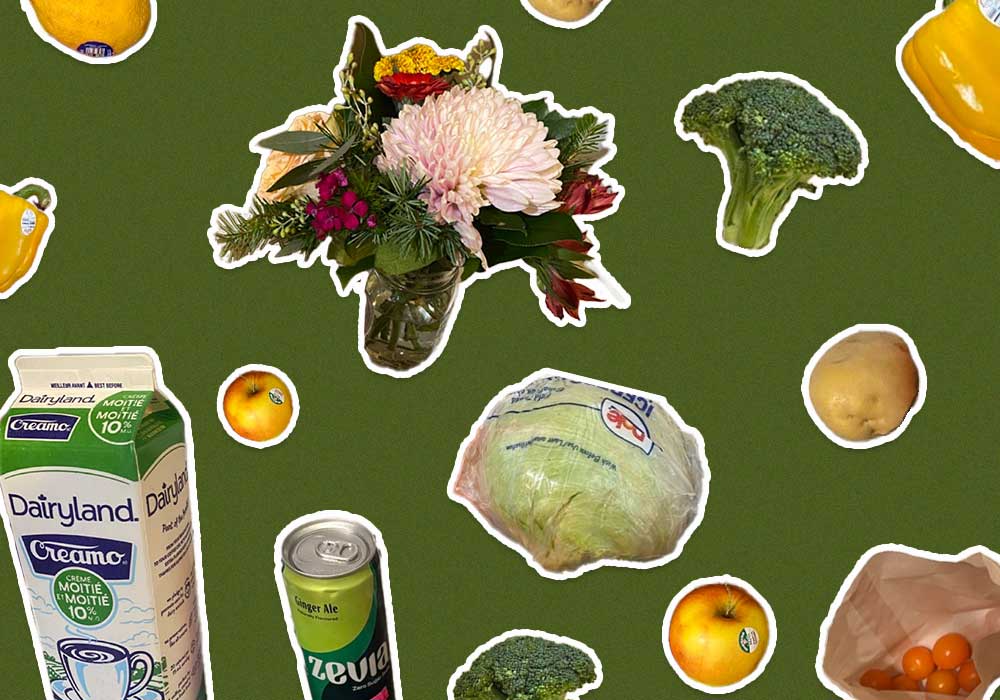
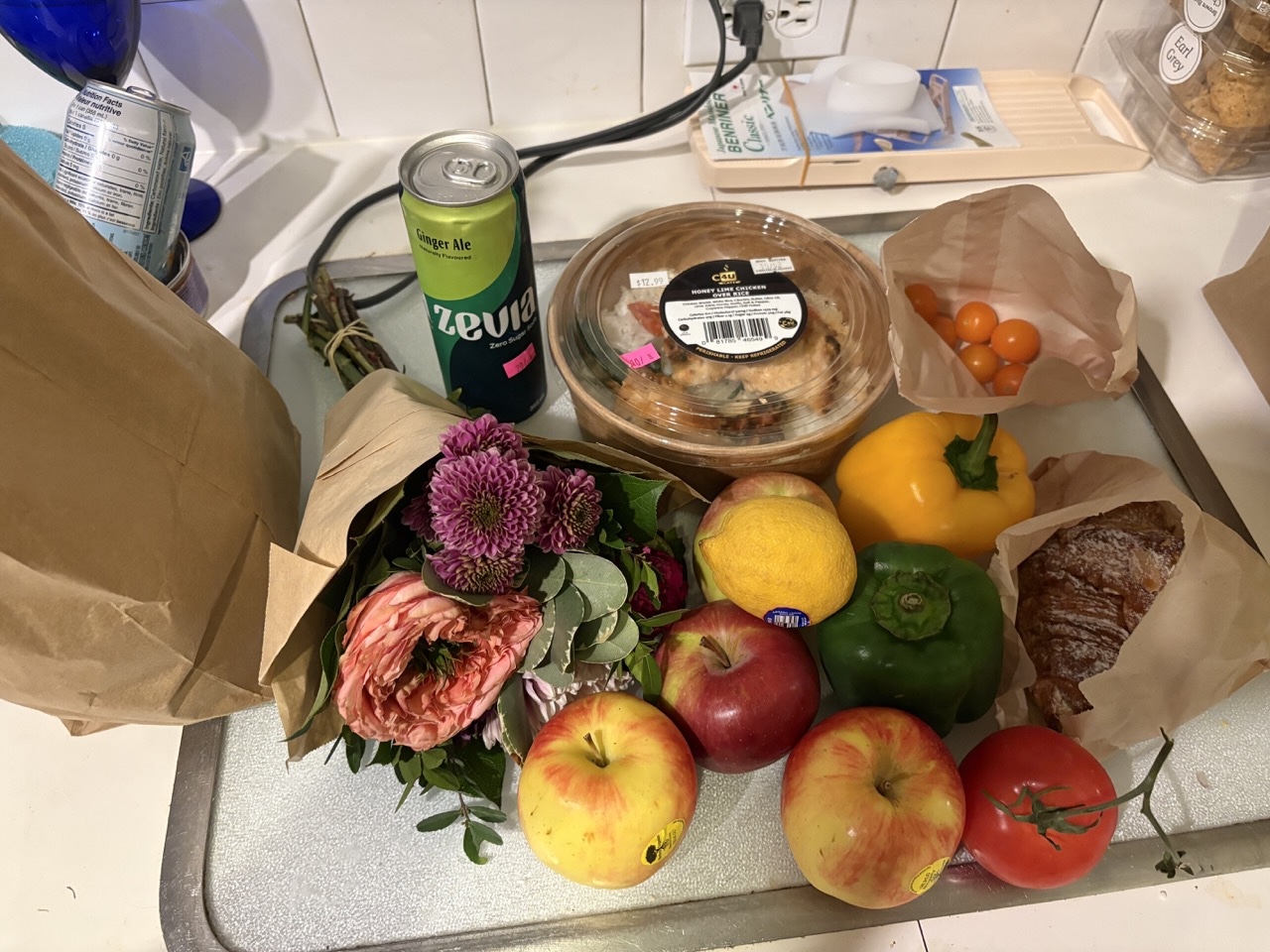
Upon arriving at my apartment, my partner eagerly meets me in the kitchen so we can unbox the bag together. One by one, I pull the items out onto the counter: in a delightful surprise, the frond turns out to be a Valentine’s bouquet. The weight I felt? Four apples, two bell peppers, a single large tomato, a bag of bright-orange cherry tomatoes and a can of sugar-free ginger ale. As predicted there’s a pre-made meal — a honey lime chicken rice bowl — with a $12 price tag still on it. And in a surprise, there’s even a big flaky almond croissant.
The amount we paid for this assortment from a small grocery store in our neighbourhood in the year 2025?
A cool $6.99 CAD.
It’s no secret that the rising cost of food is front of mind for a lot of Canadians. Food prices in Canada are projected to rise by three to five per cent in 2025, adding up to $801 more to the annual grocery bill for an average family of four. We’ve heard enough discourse about egg prices to last a lifetime. And fluctuating tariffs and a full-on trade war are throwing everything into flux.
For my household of two middle-class Vancouver millennials with not nearly enough balcony space to sustain a proper food garden (try as we may!), our desire for a little inspiration and creativity in our consumption — along with a need to save money — has led us to the food waste-saving app Too Good To Go and its various surprise bags from local grocers.
Too Good to Go connects local grocers, cafés and restaurants with would-be customers in the region looking for a deal. Local businesses with a surplus of food that would otherwise go to waste post an offering on the app. For example, a cafe will post a mystery bag of day-old items to Too Good to Go; a user who claims it on the app can pop by the café to purchase the bag of surprises (part of the concept is it’s always a surprise) at a deep discount.
We’ve become, frankly, obsessed. Sometimes we order three or four surprise bags a week from various stores and restaurants in Vancouver.
The app has certain limitations, but it’s become a valuable tool for us in the fight against food unaffordability.
Plus, it’s a fun challenge in scheming out how we eat and live in the current moment — and we could all use a little joy in our lives right now.
A tech approach to food-waste savings
Founded in Denmark in 2015, Too Good To Go connects businesses looking to offload food that would be otherwise thrown out with customers like us who are willing to pay for it at a discounted rate. A decade into its existence, Too Good To Go claims to have contributed to saving more than 400 million meals, and support a community of 100 million registered users and 175,000 active partner businesses across the globe.
The process is simple: a map within the app shows you a variety of businesses in your area with available food. You can reserve a mystery box or bag and pay within the app, and then pick it up from the business during a set time.
As long as you’re willing to put up with some elements of surprise, a bit of inflexibility when it comes to timing and the occasionally bad egg (literally — some boxes do end up with their fair share of items that go straight to the compost), apps like Too Good To Go, FlashFood, FoodHero and other services like them can be a boon in our current moment of unaffordability.
Think of it as a juiced-up version of only shopping for things that are on sale.
And it extends beyond apps and start-ups into the world of charity and non-profits: for every grocery store in Canada, there are six non-profits working on food security. In total, that’s about 60,000 non-profits serving six million Canadians. Many of these ventures, like the Vancouver Community Fridge Project, rely on what would otherwise be food waste, just like apps like Too Good To Go.
For businesses, many of these solutions serve as a way to offload products they’re likely to just throw away and still get something back in return.
And for customers like us, it’s a way to get food ranging from day-old donuts to full-on grocery items at an incredibly discounted rate.
Real-life Chopped
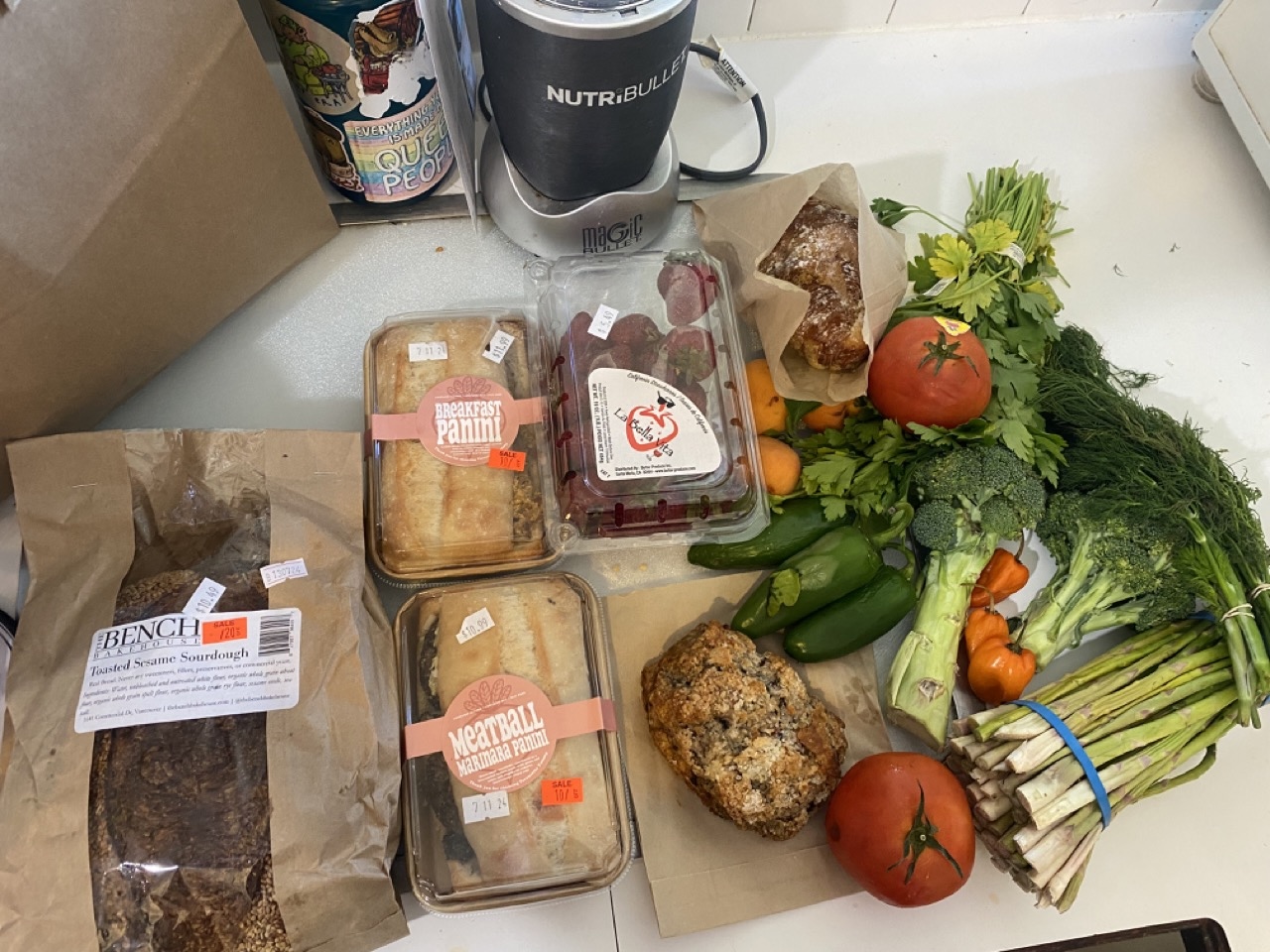
Often with small grocers like BeFresh, our local small grocery, a Too Good To Go bag is sort of like a real-life Chopped basket. That Food Network series sees a group of chefs compete to cook a dish using the same basket of mystery ingredients.
Similarly, my partner and I often let this random assortment of things we get help guide how we eat every week.
The apples from that Monday night bag became a pie, while the peppers were roasted up with some sausage as dinner one weeknight.
One week we got a box from Lena Market on West 4th Avenue that was just five pounds of different tomatoes. I learned how to make homemade marinara sauce.
The next week, we ended up with two very cheap gallons of milk that were about to expire and we made homemade yogurt in our pressure cooker.
Last week I picked up a bag from a health food wholesaler I’d never heard of that came with enough overnight oats mix to last two weeks, a big bag of pecan halves, sliced candied ginger and some snack-sized packs of caramel popcorn: as soon as I left the store I was already brainstorming a big baking project to come.
And we’ve saved a notable amount of money on groceries along the way.
Why buy bread from price-fixing Galen Weston when I can get a day-old sourdough loaf from a bakery down the street for a fraction of the cost? Sure, it may only last a few days. But the dry ends will inevitably find new life as breadcrumbs for a meatloaf or French toast on a Saturday morning.
How to really thrive on these apps
Despite all of this enthusiasm I have, I’ll fully admit that the app has its limitations. For one, there’s the accessibility of businesses using it. We live in an area both residential and commercially dense. My partner and I also have work-from-home jobs with the flexibility that allows for us to pop out at any hour of the day to snag one of those tight pick-up windows. My partner and I also have no dietary restrictions and are only cooking for ourselves — no kids or extended family to complicate things.
When I’ve recommended the app to others, I’ve also heard complaints that it’s all chain fast-food places with low-value bags, and I’ll admit there’s also a fine-tuned commitment and skill to using the app to its greatest potential.
While day-old Freshslice pizza and stale Tim Hortons bagels are bountifully available across the city, more in-demand vendors — BeFresh and Whole Foods stand out to us as bang-for your-buck, ready-to-eat meals — are snatched up quickly upon appearing in the app.
Sometimes when we’re looking to stock our fridge with low-cost premade wraps from health food and supplement store Body Energy Club, I’ll set multiple phone alarms for when the bags usually pop up just after 10 p.m. the night before.
Sniping the good bags takes a certain willingness to regularly check the app, paired with the flexibility to pick the bags up whenever and wherever they’re available.
It’s also worth paying attention to the ratings and reviews for various businesses within the app. There’ve been several instances where we’ve spotted an unfamiliar grocer, excitedly reserved a bag and then been disappointed by the results (sorry to Sweet Cherubim on Commercial Drive: a jar of tahini and carton of almond milk for $6 is not what we’re looking for!).
Still, these apps have certainly led us to grow more connected with some of our local grocers and restaurants, and have game-ified the food affordability crisis for us. It also gives me another app to scroll that’s not social media (a welcome break!), another excuse to go for a walk in my neighbourhood and a willingness to take a leap on a new restaurant or store.
Concert ticket queues have nothing on snagging an in-demand bag for a high-profile vendor (I’m looking at you, leftover breakfast items from the weekend brunch at the Fairmont Waterfront!).
My only fear is that in writing this I’m letting you in on the secret, and I’m going to have to fight even harder for those good grocery bags.
But then again, it’s for a good cause, and helping curb food waste while bringing some welcome, delicious surprises into our lives. ![[Tyee]](/design-article.thetyee.ca/ui/img/yellowblob.png)
Read more: Food, Science + Tech, Environment












Tyee Commenting Guidelines
Comments that violate guidelines risk being deleted, and violations may result in a temporary or permanent user ban. Maintain the spirit of good conversation to stay in the discussion and be patient with moderators. Comments are reviewed regularly but not in real time.
Do:
Do not: