



 SHARE:
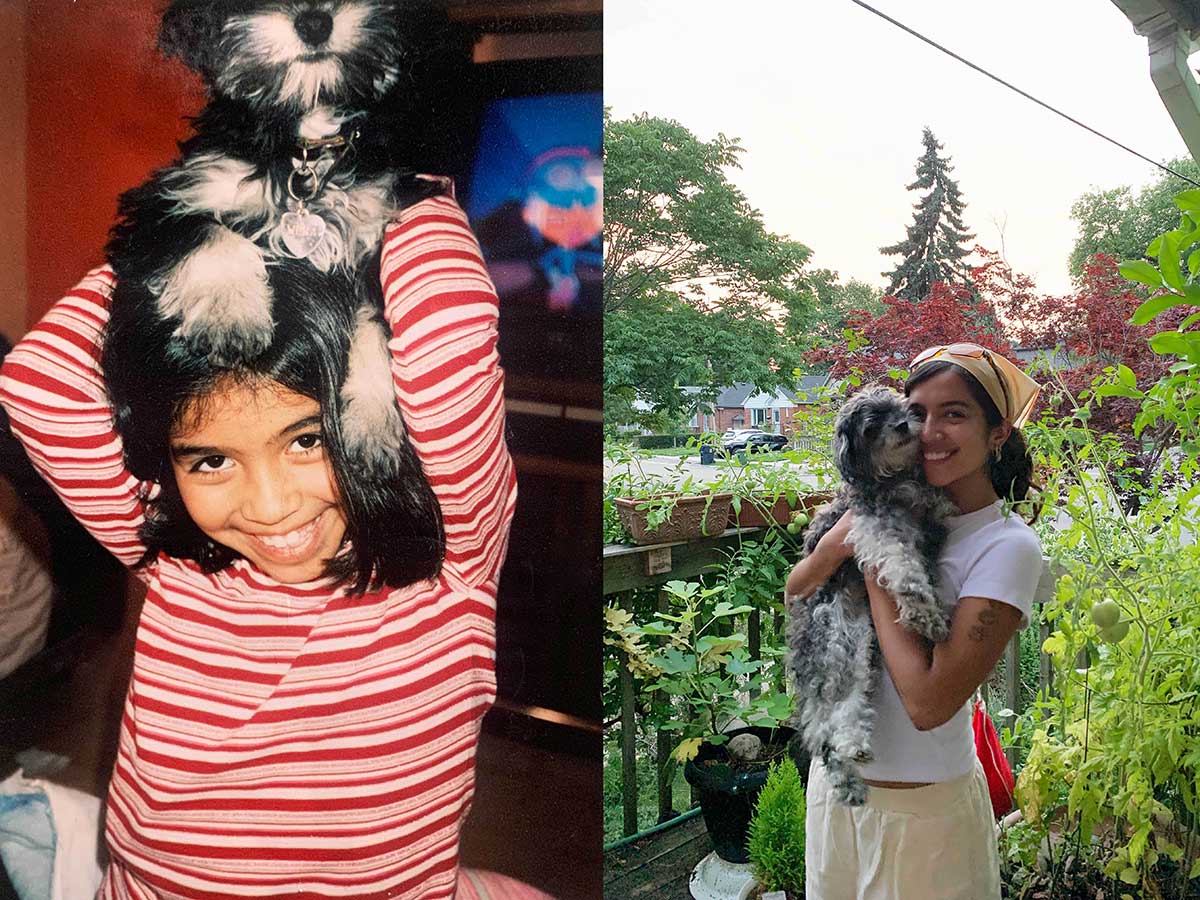
I was nine when my family adopted Dixie. It was a couple of days before New Year’s Eve, and we were visiting relatives in Mexico. My cousin spontaneously convinced my mom into letting my sister and me check out the next-door neighbour’s dog’s new litter of puppies, and before she knew it, it was too late: we were getting a dog.
From the two pups, we picked the sister — the one my mom annoyedly recalls wouldn’t stop barking. My cousin bought her for us for a few hundred pesos — around $60 at the time. Her tiny brown leather collar still said “Wera,” her old name, which is Mexican slang for blondie — a play on how she was an almost entirely black dog. Some of my earliest memories of Dixie include our first meal together — ice cream from a street vendor — and falling asleep together on the couch shortly after midnight on New Year’s.
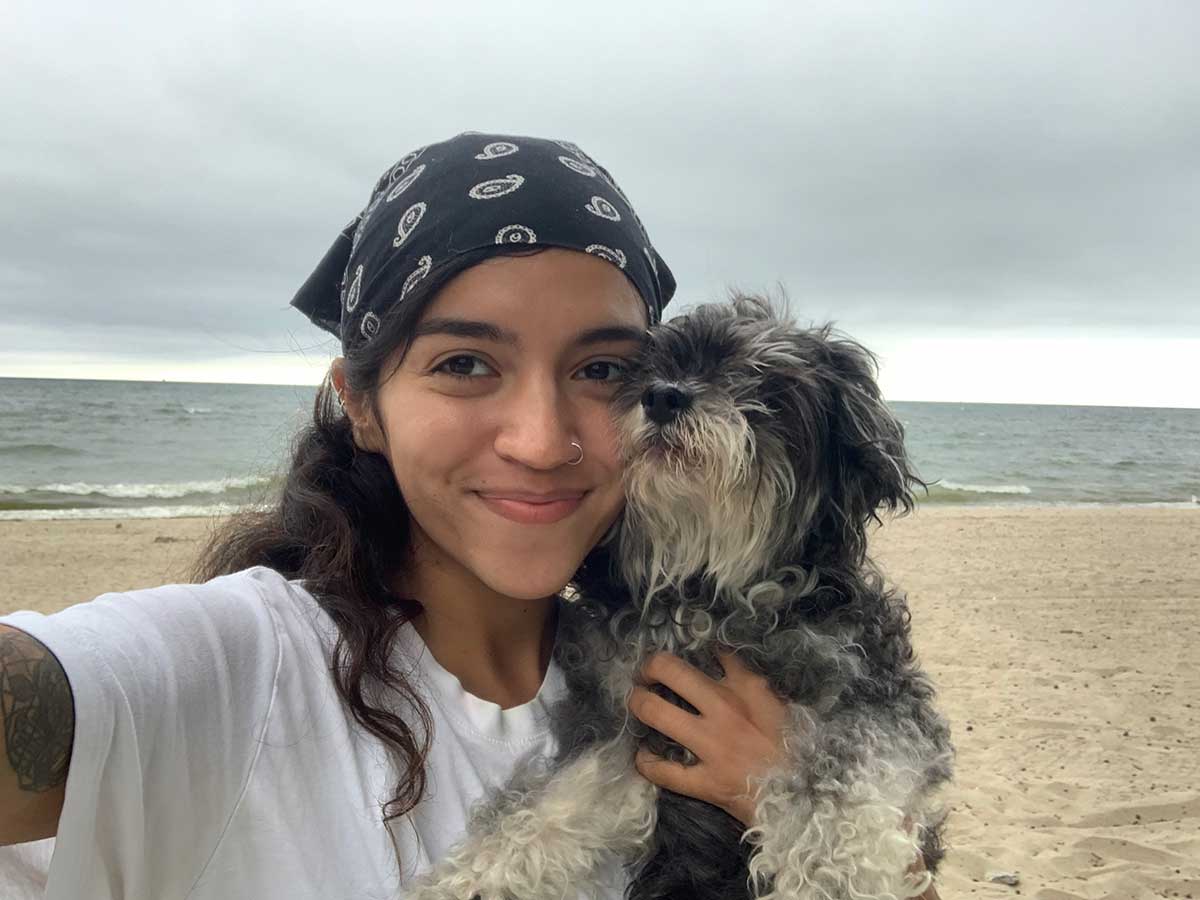
This past August, at almost 18 years old, Dixie could barely see or hear us standing right in front of her. Her hind legs gave in constantly while walking. And despite closing doors and placing barriers around my parents’ house, when she wasn’t sleeping, she would endlessly pace and get trapped in tight spaces. It became clear that her quality of life was in major decline, and that it may soon be time to say goodbye.
Over the course of the weeks leading up to her final vet appointment, especially the last few days, I wrestled with feelings of anxiety, guilt and panic. My biggest fear of all: would I regret the decision? I had moved out of my parents’ house several years before, but I spent much of the month commuting across town to be with her. I spent every day of the last two weeks by her side, and for every waking moment of the last two days, all I could do was breathe next to her.
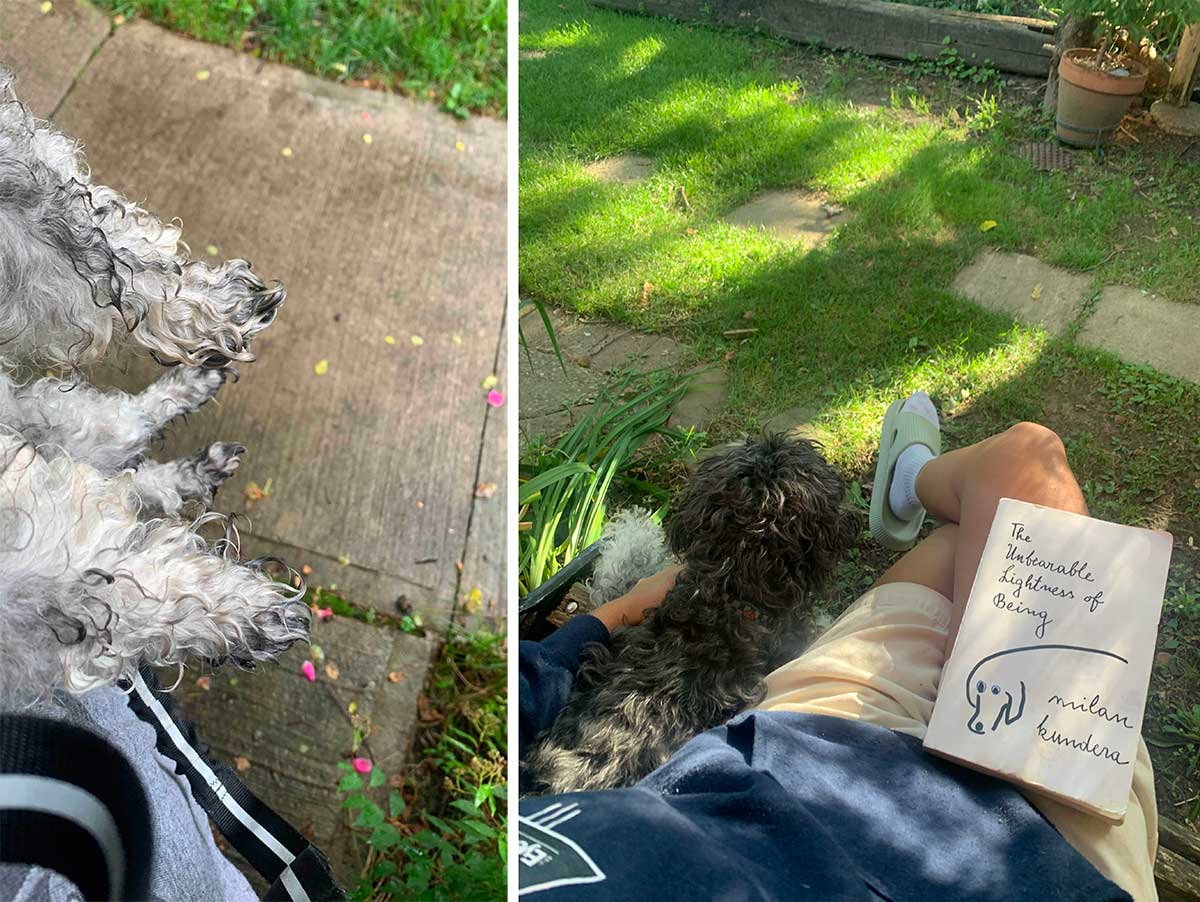
During that final month, I took nearly a thousand photos and videos of Dixie — my iPhone kept the tally. I documented her paws wet from the rain, of her posed in the tree as my mom propped her up, of us reading The Unbearable Lightness of Being together in my childhood backyard.
The last time we sat together in the yard, just before heading to the vet for the last time, I was sick to my stomach. It’s true what they say: having a dog will bring you some of the happiest days of your life, and one of the worst.
Do I look at those photos of Dixie today? Barely, if ever. They make me too sad.
But once she was gone, a new determination washed over me: to find every photo of her in existence.
Finding Dixie
In the week after she died, I began scrolling through the tens of thousands of photos on my iPhone X. Wading through the endless grid of tiny thumbnails, I wanted to make a master "Dixie" album — but was quickly overwhelmed by the volume of memories.
I tried the AI function that allows you to look up your “pet” by facial recognition or a name you’ve assigned it. It helped me find some old pictures — but it was neither perfect nor exhaustive.
My family shared their own photos in our group chats. I had seen many of these iconic photos before but couldn’t remember if I had my own copies. I saved them all, just in case — sometimes more than once as the same treasured photos came up again and again. I planned to eventually go through the collected photos and pick the highest-quality versions.
Merging duplicates and going through visually similar photos was one thing. But things were getting scattered, my device storage inching towards capacity. Some photos were saved to my phone, but didn’t get backed up to my already full iCloud account — meaning if I lost or broke my phone, the photos would be gone.
I recalled one video I posted to Instagram of Dixie adorably popping her head out of a lost-socks pile. When I went to screen-record it, it wasn’t loading, and I thought it was permanently gone. It just added to the pain.
Weeks later, it unexpectedly loaded again. It was an adorable video and I immediately saved it. But watching it paled in comparison to the visceral feeling in my body when I replayed the moment in my mind after thinking the video was lost.
It started to set in that some be-all-end-all master album of Dixie wasn’t going to heal me. As my emotions got dark or complicated, the files remained just that: files.
How to assemble a life of digital memories? I still don’t know, because I gave up on my digital hunt.
I did, however, start the journey to archive all my photos, in chronological order, month-by-month. I pulled out my one-terabyte external hard drive. I placed all my previous failed attempts in an "archived" folder so I wouldn’t lose them. I created a fresh folder, pinning it to the top. I began uploading from my iCloud, laptop and iPhone. I deleted each individual upload across devices to clean out the junk. I did this whole process slowly, intentionally and sans the existential panic that accompanied my attempt at my ultimate Dixie album.
Maybe a perfect archive of my dog’s life was never the point. Because in a tsunami of digital records, my brain was focused on optimization and efficiency, pushing down the feeling that needed to be felt to process my grief healthily: a simple yet aching heartbreak over never getting to hold Dixie and her little curly paws again.
Moving beyond digital ephemera
The reason for my over-documentation, these days at least, feels less about remembering something or someone, and more about not letting go.
Text conversations and all their related files currently take up 24 gigabytes on my laptop — that’s after having gone through and deleted many I don’t need. I still have my entire text conversation since the first day I met my partner six years ago, and I can’t get myself to delete it. I’m inclined to never delete texts from my parents. I have tons of texts and group chats with friends no longer in my life, whether because circumstances pulled us apart, or because tragedy struck.
These years-old archives of everyday exchanges serve as a convenient time capsule into the past. I revisit them on occasion, whether when I’m feeling nostalgic, or on birthdays and anniversaries when my thoughts of the past linger.
In those last few days with Dixie, taking photos was my way of denying her mortality through some digital version of her. Maybe by extension, I was trying to deny my own. But as I grow older, and become friendlier with grief, I’m finding a way to process it without over-indulging in tech-dependent comforts.
Is this what grief looks like now?
Technology has been reshaping how we experience loss for decades. In 1997, Carla Sofka, a social work professor at Siena College in New York, coined the term “thanatechnology.” According to Sofka, the term captures “any type of technology, including digital and social media, that can be used to educate people about dying, death, grief or loss or to help people cope with these phenomena in some way.”
This can absolutely include smartphone photos and videos, Sofka said. The definition has had to expand as time's gone on.
When MySpace and Facebook came along in the early 2000s, there was the relatively harmless discourse around whether it was cringe or meaningful to post about a loved one’s death on social media. There was our cultural obsession with holograms, such as when a 3D Tupac stunned Coachella in 2012. Today, AI is being used to eradicate grief altogether, from feeding Chat GPT old texts from a lost loved one to simulate comforting conversations with them, to creating a more complex "digital twin.”
Things feel more sinister when we use technology to defy human experiences rather than help us process them. Silicon Valley’s transhumanist Ray Kurzweil believes AI will accomplish “immortal software-based humans” by 2030. The 73-year-old hopes to supersede natural biological process and see the day when those who can afford it can “solve death.”
While these attempts at eradicating grief or even death sound more upsetting to me than comforting, that doesn’t mean I’m without my own subconscious attempts at defying mortality.
Still, Sofka noted: “If you hadn’t done that, you would have had to cope with the absence of something that helped you. So, who am I to judge? Who am I to say you did too much?”
What I called “obsessive” photo-taking, said Sofka, simply speaks to my individual coping style. "And that’s an important thing, because I don’t think there is a right or wrong.”
The over-documentation generation
When New York-based writer Haley Nahman’s terminally ill cat started breathing shallowly and in a panicked manner, “anxious record-keeping” kicked into full swing. Nahman sobbed in fear, and took numerous videos of the cat to send to her boyfriend, thinking it might help reveal new information. Despite her “newfound detachment from capturing every moment of note in [her] life,” she couldn’t help it. She was also aware they might be the last videos she would ever take of him.
Digital photography can serve as a metaphor for the risks of technological progress, wrote Nahman. The thought first struck her when she realized she’d lost most of the photos and videos she took between 2010 and 2015 and “felt… almost nothing.”
I had a similar experience in my third year of university when my laptop was stolen. The photos and videos it stored — with no online backup — went back to the first year of my undergrad. When I realized my computer, and all the memories it held, were gone, I didn’t skip a beat.
It’s a lesson that could help us unlearn our long story of materiality — the idea that collecting is better than discarding, leading us to have and want more than we need.
“It seems my constant documenting isn’t actually about the future, as I claim, but about the present — about quieting the neurotic voice in my head that views experience as a losing game,” wrote Nahman. “Digital photography can be extremely useful, but I wonder sometimes if it’s worth the cost. Maybe without the ability to capture life in this way, I’d have accepted that this much of life isn’t meant to be captured.”
According to a report by a Boston-based software company, the average U.S. citizen takes an average of 20 photos per day. Concurrently, device storage is only expanding. The first-generation iPod, released in 2001, had a five-gigabyte capacity. By the time I got my first iPhone when I was in high school — the iPhone 4 — it had then-whopping 16-gigabyte storage. In today’s market, 128 gigabytes is the smallest storage option. And my one-terabyte hard drive — the equivalent capacity of the latest iPhone 16 Pro — holds my tens of thousands of photos, and still has 80 per cent of its space available.
Much of the archiving is built into modern software, leading us to believe we don’t need to do it ourselves. Until a device bites the dust, a social media platform locks out its users, or a news outlet shuts down — leading Tyee reporter Christopher Cheung to ponder how realistic it is for journalists to archive all their work.
Then there’s the ecological impact of our toxic digital habits. According to a BBC report, the carbon footprint of our gadgets and internet uploads account for about 3.7 per cent of global greenhouse emissions — similar to the amount produced by aviation globally. These emissions are predicted to double by 2025.
Some companies are addressing the sentimental conundrum of having too many files by capitalizing off the cleanup. In an essay for a Verge web series that explores how the year 2004 shook the world digitally, Allison Johnson highlights how Google Photos and Apple Photos try to package your memories into reels, collages and albums, ready to purchase to print and ship to your door.
“I’m a sucker for a montage of my kid and me as much as the next parent,” writes Johnson. “But it’s weird that the photos I see most are either the ones I’ve deemed worthy of the grid or the ones a computer picked because it thought I might like them.”
Coping with loss is something we do until the day we die, Sofka told The Tyee.
“The role of those photographs and videos and how you cope with death is going to evolve. There’s no way to predict what that’s going to be. It gives you the opportunity to decide over time what goal that technology is going to have in your continuing bonds, because we know your connection to somebody doesn’t just disappear.”
But if you’re feeling anxious about how dependent you’ve become on taking photos, or whatever form of thanatechnology you are using, Sofka suggested using self-imposed limits.
“Say, ‘okay, it’s important for me, for example, to get videos and pictures of my loved one. For five minutes, I’m going to document my relationship today. Then I’m going to put my phone away.'” Or, “I’m going to take 10 pictures, and I’m going to pick when I take those pictures carefully, so that I have what’s most important for me to capture.”
It’s a form of mindfulness, said Sofka. “Once you do that, say, ‘Okay, I’ve done it today, I need to respect leaving my phone off.”
Rather than reckoning with our memory overload, we may be choosing to revert to old practices. Take the return of the crappy point-and-shoot camera. Flea markets and online Instagram accounts are selling the same 2000s-style digital cameras I had back in middle school for hundreds of dollars. While scrolling through one of those Instagram pages, I spotted a lime-green Nikon Coolpix I had never seen before. It looked so satisfying to hold that my hand flinched. There was no price listed, but with its all-caps description of “RARE,” I feared the asking price.
We as a culture appear to be craving a friction to snapping memories that provides an opportunity to make taking pictures special again, whether in the form of digital or film point-and-shoots. Anything is better than the dated aesthetic of the overly high-definition iPhone photo.
Incessantly documenting experience and cataloguing it, as if a life literally depended on it, paradoxically ends up highlighting the ephemeral nature of pictures and videos. They get lost or forgotten. And when we die, we can’t take them with us.
“It’s hard to say what’s lurking, forgotten in the 8,000 images in my Google Photos, because hell if I’m going through them all anytime soon,” Johnson went on. “In a way, they’re almost as elusive as those photos from 2004 I still haven’t tracked down.”
Returning to the present
Just two weeks after Dixie died, I headed out on a vacation I’d booked months earlier to Greece. The timing was simultaneously poor and ideal.
My partner and my friend purchased electronic Sim cards to access the internet on their phones, mapping us everywhere we went. This made my old phone — with no internet connection and its aged, grainy camera — essentially useless. It stayed in my backpack pretty much the entire trip.
During each day of the following two weeks, I easily remembered everything about the previous day, and the day before that, and the day before that — an experience I don’t often have any more working from home, but a quality I recall having back in middle school when I would come home and journal about the day. As Rebecca Seal wrote in the Guardian, when we’re not attending to an experience, we’re less likely to recall it, limiting our capacity to be creative.
I still take photos on my iPhone regularly. But where there was once a panicked desire for control, there is now a confidence that I might — that I can — approach hardships in a more grounded way. Snapping photos “for the memories” shouldn’t be about mitigating a consequence or limiting the pain of loss. At least not entirely. It’s mostly just a bonus.
Now if I choose not to document something in service of immersion, I see it as a win. Because when I'm truly present, I'm not concerned about forgetting.
On our last morning in Greece, I woke up to a fiery sunrise from the top of the hill. I spotted birds of a species I’d never seen before. A small dog that sounded exactly like Dixie barked a couple of houses away. I didn’t take any photos that morning, but I was there. ![[Tyee]](/design-article.thetyee.ca/ui/img/yellowblob.png)
Read more: Photo Essays











Tyee Commenting Guidelines
Comments that violate guidelines risk being deleted, and violations may result in a temporary or permanent user ban. Maintain the spirit of good conversation to stay in the discussion and be patient with moderators. Comments are reviewed regularly but not in real time.
Do:
Do not: