


 SHARE:
Having hope for the future can be a tall order — especially for youth.
Climate change threatens every young person's immediate and long-term future. Politicians are promoting policies that roll back their rights.
Social media shows real time footage from ongoing global genocides alongside content promoting harmful beauty standards, conspiracy theories and medical disinformation.
But hope, whether that’s for a better future or just that the sun will come out tomorrow, is necessary to keep going — and to make the changes we want to see in the world.
So how can young people find it?
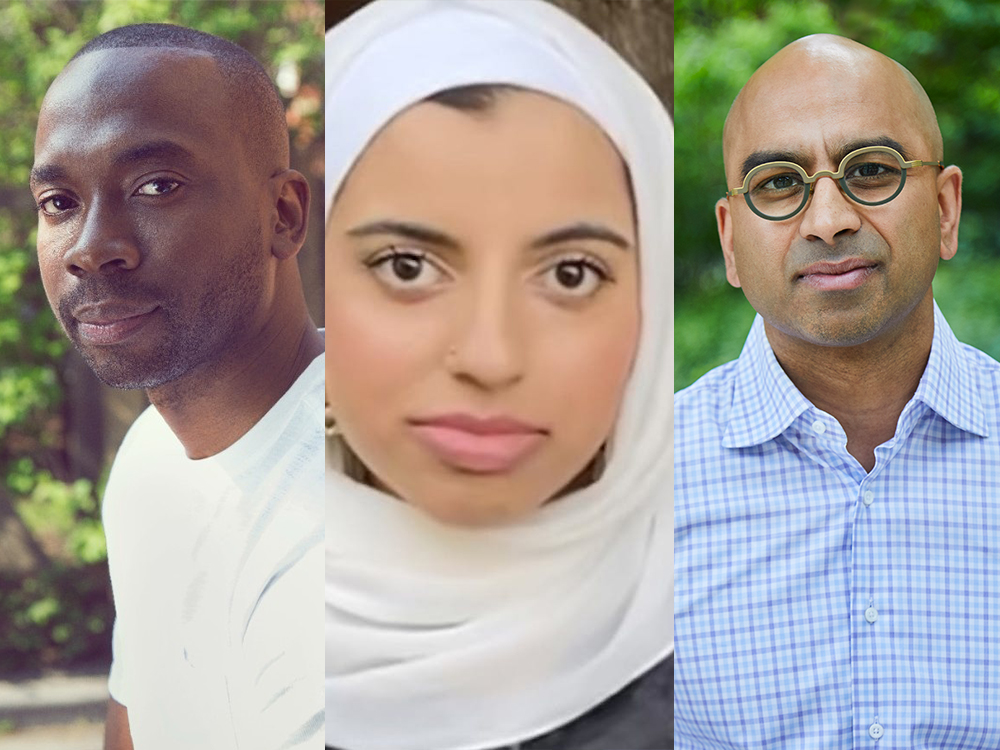
This Wednesday, Oct. 23, young adult fiction authors Sarah Mughal Rana, Kern Carter and Randy Boyagoda will share their ideas and advice at a Vancouver Writers Festival event called “Finding Hope,” happening in person and online.
Fresh off their own recently published novels exploring youthful hope in the face of incredible odds, whether that’s weathering racism and Islamophobia in a post-9/11 North America, surviving a dystopian global south or contending with the death of an abusive parent, the search for hope is a journey shared by their young protagonists.
‘Without hope, life can feel purposeless’
Kern Carter’s And Then There Was Us tells the story of Coi, an 18-year-old grappling with the sudden death of her mother, from whom she had been estranged.
Unable to grapple with the physical and emotional abuse her mother inflicted on her before she died, Coi finds herself confronting her mom and the fallout of their relationship through lucid dreaming.
The novel, Carter’s fourth for young adults, is partially based on the experiences of his own daughter, who Carter gained full custody of when she was 13. Like Coi, Carter’s daughter went through a period of not seeing her mom, too.
“I use that as kind of a springboard to tell this more fantastical story about forgiveness, essentially, and abandonment,” Carter told The Tyee in September.
Hope “absolutely” plays a role in And Then There Was Us, he said. While Coi presents a tough exterior, it’s a shield to protect her sensitive self, deeply hurt by a mom she is grieving.
“Behind her shield there is a lot of hope that one day her situation will change, and she’ll have this family that she dreamed of and really wanted,” Carter said. “Hope is an underlying theme in the book, along with forgiveness.”
Carter says he’s been pleasantly surprised to learn that out of all his books, And Then There Was Us is the one that has connected with readers the most.
“A lot of people have complicated relationships with their parents,” Carter said, but not many novels he’s read take a complicated, deep view of parental abuse and its aftermath that reflects reality, while still being an engaging read.
Carter added that he isn’t advising anyone to forgive their parents if they don’t want to.
“Partly why I put these situations in dreams was because I wanted it to feel a little bit separate from real life, to make it a little bit easier or a more creative way for people to digest the book,” Carter said.
“Part of the reason I wrote this is so we can have conversations about it.”
Hope can feel like it’s absent right now in the world, Carter acknowledges. But, in his opinion, “without hope, life can feel purposeless,” he said.
“Hope should be an essential part of everyone’s life. There has to be a part of you that feels hopeful for your future, your present, your family, for what you can accomplish.”
‘A girl finding her voice’
Hope Ablaze is author Sarah Mughal Rana’s debut novel, based on her experience growing up Muslim in America following the 9/11 attacks.
“Hope Ablaze is ultimately about a girl finding her voice,” said Mughal Rana, who spoke to The Tyee in September.
The novel focuses on Nida, an American Muslim teenager from an immigrant family who uses poetry and spoken word as an outlet for her feelings and beliefs about her society, which sees Muslims like her as a threat.
But when Nida’s work goes viral on social media, misinterpretation, hate and the expectations of the authority figures in her life converge to rob Nida of the hope and the joy found in her art.
“Throughout the novel, it’s her trying to grapple with accepting her voice, despite the criticisms and despite the controversy that it brings,” Mughal Rana said.
Born in 2000, Mughal Rana, who is Canadian of Pakistani descent, grew up in an America experiencing a sharp rise in Islamophobia.
To appease societal expectations, she tempered her religious expression and her appearance in public, “in order to be seen less as other and to more as someone who is American, or, now, because I’m living in Canada, Canadian,” she said.
America’s War on Terror, the invasions of Iraq and Afghanistan, the bombing of Pakistan, as well as Islamophobic policies passed in Europe and Quebec, had a big impact on Muslim communities in North America.
“I was really frustrated and decided to write a novel about a girl’s right to her art and freedom of expression, and her hijab, even if it’s controversial,” Mughal Rana told the Tyee.
“Her right to exercise her religious beliefs should exist,” she said. “I wanted to make that as accessible for a young/adult audience.”
Some readers have found the book’s ending sad (no spoilers here!). But Mughal Rana doesn’t see it that way.
“I still see it as a story of triumph, because hope does not look like a perfect world. Hope is seeing imperfections but believing that you have a right to exist, that you can still do what you believe in, and that you can survive it,” she said.
“Her hope can exist because she’s surviving it and she’s still trying to live in it. And that’s what a lot of immigrants go through.”
‘I am more than this current situation’
Little Sanctuary is University of Toronto English professor Randy Boyagoda’s first book for young adults.
Based on his short story of the same name, published by The Walrus in 2021, Little Sanctuary follows a group of relatively privileged Black children, Indigenous children and children of colour in the global south, sent to a remote island by their parents after their unnamed country breaks out into civil war during a global pandemic.
“They’re put up in a school, and when they get there they realize very quickly that the people who have been charged with taking care of them aren’t there to take care of them. They have other designs,” Boyagoda told The Tyee last month.
“And then the kids, particularly this one family of four girls and a boy, need to decide what to do.”
Little Sanctuary is far from the first dystopian young adult fiction on the market. But it is the first young adult novel Boyagoda knows of that centres Black, Indigenous and People of colour (BIPOC) characters living in the global south, instead of relegating them to background characters in the journey of a white, typically female, main character.
“It struck me as imaginatively boring to see the same pattern repeating. And also not true to life,” he said.
“There are many, many different kinds of privileged people in the global south. I wanted to undermine what strikes me as a rather too-familiar binary, by exploring the lives of privileged BIPOC children in a dystopia.”
For Boyagoda, hope is a virtue, something you cultivate, rather than a perspective or attitude.
Hope is a big theme in Little Sanctuary and — as in life — works in two ways, Boyagoda explained.
“One is temporal, as in ‘there could be something better ahead.’ But the other is a kind of interior disposition: ‘As awful as this current situation is, I am more than this current situation. My relationships, my sense of life, my purpose in the world is more than the current situation,’” he said.
“It can be hard in both of those cases to look beyond what’s awful and discouraging, but the capacity to do so, I would describe as hope.”
Advice for the hopeless
For any young people lacking hope right now, Carter wants them to know that he hangs his hopes on love.
“I genuinely believe that despite everything crazy going on, that love still wins, and there are more good people and good things in the world than bad,” he said.
His advice is to find hope in the positive work people are doing in your community and around the world, Carter said.
Mughal Rana wants young people to access hope by using their voice. Even if it’s just in casual conversation with loved ones, their words have an impact, she says.
For example, Islamophobia in Canada hasn’t gone away. But the pushback Canada has seen in favour of affirming the rights of Muslims and decrying hate over the last 20 years is due in large part to young people speaking out, she said.
“Your voice, as cliché as it sounds, is the only thing that can make a difference,” she said, adding even private conversations help.
Having hope is not about being optimistic, Boyagoda said, but a recognition that the world isn’t how we would like it to be.
“And that invites two responses: one is despair, you just give up. The other is to think, believe and act for something better,” he said. “The latter is hope.”
Boyagoda also suggests young people who are feeling hopeless should read more books.
“The sense of hopelessness can be overcome by the development of a fuller and richer interior life, and there’s no better way to do that than reading books,” he said.
“We want more people to be willing and able to imagine beyond their own perspective, or the perspective that the algorithm gives us.” ![[Tyee]](/design-article.thetyee.ca/ui/img/yellowblob.png)
Read more: Books






Tyee Commenting Guidelines
Comments that violate guidelines risk being deleted, and violations may result in a temporary or permanent user ban. Maintain the spirit of good conversation to stay in the discussion and be patient with moderators. Comments are reviewed regularly but not in real time.
Do:
Do not: