

 SHARE:
[Editor’s note: Closer to home, beachgoers often stack stones at English Bay, in Vancouver and in the Puntledge River, on Vancouver Island, where people build in the shallow parts of the rapids knowing their stacks will be swept away when the river rises. The practice is not without controversy. Are you a stone stacker? Tell us more in the comments, below.]
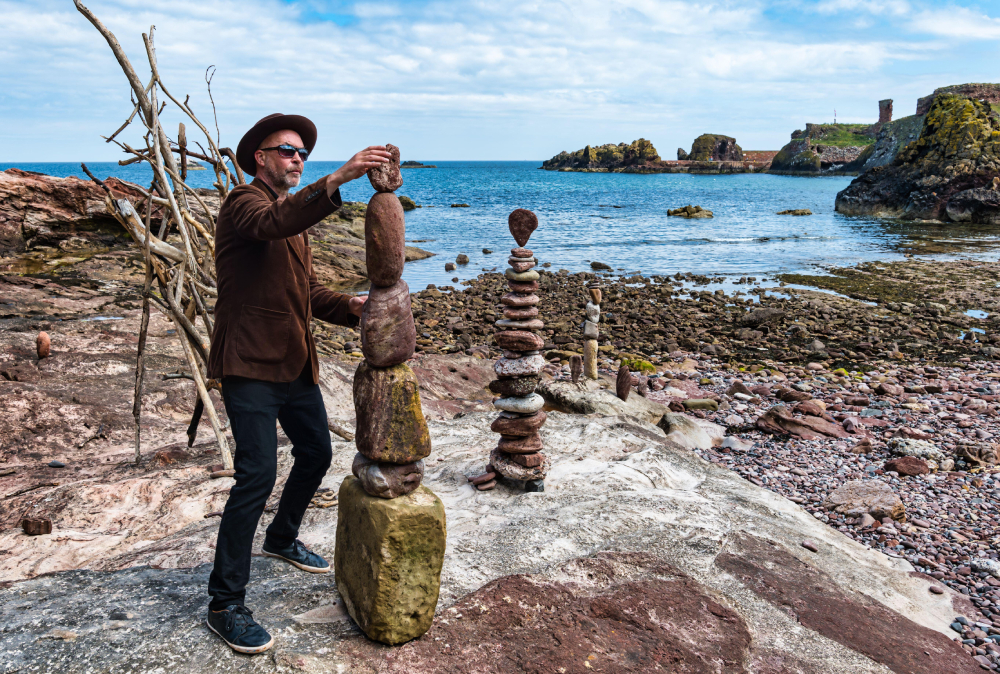
Dunbar, on the east coast of Scotland, is a town of two beaches: one covered in sand, another covered in stones. The sandy beach on the east side of the town routinely fills up with surfers, kayakers, dog walkers and children exploring rock pools. The other is home to a different pastime, one akin to the United Kingdom’s cultural affinity for strange, hyperlocal quasi-sporting events like Llanwrtyd Wells’ Man versus Horse marathon, East Anglian dwile flonking, or the annual cheese roll at Cooper’s Hill in Gloucestershire. Eye Cave Beach, as it’s known locally, is home to stone stacking and the annual European Stone Stacking Championships.
Stone stacking is exactly what it sounds like: the practice of making towers or sculptures out of stones. In the case of this artistic-cum-sporting iteration, this happens with full acceptance that these structures are temporary and will in all likelihood collapse. But they are reminiscent of more permanent, utilitarian structures — inukshuks, the route-marking cairns of Scotland and the taalo burial cairns of northern Somalia.
Their significance in Dunbar is in keeping with a more recent history of “land art” — art made from and in the natural world. James Craig Page, an artist and co-founder of the Dunbar Street Art Trail, was already familiar with land art thanks to Turner Prize–winner Richard Long’s 1967 piece “A Line Made by Walking,” in which Long walked a line back and forth in a field before photographing it.
But in 2015, Page became aware of stone stacking as an artistic practice after seeing examples being shared online, and began experimenting. “I went down and had a go, and it became my new creative addiction,” he says.
After playing with the form on Dunbar’s beaches — fastidiously searching for smooth, flat stones and finding the balance point between them, something stone stackers describe as a “click,” and talking to the many curious folk who would ask him what he was doing — Page began to introduce stone stacking to the community.
The first stone-stacking event in Dunbar was part of the Dunbar Street Art Trail in 2016. Seeing the impact it had with young people especially, Page approached schools and began running workshops in classrooms. It was here that he began to appreciate stone stacking’s meditative, almost therapeutic effects, particularly on children diagnosed with ADHD.
“They sit down and start stone balancing and they get it right away, and they’ll sit there for half an hour and the teacher’s jaws will be dropping, going, ‘That kid’s never sat there for 30 seconds, and he’s just sat there and done that for 30 minutes,’” he says.
Inspired, Page created the European Stone Stacking Championships, with the first event officially held in 2017.
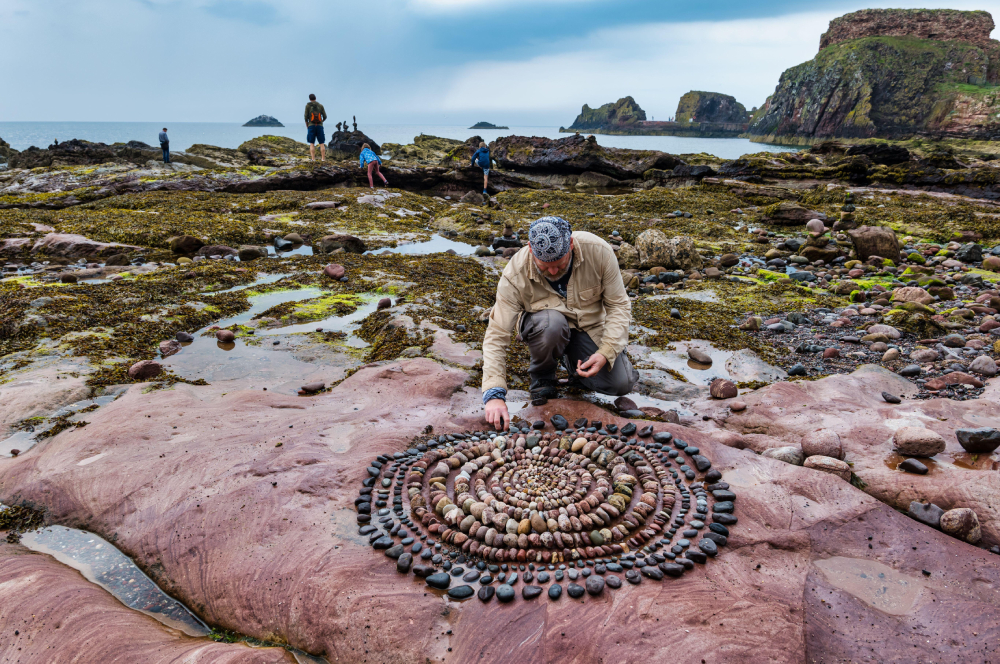
Like Page observed in classrooms, the 2021 championships begin in a meditative fashion. The stage is already set by the time spectators arrive, with the beach covered in stone stacks and land art collages put up during low tide by Page and other invited artists. Towers of seven or eight stones, barely ankle high, and artistic installations made of multiple towers that stand at least two meters tall, like fragile stalagmites, all illustrate just what can be accomplished through this simple medium. Slowly, as people begin to gather, marvelling at the gravity-defying patterns and shapes, more than one tries building a stack for themselves.
As the day progresses, the serenity gives way to a more competitive atmosphere. The first event is a half-hour competition for the tallest tower: things are quiet and methodical at first between the competitors, but then as towers begin to tumble as the clock winds down, whispers turn to shocked exclamations and eventually applause when the time is up and spectators eyeball the towers to see who has emerged victorious.
Later, there are head-to-head events in which competitors are given just three minutes to build a stack of seven stones and keep it upright. While the spirit among the participants is more playful than pugilistic, each of them self-defining as artists rather than athletes, it does not detract from how seriously they take the competition — although to paraphrase David Foster Wallace’s remarks on tennis, it’s more like the artists are playing a game against themselves.
Ordinarily, people come from across the world to take part, with around 30 to 40 competitors each year. The 2019 event brought people from 19 countries, and while COVID-19 travel restrictions ensure 2021 is a United Kingdom-only event, there are still 30 people taking part and 2,000 people who come to watch over the weekend.
James Brunt, a land artist who sometimes incorporates stone stacks into his work, comes up every year from Sheffield, England, for the event to be in community with other stone stackers, as well as to take advantage of the uniqueness of Dunbar’s coast.
“For me it’s just very different geology. The stones are very different,” he says. “There’s a completely different feel, so you’re working with them different.”
As the competitors lock into their work, there’s quiet chatter from spectators who analyze and dissect proceedings like they’re watching a World Cup final, punctuated by heavy thuds as the tide sweeps in and reclaims the towers that had stood so surely just that the morning. All the while, the seagulls that nest on the cliff face scream and dive as if they’re the audience for something far more gladiatorial.
It’s easy to see why stone stacking has been taken up by so many people.
Social media was where Page saw the practice first, and on platforms like Instagram and Twitter, glossy images of improbable stone stacks — such as those created by stone stacker Michael Grab, a.k.a. Gravity Glue — routinely go viral. This leads to copycats going into nature to do the same thing en masse, without thinking about, for example, whether the stones they’re picking up are being used as shelter for animals.
Conservation scientist Ricardo Rocha says that while the stacks can be beautiful, people should bear in mind that they’re not necessarily benign, having noticed that in his home archipelago of Madeira, Portugal, the practice is damaging the natural habitat of the Selvagens gecko.
“Outside protected areas, I think it’s less of an issue,” he says, “but if you’re doing these structures, you want to do it in a way that minimizes the possible impact.”
John Hourston, founder of the environmental group Blue Planet Society, shares these concerns around habitat damage, but also objects to the visual pollution caused by stone stacking, calling it a “plague” that dilutes a place’s sense of wildness. “What happened to ‘leave no trace'?” he asks me over the phone, adding that removing stones and pebbles from U.K. beaches is actually illegal under the Coastal Protection Act because of the potential impact on coastal erosion, flood defences and wildlife habitats.
Regardless of where one draws a line in the sand on what is and isn’t acceptable in the wild, on this one weekend, in this one place, playing in nature is accepted. Every year, everyone is welcome — even encouraged — to play with stones.
It’s the reason so many people come, and it’s what Brunt leaves me with, too. “I’m a child. I play,” he says, “Don’t ever stop playing, so many of us do!”
As the day ends and the playing on the beach turns into playing in the streets, with local bands performing and local beers flowing, the tide comes in and washes away any remaining stacks, sending more thuds echoing around Eye Cave Beach. ![[Tyee]](/design-article.thetyee.ca/ui/img/yellowblob.png)
Read more: Art, Environment










Tyee Commenting Guidelines
Comments that violate guidelines risk being deleted, and violations may result in a temporary or permanent user ban. Maintain the spirit of good conversation to stay in the discussion.
*Please note The Tyee is not a forum for spreading misinformation about COVID-19, denying its existence or minimizing its risk to public health.
Do:
Do not: