


 SHARE:
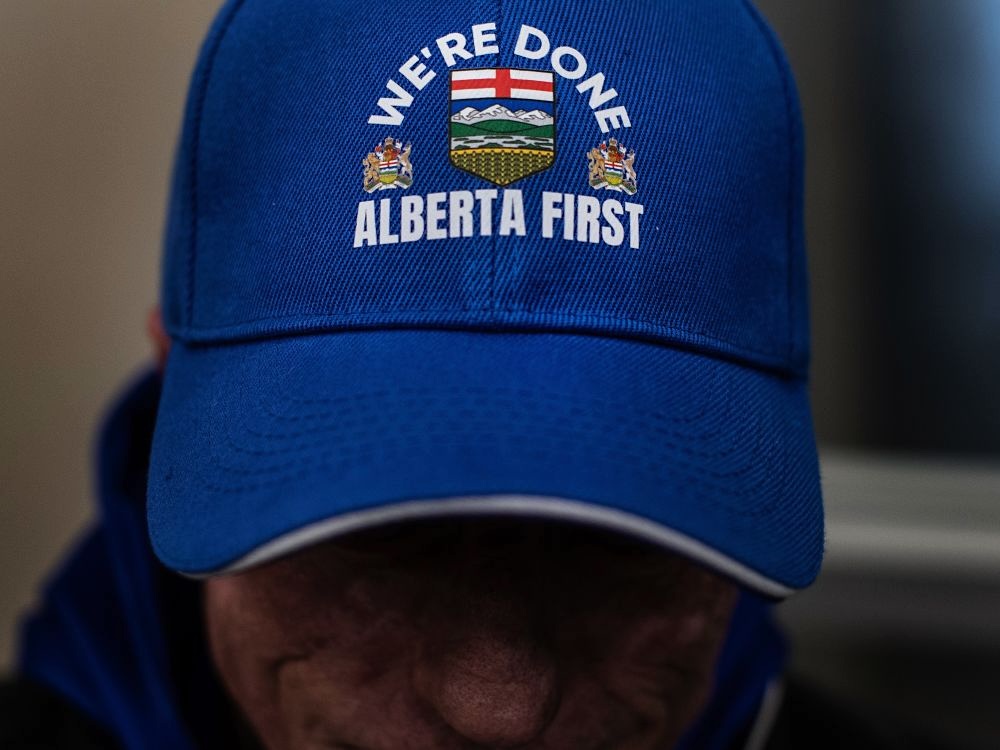
Canada has had its share of separatist scares over the years, largely coming out of Quebec.
In 1995, Parti Québécois Leader Jacques Parizeau nearly blew up the Beaver. The vote against separation was razor thin — 50.58 per cent versus 49.42 per cent in favour.
Now the danger to national unity has shifted westward to Alberta. Could Wild Rose Country go its own way, becoming a sovereign nation, or perhaps America’s 51st state?
As improbable as that sounds, the amber caution light is flashing in Alberta, where a premier with a wishy-washy commitment to Canada may prove to be the best friend separatists in the oil-rich province have.
1. Where do Albertans stand?
In the latest Angus Reid poll on separation released on Feb. 9, 29 per cent of Albertans said they would vote to leave Canada if a referendum were held today.
Of that group, 21 per cent said they were leaning that way. Not great but not panic time either. The poll found that only eight per cent would definitely vote to leave Canada. That compares with 65 per cent of Albertans who would vote to stay. Of that group, 57 per cent said they were definite about their decision.
The numbers appear to indicate Canada is safe, at least for now. But there are plenty of reasons to be worried about what is happening in Alberta.
2. What irks the ‘leavers’?
The “leave” voters believe that an independent Alberta would be free of “harmful federal policies” and assume total control of the province’s resources. Their reasons for leaving are mainly economic.
Interestingly, those who would vote for separation get most of their information from alternative media sources, buttressed by conversations with family and friends. But they are also affected by events hosted by the Alberta Prosperity Project. The APP is a group that has aggressively campaigned for a referendum on separation.
Those who would vote to stay in Canada get most of their information from mainstream media or social media. Almost three-quarters of that group said they would leave Alberta if the province separated.
3. What history has led to this moment?
The Alberta Prosperity Project has driven separatist sentiment since the federal election last April, largely by highlighting long-standing grievances in Alberta.
Alberta became a province on Sept. 1, 1905. The Social Credit Party formed the government of Alberta after the 1935 election. Although Premier William Aberhart was himself a moderate who rejected secession from Canada, some of his followers wanted to separate. Social Credit was ridiculed as a fringe party supported by the uneducated.
Then the world changed for Alberta. Imperial Oil discovered the Redwater oil reserve in 1948. The province is now a perennial net contributor to equalization payments. Most of Alberta’s trade runs north-south through Montana, rather than east-west within Canada.
Oil brought prosperity but also discontent. After the introduction of the National Energy Program by the government of Pierre Trudeau in 1980, interest in separation surged. Trudeau aimed to increase national energy self-sufficiency and Canadian ownership of the oil and gas fields while redistributing energy wealth via the federal government. In Alberta, bumper stickers appeared saying: “Let the eastern bastards freeze in the dark.”
In 1987 Preston Manning founded the Reform Party of Canada as a right-wing populist party that reflected western alienation.
Although not an avowed separatist party, Reform attracted people who were aligned with that view. Support for Alberta separatism subsided when Albertan Stephen Harper and the Conservatives were in power but resurged with the election of Justin Trudeau in 2015.
After the Liberals were re-elected in 2019, the “Wexit initiative” began trending on social media, partly driven by bots and misinformation.
After the election of Mark Carney in 2025, the Alberta Prosperity Project filed a citizen initiative petition to Elections Alberta for Alberta independence.
Here is the stark question the APP posed to Albertans: “Do you agree that the province of Alberta shall become a sovereign country and cease to be a province in Canada?”
An official petition drive was launched on Jan. 2. Organizers have until May 2 to find the 117,732 signatures needed to trigger a referendum under the Citizen Initiative Act.
4. How does the US figure in?
Most Albertans believe that the United States would pressure an independent Alberta to join the giant to the south.
And four out of five Canadians believe the United States would support Alberta separation, according to a survey published Feb. 15 by Nanos Research.
The APP has beckoned to the gorilla next door by taking “strategic trips” to Washington, D.C., to discuss Alberta sovereignty. APP co-founder Jeffrey Rath has met U.S. officials to discuss support for the transition if the petition is successful. He told CBC News that the Americans were “extremely enthusiastic about the prospect of a free and independent Alberta.”
Ominously, U.S. Treasury Secretary Scott Bessent has noted that Alberta has a wealth of natural resources, which would make it “a natural partner for the U.S.”
The right-wing leaders of Alberta’s separatist group have had three meetings in the past year — on April 22, Sept. 29 and Dec. 16 — with officials from the U.S. State Department. The claimed purpose was to discuss logistics such as switching to U.S. currency and issues of border security.
At least one of the meetings between Alberta separatists and U.S. officials was held in a secure room within the State Department that is immune to eavesdropping. All electronics must be surrendered at the door.
A fourth meeting is tentatively planned. APP co-founder Dennis Modry told NBC: “It’s heartening to us at each of the three meetings that we’ve had with the U.S. administration to be informed that the entire U.S. administration is supportive of Alberta becoming a sovereign country.”
Donald Trump himself has suggested why the United States might see Alberta separation as attractive. The president is obsessed with North American security. A takeover by the communist Chinese seems to be Trump’s new beef against Canada. He railed on Truth Social that “China is successfully and completely taking over the once Great Country of Canada. So sad to see it happen.”
Trump’s musing on Chinese domination of Canada has become political theatre of the absurd.
“Prime Minister Carney wants to make a deal with China — which will eat Canada alive. We’ll just get the leftovers! I don’t think so,” Trump said. “The first thing China will do is terminate ALL Ice Hockey being played in Canada, and permanently eliminate the Stanley Cup.”
The Trump administration has since tried to back away from this obvious interference in Canada’s national and international affairs. The White House stressed that no senior officials were present at the meetings with Alberta separatists, and no commitments were made. A senior State Department official also said that there would not be another meeting.
Will we see the separation campaign funded by grey money from the United States, as well as manipulation of social media? That’s what happened with the trucker convoy, which received substantial donations from sources in the United States.
Modry was careful to say that his group was not advocating for Alberta to become the 51st state.
But his assurances ring hollow. Modry added that Alberta would need its own military. Would the United States be willing to work with Alberta in the development of its own armed forces? “That’s on the table for discussion,” he said.
5. Is it treason?
The Alberta Prosperity Project channels anger, grievance and alienation over what it sees as federal over-taxation and over-regulation. COVID regulations are still a flashpoint.
The APP is also concerned about immigration and the growing Canadian relationship with China — mirroring MAGA concerns. In fact, a “Make Alberta Great Again” cap was spotted at an APP event last March.
That the APP would openly court support from tariff-imposing Trump, who has made no bones about his willingness to bring Canada’s economy to its knees, has been called a law-breaking agenda by some politicians and experts.
B.C. Premier David Eby called APP’s visits to Washington to talk about U.S. support for Alberta separation “treason” — and most Canadians agree.
Others have pointed out that Alberta breaking away from Canada is illegal under the Constitution and would violate Indigenous rights.
“Alberta cannot lawfully unilaterally separate from Canada,” flatly states law professor Robert J. Currie. “We know this because the Supreme Court of Canada more than 25 years ago outlined the conditions for any such attempt; the Parliament of Canada has enacted these in law; and Alberta does not meet the criteria. In addition, it would be a violation of international law.”
6. What are the similarities with the UK’s Brexit vote?
On Jan. 31, 2020, British citizens shocked the world by voting to pull their country out of the European Union. Canadian pollster Darrell Bricker warns Canadians to take a lesson from the way what seemed a far-fetched idea became a sealed deal.
“As we saw with Brexit,” said Bricker, “these things can start in one place and end up in quite another.”
Indeed, in 2016 it was widely expected that Brexit would fail. But some who have studied the ensuing four-year march to victory have noted the campaign “was full of dark money, disinformation, foreign interference, dirty tricks and hijinks.”
Ultimately, Brexit passed with just 51.89 per cent of the vote. Buyer’s remorse has since set in. Today, a mere 30 per cent of Britons think that leaving the European Union was the right thing to do.
7. Is Premier Smith pushing separation?
What has Danielle Smith done to thwart separatism in Alberta as a Canadian premier? So little that some people have wondered if she herself shares their separatist view.
In his Substack post, former RCMP intelligence manager Patrick Lennox asks the question “Is Danielle Smith a Separatist?”
He notes that “her actions speak louder than her words.”
Consider that Premier Smith has refused to condemn separatists in her province who have been seeking support from the United States. She explains that she does not want to “demonize” anyone for their views.
She claims the United Conservative Party is not a separatist party and avers that her own stated aim of a “sovereign” Alberta is not the same as wanting out of Canada.
If true, why are leaders in the party’s separatist camp getting standing ovations and applause at the party convention?
Why have some overt separatists been elected to party board positions?
Why does Smith continue to curry favour with a U.S. president who has repeatedly declared his desire to annex Canada? Example: Alberta lifted the ban on U.S. alcohol last June, initially imposed to respond to Trump’s tariffs against Canada. Sales of bourbon in the province have bounced back to pre-tariff levels.
And why those smiling photos with Canada’s antagonizer-in-chief?
Amid Trump’s musings about making Canada the 51st state, Smith flew to Mar-a-Lago in January 2025 to meet twice with the president-elect. She said it was to discuss his threats to impose 25 per cent tariffs on all Canadian goods. She also attended Trump’s inauguration ceremony on Jan. 20.
There is also the photo of a laughing Premier Smith at a dinner party, sitting between two high-profile separatists, APP co-founder Modry and CEO Mitch Sylvestre. The photo was taken in the riding of Bonnyville-Cold Lake-St. Paul. That is the heartland of Alberta separatism. Sylvestre is also the chair of the UCP’s riding association in the district.
Within Smith’s UCP, 16 per cent say they would definitely vote to leave, and 41 per cent more lean in that direction. That is important. It means that 57 per cent in the UCP could vote to separate, compared with 29 per cent in the general population.
So, if Smith hopes to retain broad support in her party, she needs to cater to a strong separatist wing. She and her government gifted that wing a potential assist on April 29, 2025, by introducing Bill 54 in the provincial legislature.
The bill was designed to pave the way for a referendum on secession. And it paved the way in gold. It allowed corporations and unions to make contributions of up to $5,000, opening the door to “grey” money flowing into the separation campaign.
Bill 54 was a shot fired across the bow of Prime Minister Mark Carney, introduced the day after the federal Liberals won the election. Many observers suppose that Smith is playing a high-wire game by using the threat of a national unity crisis to get the federal government to give in to her demands for more autonomy, but that she’s not serious about separating.
If so, the risk of a dire backfire keeps growing. In an interview with the Hill Times, pollster Nik Nanos said that any separation petition coming from Alberta should be taken seriously because referendums are unpredictable. Unpredictability also affects the economy and voter confidence, Nanos noted.
Meanwhile, Smith’s recent moves only seem to further grease the skids for Alberta to leave the federation.
For example, she is trying to lay the groundwork in the courts for rebuffing Ottawa’s constitutional resistance to separatist aims. Two weeks ago she called on Carney to give her UCP government greater say over judicial appointments, citing Alberta’s distinct legal traditions.
In response to a question about federal bail laws, Smith had previously mused on a radio show in January, “I wish I could direct the judges.” The premier has already shielded four provincial laws from challenges by invoking the notwithstanding clause in the Charter of Rights and Freedoms.
So it was no surprise that on Feb. 19, Smith used a prime-time televised address to announce that her government will put nine questions to Albertans in a provincewide referendum on Oct. 19. The questions will touch on proposals to restrict social services for some immigrants, and seizure of more control over immigration from the federal government.
Albertans will also be asked about abolishing the federal Senate, control over judicial appointments, and opting out of federal programs, without losing the federal funding for them.
And then the really big one. If the APP separation movement gets the required signatures, separation will also be on the questionnaire.
For the time being, Canada remains strong and united. But with a belligerent and disrespectful U.S. president looking to expand his territory, an Alberta premier soft on separatism, and a core of Albertans passionate about separation, there is no telling what the future may hold. ![[Tyee]](/design-article.thetyee.ca/ui/img/yellowblob.png)
Read more: Alberta






Tyee Commenting Guidelines
Please note that email notifications for replies are not currently working due to a software issue which may be resolved in a future update.
Comments that violate guidelines risk being deleted, and violations may result in a temporary or permanent user ban. Maintain the spirit of good conversation to stay in the discussion and be patient with moderators. Comments are reviewed regularly but not in real time.
Do:
Do not: