


 SHARE:
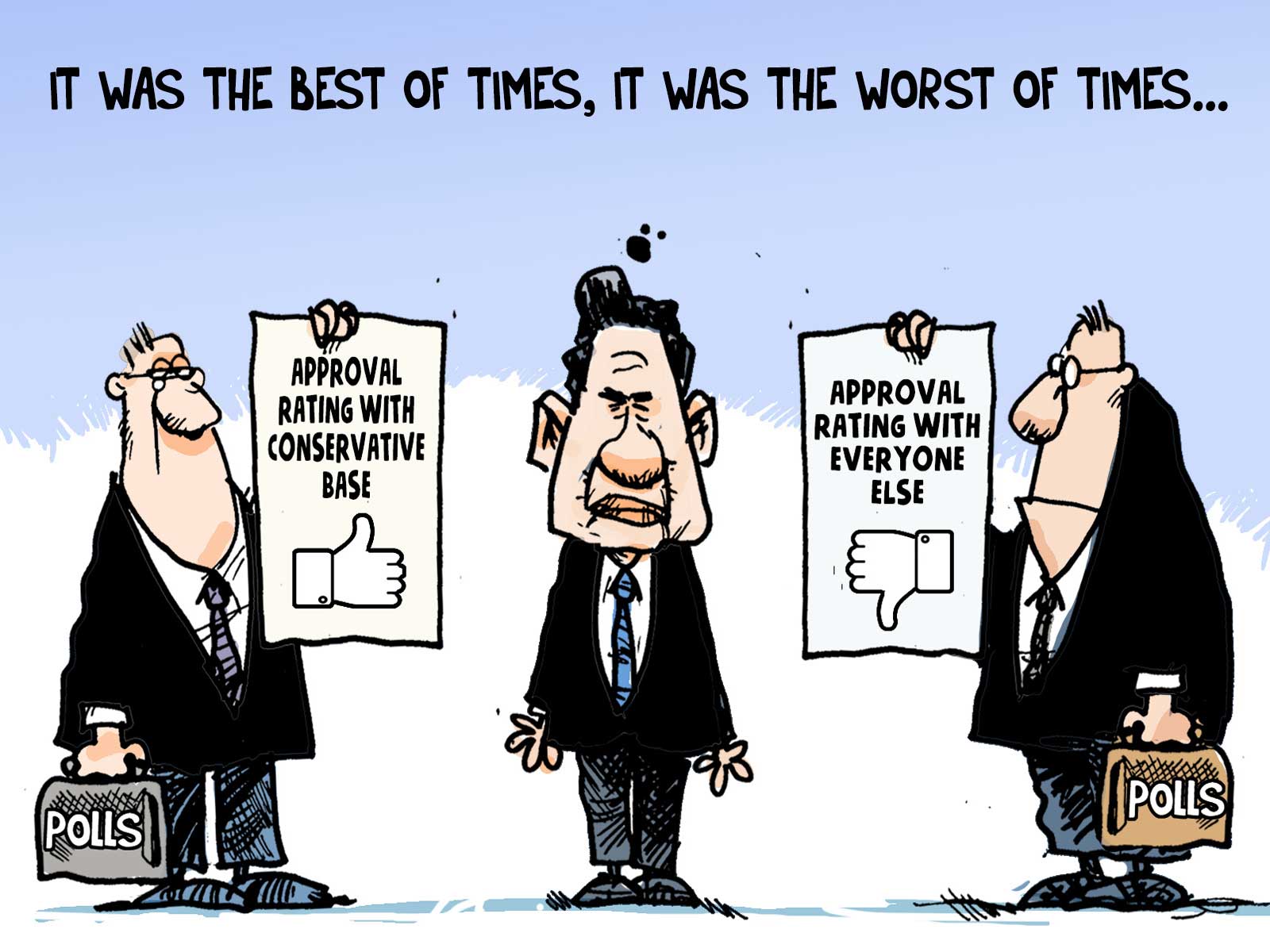
Watching the Conservatives stick with Pierre Poilievre as their leader, Mark Carney and his Liberals might be tempted to feel secure in their hold on government for quite some time.
That would be a mistake.
True, in the wake of Carney’s Davos speech and trade trips to places like China, the PM’s approval rating with Canadians soared eight points to 60 per cent, his high water mark while in office.
And true, Poilievre continues to be a flop at the box-office. While he skated through the weekend’s leadership review with 87 per cent of the vote, he has so far failed to make the political sale to Canadians. A clear majority do not believe that he is the right man for the top job.
How bad is it? According to Angus Reid, Poilievre’s personal popularity recently stood at -22 with Canadians. He is so far behind Carney, the CPC leader can’t see the PM’s taillights.
Still, no one is invincible in politics. As strong as they appear to be, the Liberals have some clear vulnerabilities.
For starters, the Conservative Party of Canada is not unpopular. In fact, it is running almost neck and neck with the Liberals as a party. In terms of voter intent, the Liberals have only a three-point lead over the CPC. So, leadership, and not necessarily populist-right policies, holds back Conservatives.
Short of changing leaders, which is not going to happen, something must shift for the CPC to make a serious bid for power.
Poilievre, whose speech to delegates on Friday was more measured than usual, appears to know that. He recently has signalled some adjustments to his persona and messaging, positioning himself as…
1. The great co-operator
The normally pugnacious Poilievre made a striking pledge just before Parliament reopened.
In a letter to the PM, the Conservative leader promised that he would “co-operate” with the Liberals to get needed legislation through the House of Commons.
What was he referring to? Mostly economic matters, including the U.K. into the Trans-Pacific Partnership and approving the Canada-Indonesia trade deal.
Those constructive words would never have come out of the mouth of the Pierre Poilievre who worked for Stephen Harper.
Nor would that Poilievre have ever offered to send members of his caucus to foreign countries to help with the government’s trade negotiations, as he did in his letter to the PM.
Poilievre the statesman could pose a greater threat to the Liberals in a way that Poilievre the attack dog never could.
2. The kitchen table candidate
There is potential danger lurking in PM Carney’s plan to diversify Canada’s trade away from the United States.
Although that plan may represent sound strategy for the future, politics is a notoriously short-term game.
Given, for example, that “affordability” is the top of mind issue these days, stubbornly high prices at the grocery store and the gas pump create the public’s present mood.
Kitchen table issues tend to eclipse grand, long-term national strategies — pipelines that may make things better at some distant point in time, or trade deals that take years to negotiate and implement.
It is not accidental that Poilievre and the Conservatives have been hectoring the government in Parliament over getting immediate relief for hard-pressed Canadians facing food prices that are rising faster than the rate of inflation. “People cannot eat speeches,” Poilievre wrote to the PM.
Poilievre’s words have clearly hit a nerve in the government. After months of concentrating on promises of mega-projects and new trading partners, PM Carney announced the Canada Groceries and Essentials Benefit.
Using the GST rebate system, Carney will increase benefits for 12 million Canadians struggling to put food on the table.
The PM said that those citizens need the help “right now.” Just as Pierre Poilievre has been saying.
3. The second-guesser on trade
Carney has another potential problem flowing from the government’s initiative to find new trading partners.
What if those new partners create more problems than they solve? What if they are unacceptable to Canadians?
The test case for those issues is China. Carney’s trade deal with the world’s second largest economy will allow Canadian farmers to sell more canola into China. But it will also allow 49,000 Chinese electric vehicles into this country with just a six per cent tariff.
That has a lot of people upset. Premier Doug Ford of Ontario has publicly expressed his disapproval of the deal. Ford worries about the impact of lower-priced Chinese EVs on Canada’s auto industry. That concern is shared by unions representing Canadian auto workers and suppliers.
If Carney’s deal with China ends up hurting Canada’s existing domestic auto industry, it could have disastrous political results for the Liberals in Ontario, which has the most parliamentary seats in the country.
And Carney faces another potential stumble as he seeks to diversify trade. With upwards of 75 per cent of Canada’s exports currently going into the United States, is it even possible to replace that level of trade by finding new partners?
The sad likelihood is that no matter how many alternative markets the PM may find for Canadian goods, nothing can replicate what we sell the U.S.
When Carney at Davos proclaimed that the old world order is dead and American hegemony must be replaced, Poilievre signaled impatience by declaring, “now we need results.”
Expect a similar tone from Poilievre as Carney renegotiates the Canada-U.S.-Mexico free trade pact.
How will U.S. President Donald Trump react to Carney’s determination to find new trading partners? The preliminary evidence suggests not well. In the wake of PM Carney’s trade deal with China, Trump threatened a 100-per-cent tariff on all Canadian exports into the United States.
The president has already used tariffs against Canada in a way that American billionaire Warren Buffett has described as an “act of war.”
The latest example is Trump’s threat to place a 50-per-cent tariff on all Canadian-made aircraft sold in the U.S — a move that could have disastrous consequences for companies like Quebec’s Bombardier.
Uncertainty about the trade relationship with the U.S. benefits Poilievre and the Conservatives in two ways.
First, it allows Poilievre to accuse the government of mismanaging the economy, traditionally the most important issue with voters.
Second, it allows Poilievre to remind Canadians why they elected Mark Carney in the first place. He was supposed to be the best person to negotiate trade deals with the Americans.
Instead of new deals, the U.S. has slapped punitive tariffs on key Canadian exports — auto, steel and aluminum.
The political opening is obvious. Poilievre will pose the unavoidable question. What happened to the great negotiator?
4. The solver of separatism
There is one more issue the CPC is trying to exploit at the expense of the government — separatism.
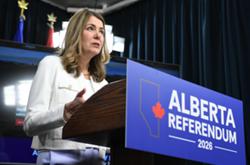
In his speech at the recent leadership review, Poilievre blamed the Liberals for separatist movements in Quebec and Alberta. The pressure point is clear. If the country is so strong, why does it harbour these growing movements to leave it?
For the Conservatives, success in federal politics in the coming months depends on persuading Canadians that all is not well in Great White North.
That Mark Carney is not the leader he purports to be because the economy is faltering, the Liberals have done nothing to ease the affordability crisis and even national unity is at risk.
But Poilievre must also solve the conundrum at the heart of the leadership. As political scientist Stewart Prest notes, “Poilievre is the most successful unsuccessful leader in Canadian politics.”
He has grown his party while polarizing Canadians, because “everything Poilievre does to secure the support of the more populist wing of the conservative movement in Canada tends to alienate the rest of the country, while any move to the centre risks condemnation from those further to the right,” observes Prest.
Here, then, is Poilievre’s difficult task.
He must persuade Canadians that attack dogs can morph into statesmen.
That his latest iteration is genuine, not a pose.
That a person with no experience outside politics is worthy of the highest office in the land.
That he is not an ideologue who will lead Canadian public life to the hard right.
In other words, can he be trusted? ![[Tyee]](/design-article.thetyee.ca/ui/img/yellowblob.png)
Read more: Federal Politics







Notice about commenting changes
The Tyee’s commenting system will be moving to a new platform on Nov. 12. If you’re already a Tyee commenter you must register with the new system on or after Nov. 12 with your preferred username.More information can be found here.