


 SHARE:
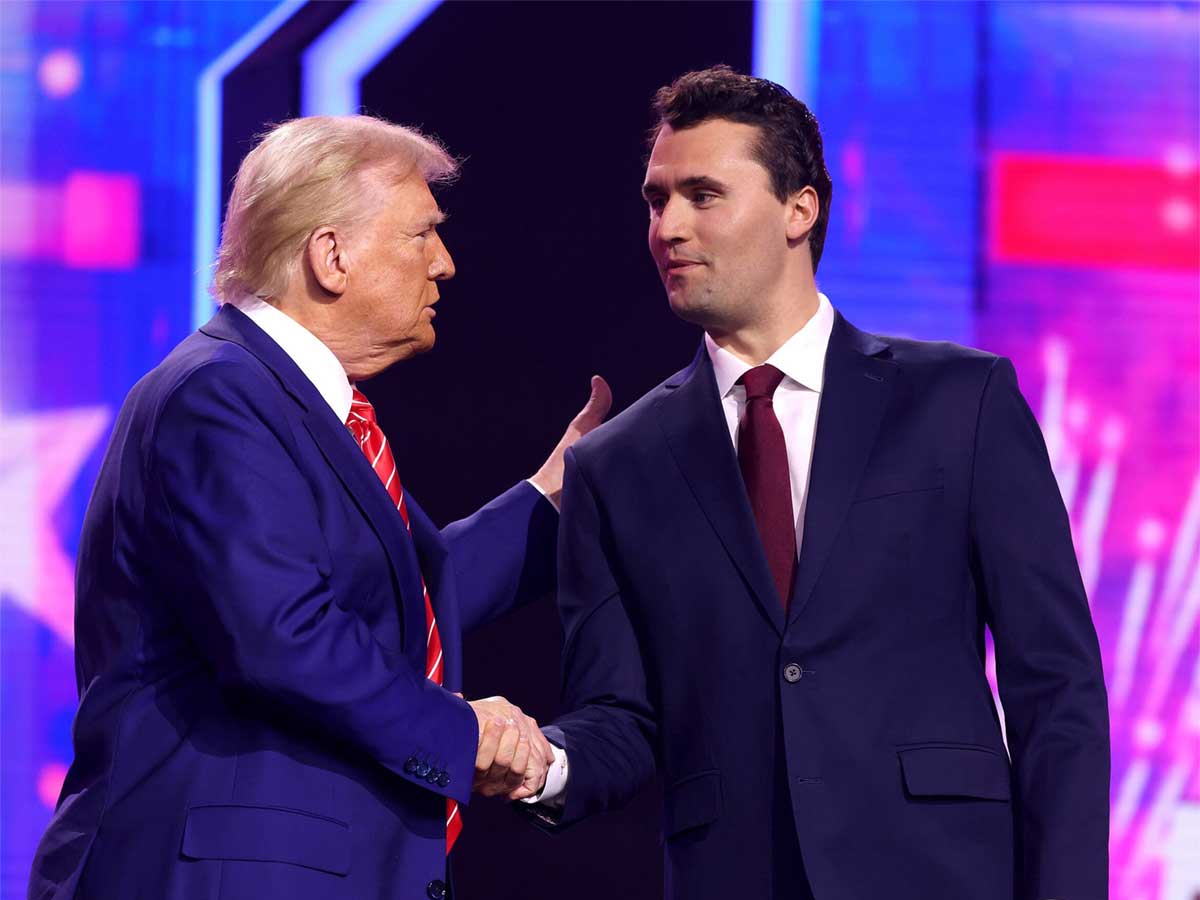
The murder of Charlie Kirk at Utah Valley University last Wednesday was guaranteed to become a flashpoint in America's tinder-dry political landscape. Once upon a time, this would have been the moment for a president of the United States to step up with a message of calm, urging people not to overreact.
“Once upon a time,” of course, is the usual signal that one is about to hear a fairy tale. These days a magisterial, reassuring president is a fantasy to rival the most far-fetched space opera or dragon epic. Dark fairy tales have replaced the shining myth of American nationhood.
A year ago, the Atlantic magazine tallied “40 instances in which [Trump] incited or praised violence against his fellow citizens.”
On Wednesday, with no suspect yet in custody, Trump delivered a statement from the Oval Office in which he railed against “radical-left political violence” and listed some of its victims, naturally starting with himself.
“My administration will find each and every one of those who contributed to this atrocity and to other political violence,” Trump said.
He was just getting started. Appearing on Fox & Friends on Friday, Trump was asked by co-host Ainsley Earhardt: “How do we come back together?”
Trump's answer: “I couldn't care less.”
Once upon a time, Melania Trump wore that sentiment on her back, and it caused a scandal. It's a different story now, and the current narrative makes the Brothers Grimm sound like The Friendly Giant. The president went on to Trump-splain his worldview to the fawning Fox crew. Right-wing radicals, he suggested, are really just concerned citizens, perhaps a little rambunctious, but well-intentioned.
“The radicals on the left are the problem,” he said. “They're vicious and they're horrible.”
On Monday vice president JD Vance followed up by saying the Trump administration would crack down on leftist organizations, adding there was “no unity” with those who criticize Kirk.
Once upon a time in a century long, long ago, an American president, facing the greatest division the country had ever seen, said this: “We must not be enemies. Though passion may have strained, it must not break our bonds of affection. The mystic chords of memory, stretching from every battlefield and patriot grave to every living heart and hearthstone all over this broad land, will yet swell the chorus of the Union, when again touched, as surely they will be, by the better angels of our nature.”
Better angels? Trump eats their wings with hot sauce. Eight-score-and-four years later, the Anti-Lincoln sings a very different chorus to an angry nation.
Trump's Wednesday evening statement cherry-picked the list of political violence targets. He name-checked Louisiana Republican Steve Scalise, whose wounding happened eight years ago. Conspicuously missing from the list however was the only American legislator to be murdered by a political assassin this year, Minnesota state representative Melissa Hortman, who was killed in June along with her husband. The assassin also seriously injured another Minnesota state senator, John Hoffman, and his wife Yvette. No mention was made of the violent attack on Nancy Pelosi's husband or the arson attack on Pennsylvania Governor Josh Shapiro's home. But those victims were Democrats. In the Trump narrative, their attackers were merely concerned citizens.
With the president playing the role of storyteller-in-chief, the Kirk narrative was established early — the activist's death was the result of leftist ideology run amok. The Wall Street Journal co-operated with misinformation about “transgender” messages printed on bullets left behind by suspect Tyler Robinson, a claim they later walked back. As facts emerged it was legitimately difficult to sort through the misinformation, not just from social but also mainstream media.
But then, the nuances of 21st-century American extremism do not always lend themselves to the simple answers preferred by major media organizations. Robinson's messages include references apparently drawn from the world of gamers, where in-jokes and ironic statements blur the meaning to those not immersed in group lore. Charlie Warzel, writing recently in the Atlantic, describes an online culture in which mass shooters are in effect performing for each other, not necessarily acting out of any defined ideology but only a nihilistic and unhinged urge to join the fraternity of killers.
It's a phenomenon that predates the internet. Although Kirk was not an elected official, his shooting echoes that of Alabama governor George Wallace, another American radical who managed to take his racist message mainstream. In 1972 Wallace was shot and left permanently paralyzed by Arthur Bremer, a Milwaukee man who had quit or been fired from a series of menial jobs. Bremer, it later emerged, had initially stalked President Richard Nixon on the campaign trail but found security too tight. Wallace, then a Democratic presidential primary candidate, was a target of opportunity.
Bremer was motivated not so much by ideology as by a desire to join the dark pantheon of American assassins like Lee Harvey Oswald, James Earl Ray and Sirhan Sirhan. Like later killers, Bremer had prepared a catchy message — he intended to shout “a penny for your thoughts,” but in the heat of the moment forgot to do so.
Fifty-three years ago there was also an attempt by a lawless president to craft a post-shooting narrative. It was reported by Seymour Hersh that Nixon's people intended to plant campaign literature from leading Democratic presidential candidate George McGovern in Bremer's apartment, but failed because the FBI had sealed it off.
These days thanks to online partisans and media outlets like Fox, planted evidence is no longer necessary — just a coordinated message, delivered from the top down.
Then again, where Trump is concerned a coordinated message is rarely possible.
Thursday, in a truly bizarre moment on the White House lawn, Trump was asked by a sympathetic reporter how he was holding up personally following the murder of his good friend Kirk. “I think very good,” Trump replied. “And by the way, right there, you see all the trucks? They’ve just started construction of the new ballroom for the White House, which is something they’ve been trying to get, as you know, for about 150 years. And it’s gonna be a beauty.”
Grief and narcissism are like oil and water. If Trump delivers Kirk's eulogy, they'd better make sure the victim's name is in the teleprompter. Otherwise, it'll all be monologues about windmills and golf.
Bad-faith fairy tales drive hatred and violence from the political far right. But progressive voters are not above some morbid fantasies themselves. A couple of weeks ago the internet was abruptly awash in rumours that Donald Trump was dead. The whispers were inspired by the fact that the notorious publicity hound had not been on camera in days. The tone of these social media reports was not one of concern. Rather, the mood seemed to alternate between Christmas Eve-type excitement and warnings that Santa was unlikely to get that wished-for pony down the chimney. Many suggested that the rumours were overblown, and thus it proved.
But ponder for a moment the reality that, for millions of Americans and Canadians too, wishful thinking took the form of imagining the president's demise — not via political violence but due to natural causes. Trump’s divisive run had come to its end, and now the old man had shuffled off this mortal coil.
That so many felt this turn of events might offer a path back to civility is not simply an indictment of Trump — it's a testament to the helpless rage of observers who have been waiting for America's political leaders to mount meaningful opposition as Trump, with the help of his Supreme Court lickspittles, obliterates democracy and the rule of law. Such is their frustration that they are reduced to concocting fantasies about a death that might, perhaps, deliver America from a crisis moment it is so clearly failing to meet.
But Kirk’s assassination, and Donald Trump’s determination to make full political use of the passions it enflames, show how dangerous it would be to retreat from reality, from reason, from naming things as they are rather than being put to sleep by gaslight.
This story is almost certain to have a fairy-tale ending — but whether Disney or Grimm remains to be seen. ![[Tyee]](/design-article.thetyee.ca/ui/img/yellowblob.png)
Read more: Politics












Tyee Commenting Guidelines
Please note that email notifications for replies are not currently working due to a software issue which may be resolved in a future update.
Comments that violate guidelines risk being deleted, and violations may result in a temporary or permanent user ban. Maintain the spirit of good conversation to stay in the discussion and be patient with moderators. Comments are reviewed regularly but not in real time.
Do:
Do not: