


 SHARE:
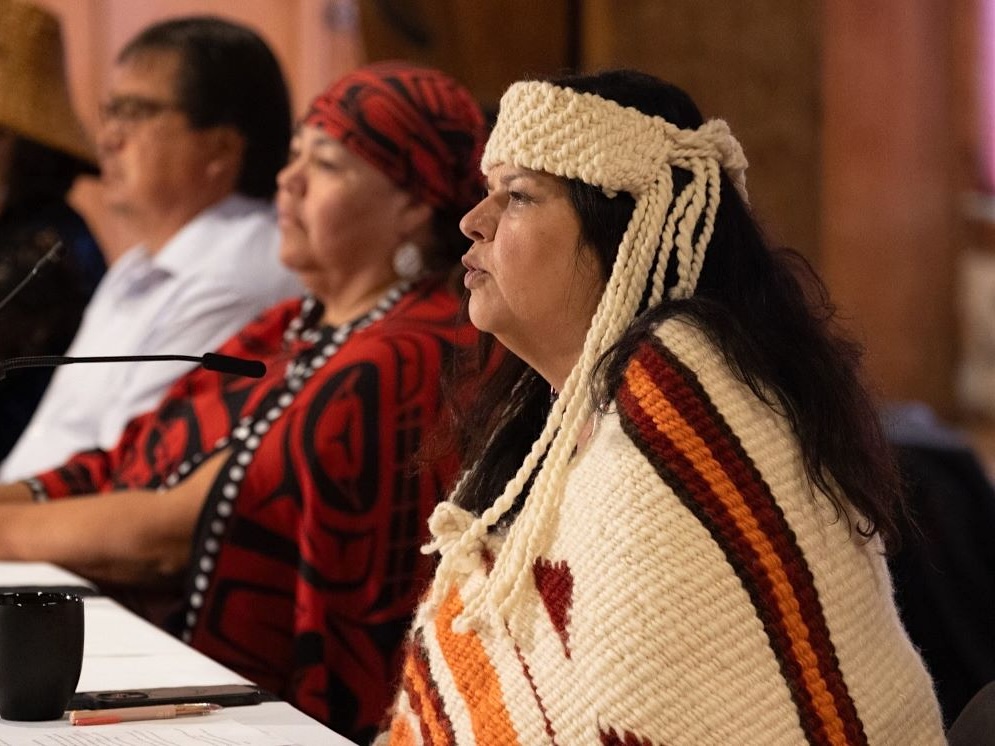
The B.C. Supreme Court’s decision in Cowichan Tribes v. Canada has been felt across the province, affirming that Cowichan Nation holds title to Tl’uqtinus, a village site on the south arm of the Fraser River.
The ruling found that “Crown grants of fee simple interest deprived the Cowichan of their village lands, severely impeded their ability to fish the south arm of the Fraser River and are an unjustified infringement of their Aboriginal title.” Crucially, “the Province has no jurisdiction to extinguish Aboriginal title.... Aboriginal title lies beyond the land title system in British Columbia.”
Attorney General Niki Sharma responded quickly: “We disagree strongly with the decision.... This ruling could have significant unintended consequences for fee simple private property rights in B.C. that must be reconsidered by a higher court.”
This focus on “unintended consequences” distracts from a truth anyone familiar with B.C.’s history knows: this decision is not an outlier but part of a legal trajectory the Crown has been warned about for decades.
The unresolved land question
In Reconciling History: A Story of Canada, Jody Wilson-Raybould and Roshan Danesh quote a correspondent to the Times (U.K.) from 1877:
“First and foremost, there is a question of the unextinguished Indian Title in the soil.... It would cost a great sum of money to extinguish the Indian title here.... The practical difficulties in settling this question are so great that it has not been raised at present.... But what guarantee can there be that the Indians themselves will not raise it at some future, perhaps not distant, time?”
The unresolved land question has been raised repeatedly over decades. Landmark cases from Delgamuukw (1997) to Haida (2004) have urged governments to negotiate rather than litigate. The courts saw this day coming.
The federal and provincial governments themselves have argued for negotiation, such as in the Aboriginal title resolution reached with the Haida Nation in 2024. Yet too often, negotiations stall because the Crown refuses to move beyond minimal concessions.
Private property and political framing
The Cowichan case was never about seizing private homes. In a 2017 pre-trial ruling, the court noted “the plaintiffs... do not seek to invalidate or render defective the fee simple interests held by private landowners.”
If anything, it is the Crown’s choice to litigate, instead of negotiating resolution, that puts the private property rights regime into conflict with Aboriginal title. By framing the decision as a threat to property owners, the attorney general risks stoking public fear and scapegoating First Nations for a problem they did not create.
Negotiation vs. litigation: Why talks fail
The attorney general says the province prefers negotiation “where we can protect property rights directly,” but at the table, First Nations face delay, denial and distraction. Negotiations are further complicated by the Crown-imposed views of British Columbia geography. Historical decisions by Indian agents creating Indian Act bands and boundaries, and more contemporary BC Treaty Process maps, have carved up Indigenous homelands into Crown-constructed territories, creating overlaps and disputes that now cover more than 100 per cent of the province.
The government knows this. That is why Action 1.1 of the Declaration Act Action Plan and the premier’s mandate to the minister of Indigenous Relations explicitly call for boundary dispute resolution.
Litigation is costly, divisive and challenging to implement. Good-faith negotiations, respectful of Indigenous world views, can produce agreements that are implementable and durable. Yet without political will, talks become another tool to wear First Nations down.
The real liability
The Times correspondent in 1877 warned that the cost of addressing title would only grow. Nearly 150 years later, the Crown’s inaction has made that prophecy reality. These liabilities are no longer legal abstractions; as the jurisprudence advances, they affect infrastructure projects, resource development, land-use planning and community relations.
Every day the province delays, the financial and political costs rise. The attorney general’s office does not have another 150 years of legal runway ahead of them.
Sharma calls the ruling’s impact “unintended.” In reality, it is the entirely foreseeable consequence of ignoring the land question. This is not a “woke” ruling from a radical bench. Justice Barbara M. Young was appointed in 2015 by Conservative Justice Minister Peter MacKay under Stephen Harper. The decision aligns with three decades of Supreme Court direction.
This also is not a decision about the United Nations Declaration on the Rights of Indigenous Peoples. Indeed, the case was begun years before the Declaration on the Rights of Indigenous Peoples Act was adopted in 2019, and the reasoning of the judge, and what is at issue, is about Section 35 of Canada’s Constitution.
The best way to protect private property rights, and create certainty for all, is to resolve Aboriginal title across the province through negotiation, not litigation. That means committing the resources, political capital and imagination to reach agreements.
A call to political responsibility
Governments, not courts or private property owners, hold the power and responsibility to resolve the land question. The Declaration Act was one courageous step in establishing a framework for reconciliation. But laws based on rhetoric, laws lacking the political will to effectively implement to build social cohesion and public momentum, are empty.
Negotiation tables must be places where innovative models are explored, where responsibility is shared, and where reconciliation is not just a word but a practice. That requires a government willing to give an inch, and more, to meet its constitutional and moral obligations.
The province has said it will appeal. That could take years. Between now and then lies an opportunity. Sit down with Cowichan, tie the work to the Declaration Act Action Plan, address overlaps and begin resolving the land question before the costs, in every sense, grow beyond reach.
History has been patient. Current and future generations will not be. ![[Tyee]](/design-article.thetyee.ca/ui/img/yellowblob.png)
Read more: Indigenous, Rights + Justice, Politics







Tyee Commenting Guidelines
Please note that email notifications for replies are not currently working due to a software issue which may be resolved in a future update.
Comments that violate guidelines risk being deleted, and violations may result in a temporary or permanent user ban. Maintain the spirit of good conversation to stay in the discussion and be patient with moderators. Comments are reviewed regularly but not in real time.
Do:
Do not: