SHARE:
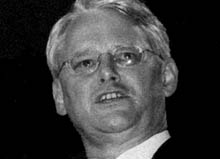
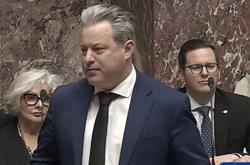
I don’t know whether you noticed it. None of the commentators on the May 3 party leaders debate mentioned it. But I watched the premier’s body language early in the debate when he was under attack from Carole James. Did you see him turn his head away from James instead of looking her in the eye? He turned turtle. He simply did not acknowledge her presence as he pretended to read his notes. I half-expected former school-trustee James to wag her finger and tell him to look at her while she was talking to him.
The thing that bugged me the most about covering Mayor Gordon Campbell for Vancouver magazine from 1986 into the ’90s was not his lack of emotional range, however fascinating that subject is. It was his unwillingness to declare what, if anything, he stood for. As far as the City Hall press corps of those days was concerned, it was impossible to measure the man because he promised not much more than to look better than his opponents in office. Not for nothing was he dubbed during his single pre-mayoral term on city council “the designer alderman.”
His only issue with the Mike Harcourt-COPE coalition majority was spending. To him, the way to reduce spending was to subtract $2 million from the budget, period. Not $2 million from any department or specific program or underused service. That would have started an argument. It would have pissed somebody off. So, early in his political career, he developed a certain high-sounding vagueness. Surely, I remember him whining, we can all agree on $2 million worth of cuts. Whom and where? To him, that was beside the point. Sound familiar?
Playing to Vancouver’s vanity
He won consecutive terms as mayor by exploiting Vancouver’s great character flaw, our narcissistic self-regard, by presenting himself as, essentially, better for tourism than Harry Rankin (1986) and Jim Green (1988), both of whom had age lines and bore scars of grassroots battles that Campbell will never know. Both had personal and public achievements, not to mention ideas, that were missing from Campbell’s life at that point.
They still are. One critical element absent from his life in public office is a life outside public office. Campbell is a pure politician. That missing element has plagued him ever since. He consistently scores lower in approval ratings than the party he leads. People just don’t trust him. Women don’t like him. He is almost entirely absent from Liberal campaign ads. He is the bad medicine he says we need.
There have been several attempts to psychoanalyze him. What, the deep thinkers ask, caused the idealistic bushy-tailed chirpster who returned from modernizing Africa to be right-hand man to Mayor Art Phillips, the man who saved civic democracy in Vancouver, to morph somehow into Premier Campbell MacScrooge, who squeezed child-care workers, doctors, nurses, schoolteachers and legal-aid lawyers drier than Ritz crackers. How? Well, he did become a property developer.
Neutering debate
He was, in the words of a colleague, “a so-so developer,” working on the proposal of the CPR’s real estate arm, Marathon Realty, to develop the north shore of False Creek. Marathon decided it didn’t have the resources to build the kind of project the site demanded. The only project I’m aware of that Campbell developed more or less on his own was the Georgian Court Hotel, his team’s attempt to cash in on Expo 86. This was the lifetime’s achievement (family aside) that he brought to the premier’s office.
He had such promise. One early attempt to take his pulse appeared in the autumn of 1986. It said Campbell is “young, handsome and bears all the legitimate trappings of a modern success story. At the tender age of 38, he draws selectively from the annals of Vancouver’s municipal saga and reminds us that he is ‘older than Mike Harcourt when he was first elected mayor.’ Dynamic, dedicated, he speaks confidently about ‘spearheading a new boost of energy’ into the next decade. There is almost a storybook quality about this contender, a too-good-to-be-true aura that panics the skeptics and incenses the politically wary…”
Is this copy from a 1986 Non-Partisan Association campaign brochure? No. Too sappy. This is B.C. Business’s inquisition of Campbell, published that September. He was too good to be true.
His strategy in running for mayor that first time was to plan a personality campaign without issues, get himself elected, and then turn to carefully-chosen task forces to develop his agenda. The effect was to de-politicize such issues as developing False Creek North and the Fraser River Lands, the loss of low-cost housing to Expo 86, and the regionalization of public transit. Important council meetings were moved to weekday afternoons, when neighborhood groups could not attend. Critical questions went unasked.
Privatizing issues
Speaking of unasked questions, Gordon Campbell once lost his mayoral cool with me. It was during that first term. I asked whether the task force whose composition he was announcing that morning was the seventh or eighth he had appointed. I had honestly forgotten how many civic issues he had privatized so far. By privatizing issues, I mean taking a question out of the public realm, choking off debate (except among the task force appointees), and side-stepping personal accountability for the eventual recommendations.
The scary thing was that he, too, was unable to say how many there were. He got that pained Gordon Campbell look on his face. He didn’t turn his back on me. He didn’t slam his fist on the table. Instead, he glanced around at the broadcast and daily newspaper reporters with a look that said Can you believe the shit I have to take in this job? With that, he wrapped up the press conference.
Nor, by the way, did he offer to get back to me with the actual number of task forces he had appointed so far. That’s not his style.
Sean Rossiter wrote an award-winning column about civic affairs entitled Twelfth & Cambie for Vancouver magazine for 16 years. ![[Tyee]](/design-article.thetyee.ca/ui/img/yellowblob.png)