


 SHARE:
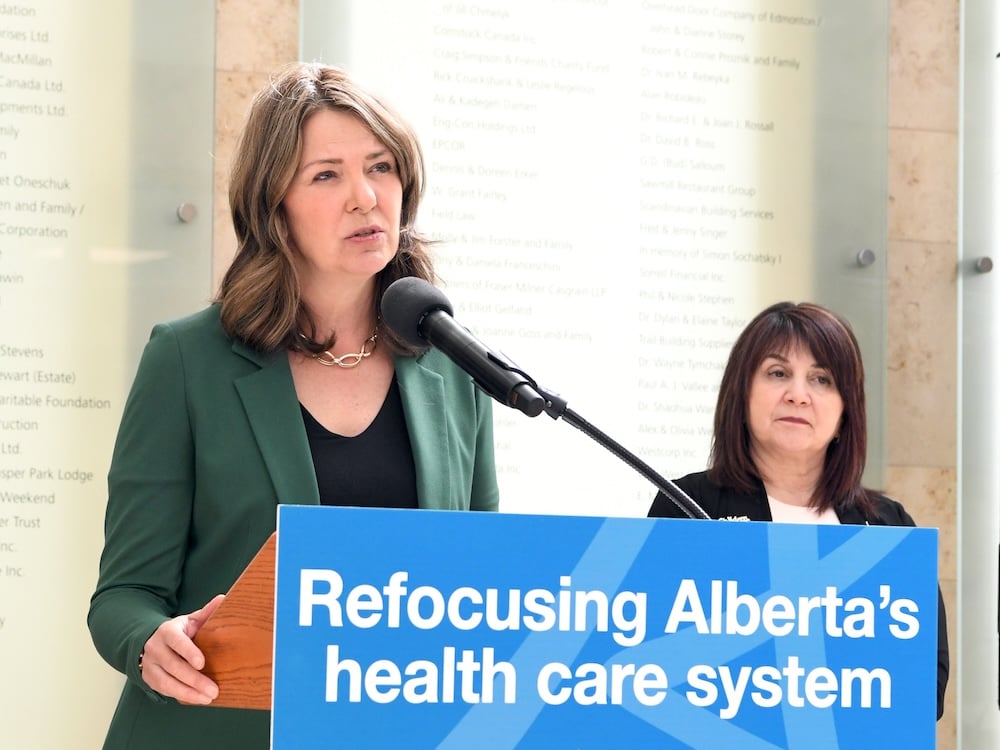
Despite its name, Alberta’s Health Statutes Amendment Act, 2025, is not health-care legislation.
The purpose of a law that was granted royal assent on Dec. 11 is to destroy public health care as we know it, not just in Alberta but throughout Canada, by legislating two-tier health care.
It may well succeed.
But at base it is an insurance law, because in addition to bringing American-style cash-register health care to Alberta — and through Canada’s trade agreements with the United States and other countries opening a back door to the same thing in every other province and territory — it uses private insurance to undermine public health care.
A short and clear report by the Canadian Centre for Policy Alternatives and the Edmonton-based Parkland Institute released this morning outlines in plain language how these objectives will be achieved by Bill 11 if the federal government can’t find the courage to enforce the Canada Health Act.
Written by researchers Andrew Longhurst of the CCPA and Rebecca Graff-McRae of the Parkland Institute, “The End of Canadian Medicare?” outlines in plain language 10 ways that, without a sharp national response, the blandly named act will undermine and likely destroy public health care in Canada. (The question mark in the title, it’s said here, isn’t necessary. This is exactly what is intended by the far-right ideologues who drafted and passed this act.)
- The key provision of the bill allows physicians to work simultaneously in the public health-care system and bill their private patients for the same services delivered more speedily. A large body of international evidence shows this will not only mean unequal access based on income but increase wait times for most of us.
- By allowing all doctors to engage in “dual-practice” medicine, the legislation will let physicians pressure patients to pay or go to the back of the line. It will also deprive the public system of physicians who will want to focus on the more profitable private pay market. As we shall see in Point 10, this is intentional.
- By creating Canada’s first private health insurance market, the law will drive up health-care costs, just like in the United States. “The cost of the same basket of services is bid up by increasing profits, often disguised as ‘administrative costs,’” the authors explain. “The result is that health-care costs rise rapidly for the government (the public insurance plan), placing a greater burden on the public plan.” Over time, this results in governments narrowing the scope of insured services.
- Private payments increase public wait times. “Alberta’s two-tier system will not reduce public wait times.” Instead, it will “increase public wait times as physicians and surgeons focus their time in the lucrative and less-complex private-pay market.”
- Bill 11 will open the door to hospital user fees. The legislation establishes “non-insured hospital services” and “enhanced goods and services,” as yet undefined by the UCP. Regardless, that ensures patients will have to pay more to get less.
- It “muddies the definition of hospital” to let in for-profit hospital operators. “Governments engaged in privatization initiatives tend to blur the definitions, so the very essence of public entities lose their meaning and confuse citizens. In Alberta, the government is doing exactly that.”
- Bill 11 aims to encourage anti-social private-pay insurance plans for private-pay health services. This is a feature, not a bug. Big profits will result.
- It encourages hospitals to compete for revenue. “The Alberta government is creating health-care insurance and provider markets where every patient is seen as a source of revenue.” Not incidentally, this will increase the cost of operating hospitals, which will now require bigger billing and collections departments.
- It is bound to attract U.S. health-care insurance and delivery corporations — and like toenail fungus, once we’ve got ’em, they’ll be almost impossible to eliminate. This is the key point of Longhurst’s and Graff-McRea’s report, if you ask me. “Once these corporations enter the Canadian market, they will become entrenched and protected by trade and investment agreements.” Not only will we have U.S.-style health care, “we will have U.S. health care.”
- Dual physician practice and private health care require long public wait times. After all, the business case for private care is long wait times for everyone with less money. Count on it, if the UCP government remains in power, it will make sure that wait times increase.
Two other points not mentioned in the report are worth considering.
- Bill 11 will increase tax revenues for the government through its three per cent tax on premiums for “sickness insurance,” a cost that will inevitably be passed on to citizens.
- Unions will negotiate contracts that require employers to contribute to employees’ insurance coverage, raising costs and reducing profits for other industries, not to mention the public sector.
The UCP is bound to respond to the report’s criticisms by repeating its questionable claim that it’s not introducing U.S.-style health care, but rather European-style health care.
There are, of course, more than 40 distinct health-care systems in Europe. So which ones? The universality of European plans’ universal coverage varies from country to country.
At every turn, though, despite the UCP’s rhetoric, the reforms the Smith government proposes lead straight to the nightmare south of the 49th parallel.
The report’s 11th point — introduced presumably for symbolic consistency with the number of the bill when it was introduced in the legislature last year — actually proposes a solution to this ideologically driven effort to wreck Canada’s single-payer health-care system. (One also suspects the UCP put this bill 11th in their legislative lineup to mirror Ralph Klein’s 2000 Bill 11, the Health Care Protection Act, which failed in the face of strong public opposition to its privatization push.)
So the report’s 11th point declares that Bill 11 ignores the universality and accessibility principles of the Canada Health Act, which puts federal funding for the Alberta health-care system in jeopardy.
Remember, if the UCP succeeds, other Conservative-run provinces, naturally, will plead “nothing we can do” and try to do the same thing.
“The more provinces that join Alberta, the greater the likelihood that it will lead to the dismantling of the Canada Health Act as the federal framework that upholds provincial public health insurance plans,” the authors say. “This could end Canadian medicare as we know it.”
Not could, though. Would. Will.
If it chooses, Ottawa can block this by enforcing the Canada Health Act.
Longhurst and Graff-McRae concluded: “Will the federal government remain silent on the potential for multiple violations of the Canada Health Act? Will civil society be compelled to seek a court order to force the federal government to enforce the Canada Health Act?”
The answer is probably. The Smith government has thought of this. Arguably, that is one of the motives of the premier’s ongoing separation shakedown of the rest of Canada — although that’s not to say separation doesn’t remain their UCP’s ultimate goal.
Likewise, a Conservative government in Ottawa, especially one led by Pierre Poilievre, would probably repeal or significantly declaw the Canada Health Act. ![[Tyee]](/design-article.thetyee.ca/ui/img/yellowblob.png)












Notice about commenting changes
The Tyee’s commenting system will be moving to a new platform on Nov. 12. If you’re already a Tyee commenter you must register with the new system on or after Nov. 12 with your preferred username.More information can be found here.