


 SHARE:

The ripples of Charlie Kirk’s violent and tragic assassination have spread well beyond the bounds of the United States.
Kirk’s cultural influence in life as a social media influencer — and now after his death — means that his impact seamlessly flows over borders on the internet. Just look at the Google Trends search history of his name over the past 12 months in Canada.
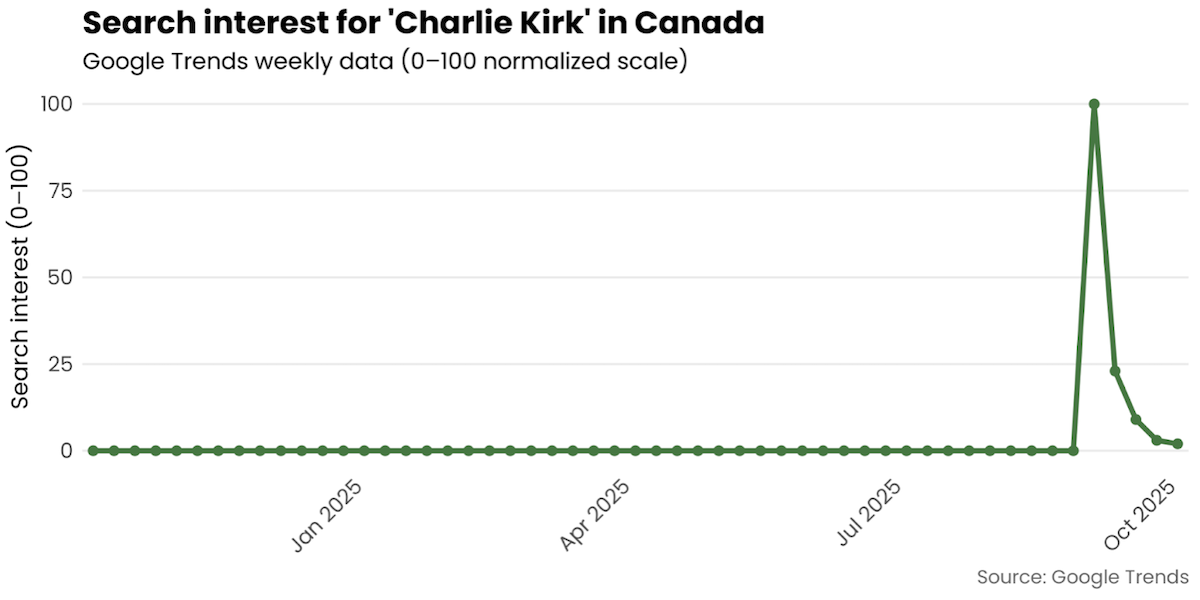
And while most readers already know this, I just want to make the point clear: Kirk was very much a figure of the internet.
His life’s work centred on the circulation of viral videos where he would debate students on college campuses, promoting socially conservative and Trump-aligned arguments. You’ll find him in short video format on YouTube Shorts, Instagram Reels and TikTok. That was the vehicle of transmission for his content. Linger on one of his videos, and algorithmic feeds will dutifully serve you more as they compete for your eye contact.
Kirk’s death rocked the internet. And it brought out the worst in us. I was reminded of Bo Burnham's viral Netflix special Inside and his song “Welcome to the Internet.”
The verse that captures what it felt like to scroll X (Twitter to me still) the day Kirk was killed:
Welcome to the internet
What would you prefer?
Would you like to fight for civil rights or tweet a racial slur?
Be happy
Be horny
Be bursting with rage
We got a million different ways to engage.
We saw emotional and extreme reactions flood our timelines because that is how the ecosystem is designed — social media companies farm rage. I think social media is a bad place to air your first reactions to someone’s death. But people did, and the takes we saw were predictably more extreme than those in traditional news or in real-life conversations.
It wasn’t just rage. Conspiracies surrounding the assassination have been rampant. From supposed “deep state” plots to anti-Israel theories so viral that Benjamin Netanyahu himself released a video calling them absurd, the vacuum of verified information was quickly filled with speculation. At first, online sleuths thought the shooter was a middle-aged man dragged from the site. When Tyler Robinson, a 22-year-old, was identified as the suspected shooter, strangers scoured his family’s Facebook posts, archiving dinner photos and childhood snapshots. It is an all too familiar but still obnoxious exercise of strangers diagnosing conclusions from screenshots.
But this shooting was also born from the internet, from how the alleged shooter came to know Kirk to the bullet casings engraved with online in-jokes found at the scene. CBC’s Front Burner podcast covered it well: the era of meme shooters is here. And it clearly can result in offline violence.
What does this mean for us, as Canadians? Our online and offline worlds are deeply connected to the United States. My workplace, the Media Ecosystem Observatory, or MEO, is currently activating our incident response process, looking at how our social media environment has been affected by the assassination. One angle I, as the survey analyst, am exploring is our attitudes toward political violence.
So far, we have not seen the same high-profile forms of political violence here in Canada. But similar to the United States, our political culture and institutions are reacting to Kirk’s death. We’ve seen intense political debate over what counts as appropriate commentary on the assassination. Several university professors were put on leave after social media backlash about their posts. Manitoba MLA Nahanni Fontaine faced criticism for her comments and later saw her office vandalized multiple times — though the motives remain unclear. Canadian journalist Rachel Gilmore was also targeted, appearing at the top of a list that accused various social media users of making “inappropriate” comments about Kirk’s assassination.
The effect of Charlie Kirk on Canada is still being written. Conservative MP Jamil Jivani is conducting a “Restore the North” campus tour — a political strategy closely resembling Kirk’s own youth-outreach style. Much of Jivani’s work focuses on young men, a group who spend much more time on YouTube and Twitter than their female counterparts.
One of the most worrying effects of our current political polarization is how we interpret events radically differently than “the other side.” For example, read the comments on a video of a Conservative MP paying tribute to Charlie Kirk and denouncing political violence in the House of Commons that led to a cross-partisan standing ovation. They are filled with outrage and accusations of ideological hypocrisy.
And to be fair, there are vastly different ways to interpret the event and how we talk about political violence. New York Times columnist Ross Douthat interviewed left-wing streamer Hasan Piker after the shooting, and it generated a fascinating discussion of blame and causal attribution to events like Kirk’s death. In the wake of the assassination of a health-care company CEO in the United States by Luigi Mangione, the internet has been reconciling how change can happen in our society and the role of violence. Ideological crossover conversations like this, in good faith and in long form, are a solid step toward breaking out of one’s own ideological bubble.
Clearly we are in an extremely charged moment and blame is thrown around faster than individuals are willing to take responsibility. The social media environment thrives on outrage and clicks, not calm reflection. We won’t see the people who speak carefully or choose silence; instead, we see bitter arguments by politicos accusing the other side of stoking political violence.
Interpreting events through the lens of your political tribe isn’t new, nor is it un-Canadian. Last year, when a bot campaign amplified Pierre Poilievre’s rally in Kirkland Lake, our research team at MEO surveyed Canadians, and partisan groups thought the other side was responsible. Our research also showed how easy it was for modern technologies to manufacture these moments and how it is often the ensuing conversations that scale the problem. People usually don't wait for evidence before forming their opinions.
When our online information ecosystem experiences major disruptions or fraught moments susceptible to interference by bad actors, careful research and analysis can help provide evidence-backed context. In the coming months, the Media Ecosystem Observatory will produce a report that we hope will make sense of the chaotic online environment. ![[Tyee]](/design-article.thetyee.ca/ui/img/yellowblob.png)












Tyee Commenting Guidelines
Please note that email notifications for replies are not currently working due to a software issue which may be resolved in a future update.
Comments that violate guidelines risk being deleted, and violations may result in a temporary or permanent user ban. Maintain the spirit of good conversation to stay in the discussion and be patient with moderators. Comments are reviewed regularly but not in real time.
Do:
Do not: