

 SHARE:
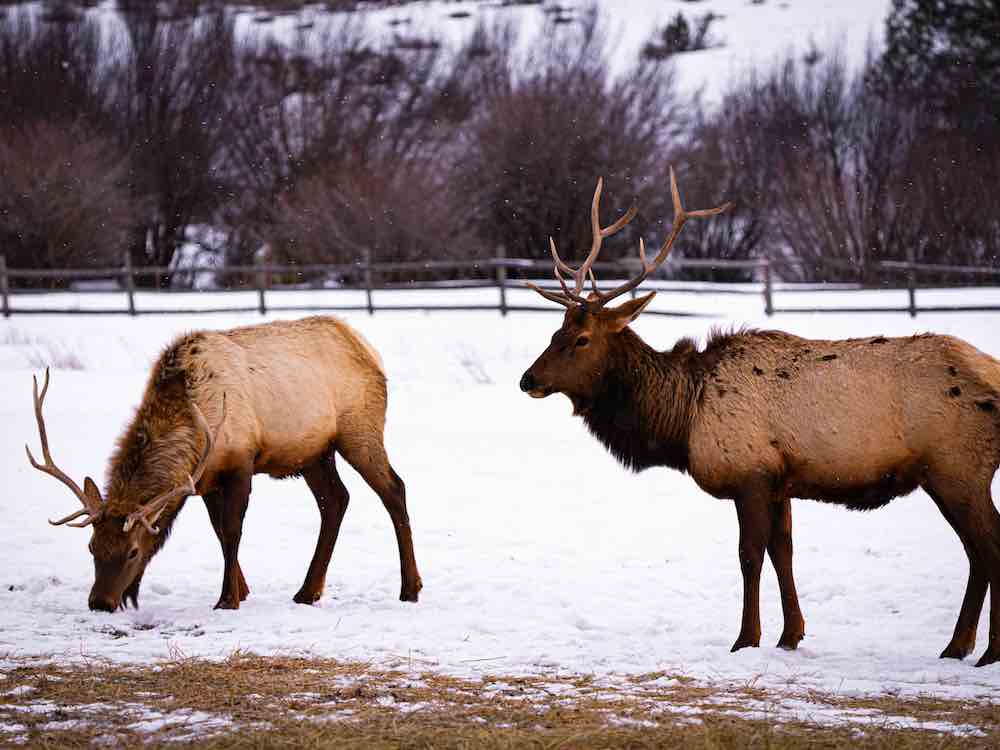
Alberta’s struggling elk farmers are trying to win a gruesome new way to make money.
Instead of just sending the elk off to be butchered and sold as high-end meat, they’d like to offer people the chance to come and shoot the animals on the farm.
And, of course, pay for the chance to shoot a captive animal.
The Alberta Elk Commission, which promotes the industry, has been lobbying to turn farms into places people can kill trophy elk for a price.
It seems to have worked, with the United Conservative Party government apparently poised to allow the sport shooting of farm animals next year.
It’s not surprising the UCP government would see little wrong in turning game farms into hunt farms. After all, they have given us the spectre of mountaintop coal mining, draining prairie rivers dry for irrigation, ratcheting up logging to unsustainable levels and slamming the door closed on renewable energy in favour of more greenhouse-gas-emitting fossil fuel extraction. It’s all about the money, not good public policy. Short-term gain with the inevitability of long-term pain.
The farming of elk has been one of those get-rich-quick schemes promoted first by the government of Alberta. Except it never turned out as planned for most, and now it’s a failing industry clawing at anything to stay afloat. It’s unfortunate that many were sucked into the economic hype of game farming.
Greenwashing the concept of a hunt farm with the centrifugal spin of a “cervid harvest preserve” starts to paint a picture of an industry so bereft of ethics that it takes one’s breath away. This is not hunting or “harvest.” This is shooting a captive animal enclosed in a “preserve” with an escape-proof fence without any of the classic rules of fair chase.
This is an enterprise that is all about the money. In a 2023 Western Producer article, then-agriculture minister Nate Horner was asked if he understood what these “hunt preserves” could do for Alberta and the economic importance of having hunters travel to Alberta to shoot a trophy elk.
The Alberta Elk Commission points out producers receive $1,500 to $2,200 an elk when it is sold for meat. Elk sold to hunt farms can fetch $4,000 to $10,000 or higher, depending on antler size and hunt farm clientele.
The issue is that to get top dollar for the animals, Alberta elk farmers currently must send their male elk with large antlers, prized by trophy hunters, to hunt farms in Saskatchewan or the United States. Elk farmers argue that other jurisdictions have hunt farms, so why can’t Alberta? Think of the response from your mother to some dumb activity of the rest of your group: “If all your friends want to jump off a bridge, that doesn’t mean you should too.”
Hunters should be appalled by this because there will be blowback from the public. This has the very real potential to tarnish ethical, responsible hunters with the image of blood-thirsty, rapacious gunners. Allowing the shooting of captive animals is ethically flawed, and added to that is the concern this may negatively influence the perception and legitimacy of hunting on the part of the non-hunting public.
This also debases the sport of hunting. It certainly debases the hunting that most of us do where a combination of skill, observation, time and luck are necessary for a successful event. Stepping into a fenced enclosure involves little or none of those essential pieces of a hunt. It degrades hunting to the denominator of a price tag. Commercializing wildlife, even farmed wildlife, creates a slippery slope legally, ethically and perceptually.
There are also serious biological issues that may be an order of magnitude greater than the ethical ones. A technical review of hunt farms by the Wildlife Society, an international association of wildlife scientists, provides a summary of biological issues. At the top of the list are chronic wasting disease and meningeal worm.
Every informed hunter and conservationist knows the toll CWD has exacted on wildlife populations in Alberta. The disease is transmissible and is caused by prions, which remain infectious for years and for all practical purposes cannot be destroyed. The disease is considered 100 per cent fatal in deer, moose and elk once clinical signs develop.
Meningeal worm naturally has been found farther east and becomes rare west of the Saskatchewan-Manitoba border. This parasite can hide in elk, killing some, while survivors spread the disease. Recently it has shown up in various places in Saskatchewan, carried there in farmed elk. Wild mule deer, moose and possibly caribou are affected. If hunt farms are allowed in Alberta, it is a certainty the next step will be to allow farmed elk from Saskatchewan to be moved into Alberta, increasing the risk here.
Pandora’s box of wildlife diseases wasn’t wrenched open by divine intervention — it was through game farms, as wildlife experts correctly predicted.
In those jurisdictions where hunting of farmed wildlife exists, diseases — especially CWD — have been shown to be nearly impossible to control or eliminate. No thought of that exists in this ill-advised scheme for Alberta. Ignored are the issues arising from a quick buck syndrome, especially the costs not accounted for in this scheme to make game farms profitable.
It's easy to see what the next steps might be. Some game farms may not be big enough to offer a “challenging” and “sporting” experience. Why not include some adjacent public land, fence it in, too, and expand the operation to be more profitable? These things have a way of moving from the illogical to the absurd.
Past governments created this problem. The solutions must lie with current ones. Ignoring the issue, hoping problems will go away and kicking the can down the road are not solutions, nor is a knee-jerk response of permitting the killing of trophy animals. All of these treat symptoms, not the main issue that game farms were a bad idea and it has got worse.
The argument comes down to a simple question. Does the desperation of a small group of game farm owners rationalize continuing the risks from their operations, including shooting trophy animals in a fenced area? Does the plight of a failed industry mean the hunting community and wildlife enthusiasts in general have to roll over and play dead?
If Albertans, especially hunters and the conservation community, don’t stand up, this will slide through with all the ease of inserting a credit card and opening a gate to the unearned bragging rights for shooting a trophy bull elk in a barrel. ![[Tyee]](/design-article.thetyee.ca/ui/img/yellowblob.png)
Read more: Rights + Justice, Alberta, Environment




Tyee Commenting Guidelines
Comments that violate guidelines risk being deleted, and violations may result in a temporary or permanent user ban. Maintain the spirit of good conversation to stay in the discussion and be patient with moderators. Comments are reviewed regularly but not in real time.
Do:
Do not: