

 SHARE:
I am standing on a porch surveying a stormy July sky over Brandon, Manitoba. To the west, the lingering glow of sunset still reflects off the clouds, illuminating showers of rain. To the east, rather incongruously at this late hour of the evening, is a faint rainbow. Adding to the fantastical nature of the scene, the rainbow is periodically split by branches of lightning. It's a reminder that nature offers few spectacles to match a prairie summer sky.
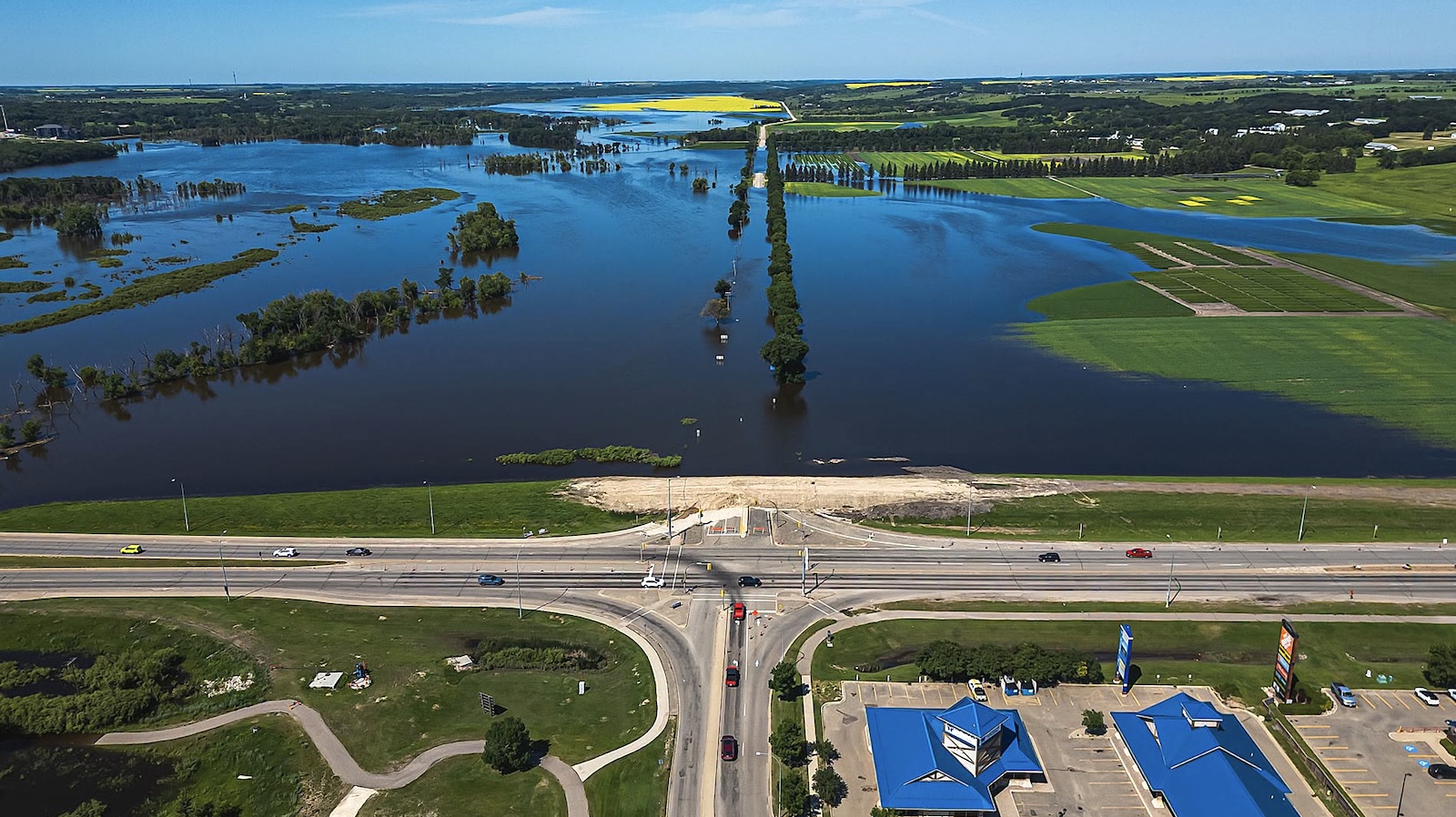
Locals, however, may not be quite so appreciative of the panorama, and not just on account of familiarity. The issue is the rain. Brandon, a city of roughly 60,000, is already under a state of emergency, with Assiniboine River levels expected to crest within a week. An earthen dam has been built where 18th Street meets the Grand Valley Road. Sandbags are being filled. Rain is not what anyone wants to see right now, regardless of entertaining sideshows. And there are larger implications to the current situation — implications that at least one small Brandon organization is attempting to address.
Brandon has been here before. In 2011 a massive snowpack and delayed melt led to epic flood levels in much of southern Manitoba. The Assiniboine reached a peak 60 per cent higher than any previous record, and the river valley that runs through the northern end of Brandon was entirely submerged.
The city, two hours' drive west of Winnipeg on the Trans-Canada Highway, was not ready — no one had seen flooding like it in years. Yet three years later the floodwaters were back. The 2014 flood was not as high, and the response was swifter. Now the warnings are out again, the dam has reappeared, and the city waits. My friend Pete, who lives in the flood plain, has already received an evacuation advisory — keep a bag packed and be ready.
This year's trouble is not related to a spring melt. It's just been a crazy summer. My evening sky viewing was accompanied by a soundtrack of tornado alerts squawking from my cellphone. As I drove into town days earlier, CBC’s Ian Hanomansing had been interviewing a man whose farmhouse in Rossburn, Manitoba, had been destroyed by a tornado a week earlier. Afterward, the farmer said, the looky-loos had descended. “It's been like a Bomber game around here,” he complained.
Rossburn is about 90 minutes northwest of Brandon. All the water from the associated storms that hit the western region of the province was now finding its way to the Assiniboine and flowing toward Brandon.
One afternoon I am sitting in my favourite local cafe, Forbidden Flavours. There's a small gathering at a nearby table. I cannot help but overhear — really, I wasn't straining — that they are discussing issues connected to climate change. I wander over to say hello, and that is how I am introduced to Sustainable Brandon.
It turns out we have a connection. Sustainable Brandon is a small activist group that grew out of Knox United Church, where my late father was once minister. “Both Quentin and I were part of the Knox Green Team,” says Madelyn Robinson, indicating her husband at the café table.
I shouldn't be surprised. I have written about Knox before. Over the years the church has become a model of community activism. Inspired by the interdenominational movement For the Love of Creation and Kairos Canada, a coalition of churches and religious organizations that work together for ecological justice and human rights, Sustainable Brandon emerged from the Knox congregation and began organizing climate strikes and offering workshops on issues like composting and electric vehicles. One of their projects hit particularly close to home — advocating for a proposed bike lane that would have run past my old elementary school on 26th Street. It was defeated.
“Some parents who had concerns about how the drop-off zone would be affected got very, very vocal,” Madelyn says. “Just argued and said, 'No, we can't have it.' It was a small number of people, but they were evidently loud enough, or powerful enough.”
In my day we walked to school, damn it.
Today the group has a new concern. They are meeting to plan a communications strategy for an upcoming provincial hearing. Manitoba Hydro has a plan for natural gas-fired turbines to provide power during peak times. Sustainable Brandon plans to intervene at the hearings.
“The proposal they're bringing forward is to install 750 megawatts of natural gas-powered electrical generation in Brandon. Sustainable Brandon and other climate activists in Manitoba are saying, 'Hey, we're not sure you gave a serious look at what the renewable alternatives are,'” Quentin says. “Our suggestions are focused on using battery storage systems, usually a lithium-ion battery of some kind, with some suggestions about the best type of battery to use, and also how they should be distributed throughout the province to kind of increase flexibility.”
Although battery storage is often associated with wind and solar power, that might not even be necessary here. “A hydroelectric system can generate surplus energy, so it makes sense that maybe we can harvest that extra energy in non-peak times and put it into batteries.”
The hearings start on July 27 and continue until Sept. 4. Most of it will happen in Winnipeg, two hours away. “We have proffered an invitation for some of the hearings to be held in Brandon, since this is about a Brandon proposed facility. We think it would be good for the board to come here and be on our turf.”
“We're hopeful we could then get other people from Brandon to attend,” Madelyn says, “to show it's not just five people from Sustainable Brandon, but actually more of the public interested in this.”
‘More are making connections’
Are Brandon people interested? Quentin and Madelyn — who make it clear they are speaking for themselves and not the organization — have been encouraged at the response to Sustainable Brandon. But is the connection between the current flooding and wider climate issues landing?
“I think more are making the connection than would have made the connection five years ago,” Madelyn says, “but how many more, and how many would that be in total? I don't know.”
“I'll have to go out and talk to more people and ask them that question,” Quentin muses. “But we were told in 2011 this is a once-in-500-years flood. That's the flood that made all the dikes that are now in place necessary. Then three years later in 2014, well, it's a good thing we got those dikes there because the water is just about as high. The average person says, 'Hey, this is the first time that we've had three 500-year floods in 15 years.' So there's an awareness that our climate situation, our weather situation, looks different.”
As the days pass, the Assiniboine continues its inexorable rise. Grand Valley Road is now underwater with gentle waves lapping at the earthen dam. Sandbags line First Avenue. The city is now practised in its response — in the short term, at least.
Sustainable Brandon is a small organization. But Quentin and Madelyn have seen signs of hope during public consultations. “There are folks within the administration of the city who have goals and perspectives that are very similar to most of us in Sustainable Brandon,” Quentin says. “So that makes us feel less like an island.
“In public engagement for city planning, where we thought that we might be voices fighting against the current, most of the people there were advocating for things that we saw as being helpful for the climate situation. They were stating their individual opinions that we needed to have more active transportation, less parking, that cities were not just designed for cars but designed for people. That changed my sense of the numbers of people who are on board.”
On July 13, the city reported that, after rising seven feet over the previous six days, the Assiniboine had stabilized. Grand Valley Road was underwater and valley walking trails submerged, but catastrophe had been avoided. Pete was not forced to evacuate — this time. But the next 500-year flood is bound to arrive ahead of schedule. The sandbags will surely be back. ![[Tyee]](/design-article.thetyee.ca/ui/img/yellowblob.png)
Read more: Environment







Tyee Commenting Guidelines
Please note that email notifications for replies are not currently working due to a software issue which may be resolved in a future update.
Comments that violate guidelines risk being deleted, and violations may result in a temporary or permanent user ban. Maintain the spirit of good conversation to stay in the discussion and be patient with moderators. Comments are reviewed regularly but not in real time.
Do:
Do not: