


 SHARE:
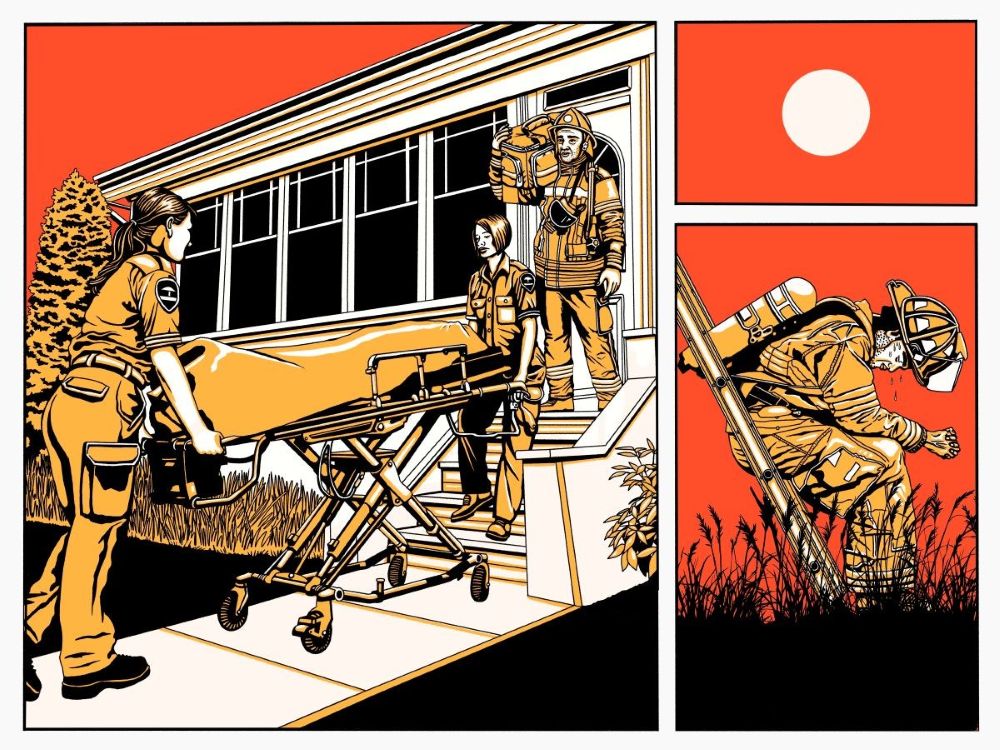
Anonymous is a firefighter in the Lower Mainland, British Columbia, who was on duty when an extreme heat wave hit the region. Their identity is being protected because the media relations policy at their fire department requires interview requests with employees be vetted by public affairs staff. Most public sector employees in Canada are similarly restricted. This is last in a series of first-person accounts of surviving B.C.’s 2021 heat wave created with the Climate Disaster Project at the University of Victoria.
I’m Canadian. We talk about the weather, we look at the weather. I check the weather online, I listen to the radio all the time. It’s part of what I do. I became aware of the heat wave through CBC. In our apartment there’s no air conditioning. The windows are louvered, so they don’t open all the way. We had two or three fans going, but you're just pushing hot air. I don’t know how high the thermostat got because it is only two-digits and it was over 99 Fahrenheit. Candles bent right over in the heat.
I had moved a mattress onto the hallway floor to try and get some relief. Heat rises, right? The elevation makes a little difference. It was only slightly better than the bedroom. I was having a hard time keeping myself cool. That means a lot of things to me as a first responder. If a healthy adult is having a hard time keeping cool, then there are people in a lot of trouble. The people that suffer the most are the young and the old. They’re not able to respond, make decisions for themselves, nor communicate well.
Late at night I got a phone call from a chief asking me to come in. I was supposed to work the next day. They were just calling ahead to see if people could come in early. I was told to report at midnight. As soon as the crew got to work, we went on a live call that had been underway for several hours. There was another unit there and they wanted to change out because they were waiting and waiting for an ambulance. Ambulance is the only way you can get a patient to the hospital in the pre-hospital care system. Your job is to stabilize the patient until the ambulance arrives.
This woman had dementia and was elderly and in pain. She was confused, hot and sick. We were there six or seven hours ’til my actual shift started in the morning. I remember being frustrated by the fact that we had to wait there for hours and not be useful. By the fact that this son would do nothing seemingly to assist his mother, like taking her to the hospital. Patients can transport themselves. Then another crew relieved us. That woman was waiting for an ambulance for 12 hours. Normally, our wait times could be anywhere from simultaneous arrival to, on a good day, 15 minutes.
The next call was a cardiac arrest. This woman was in her 60s. She was on the second floor of her house, lying in a pool of feces on a white carpet. The house was hot. The smell of shit. The heat. The grieving family. It’s a lot. We started CPR right away. Compressions for a maximum of two minutes, then switch out to another person. We were doing CPR for an hour. That’s some serious, physically exhausting work. Then you do that in the heat.
There’s all the grief and fear that you’re trying to collect and hold while all of this is happening. People are asking, “If I’d done this, would the outcome be different? What do you think happened to her?” I can’t answer any of that. I understand why you want to know. I would too, if it was my mother. It’s important for me that I express deep empathy with whatever people are feeling, and to stick to the facts as much as possible: we’re working on your mother. We’re doing everything we can for her. She has no pulse at this time. Ambulance was there at some point helping. She was declared dead and then we left.
I remember another apartment in the East End. An old guy, alcoholic, probably in his 70s, in a sparse, dirty apartment that’s not cool enough. He was emaciated, dehydrated and sick. Unconscious in his bathtub in some weird position, covered in shit. We go to a lot of “code brown” calls. That smells great on a good day, but you take some heat and you can imagine. He was in very bad shape. We were breathing for him. I don’t think he died, but we never know whether people die or not unless they die right in front of us. Sometimes, the chief can ask the ambulance about patients we work on, but it’s often better not to know.
We see clientele impacted by poverty, colonialism, addiction, trauma. Their ability to respond to anything is so limited. I think of the conversations I have daily with people about just the simplest things. Communication about a climate crisis where they need to take action to save themselves is next to impossible.
We went to one call where this couple couldn’t keep their baby cool. Pudgy little baby. Four or six months old. The baby was suffering, but not going to die. I remember patting water on, letting the evaporation cool the baby and making a plan with the parents about keeping cool. You need to get out of this apartment. You need to take your baby to a cooling centre. You need to go somewhere that is not this temperature. You can’t be in this place. Nice apartment, just no air conditioning.
We went to another call where the baby died: a stillborn birth. It was chaos when we got there. It was hot. The layout was crowded, not a lot of air movement, no air conditioning. They had fans going, getting in the way of our equipment and our bodies. I remember the mother was on the bed. The father was there. The midwife was there. It was hard to get information about what had occurred. When was the delivery? Was it two minutes ago, or 10 minutes ago? It’s so important for us to get background right away — very hard if people are not co-operative or they’re in shock and can’t answer questions. Because of the trauma of the death, that communication was not where it would have been if that baby had been alive and in trouble. Everyone was just hopeless.
I remember trying to take the baby and do CPR. The midwife was aggressive. She questioned our professionalism. It’s not fun having your professionalism questioned, but I understand. People behave differently when they’re stressed out. I remember thinking, We do more CPR than you’ve ever done in your life. We’re really good at this shit. But I can’t say that to her because I’m wearing a uniform. She said, “I don’t even want you here. We’re here. I just want infant transport here.” That’s the B.C. ambulance car that specializes in infant care. They did arrive, right behind us. They took the baby.
I feel sadness and anger at the number of people impacted by that event and our inability to provide better care. We had a limited scope of practice medically, coupled with an inability to transport patients to the hospital. Feelings of powerlessness weighed heavily. I’m used to being busy, but to know that every other crew across the city is also busy and our whole organization is stretched to the max is a different feeling. We were also struggling to stay cool. We’d be going into these hot environments and there wasn’t enough relief back in the fire hall. There’s a certain element of discomfort that is just part of the job, we’re getting paid, but at the same time, it was hard on everybody.
Government agencies weren’t prepared. We had never experienced something that destructive. It revealed the problems in the system. We now have a high-demand action plan: how resources are allocated depending on what else is going on until, ultimately, if we’re really strapped, we’re just going to fires. We’ve also got a higher level of medical licence now, equivalent to the basic paramedic licence. We have more ability to act while waiting for ambulance.
That event was a wake-up call for people living on the coast here. I think a lot of us had a feeling that climate change was affecting other people and not us. We think that we’ve got this temperate mid-range climate where it doesn’t get too cold, doesn’t get too warm. Clearly, that’s not quite accurate anymore.
I felt fortunate to work through that time because I really like the work that I do and I enjoy the challenge. I have faith in the people who do the work that I do and I have hope for our ability to respond to changing circumstances. I see the amount of compassion that people have for others, both in my industry and across the city. Hopefully there wouldn’t be as much pain and suffering next time around.
This testimony was co-created by the Climate Disaster Project, a newsroom co-ordinated at the University of Victoria that works with climate-impacted communities to document and investigate their stories. Subscribe to the project’s newsletter here.
Read the five-part series “Surviving BC’s Hottest Summer.” ![[Tyee]](/design-article.thetyee.ca/ui/img/yellowblob.png)

Tyee Commenting Guidelines
Please note that email notifications for replies are not currently working due to a software issue which may be resolved in a future update.
Comments that violate guidelines risk being deleted, and violations may result in a temporary or permanent user ban. Maintain the spirit of good conversation to stay in the discussion and be patient with moderators. Comments are reviewed regularly but not in real time.
Do:
Do not: