



 SHARE:

It was a Friday night in 1991 and Robert and a buddy were sitting in a small Richmond basement suite after work, drinking beer and griping about their lives.
The pair were 21, loved the outdoors and were “pissed off” at how busy and hectic the world around them was. They wanted a new start. The only question was where. So they spread out a map on the living room floor, and Robert closed his eyes and dropped his finger into the middle of British Columbia, near the word “Horsefly.”
Two weeks later, Robert quit his job at a regional equipment supplier and moved north; his friend, who worked at the same place, got a transfer and followed.
On a recent May afternoon, Robert, now in his 50s, sat and nursed a coffee in a Williams Lake Tim Hortons, reflecting about the decades that followed. Even for two outdoorsy guys, Horsefly was a little too small and remote — but the rugged city just to the west was not. Williams Lake turned out to be just what Robert needed, and though it has changed over the years, he says it has retained its charm.
“It’s a small community,” he said. “It's still a town where, if you're driving through in the middle of the night and your car breaks down, somebody will stop and help.”
But that doesn’t mean that living in the region is always easy.
Four months ago, Robert suddenly lost most of his hearing. He found himself searching for answers and trying to navigate a health-care system stretched to its limit. Even now, after some of his hearing has returned, he still doesn’t know if a life-threatening issue like a stroke or a tumour could have been behind the sudden event.
“Am I going to have a full-blown stroke in six months? I kind of need to know,” Robert told The Tyee. At his request, The Tyee is using a pseudonym because he is discussing a personal health condition.
Health worries aren’t unusual in middle-aged people, but they can be particularly worrisome in the B.C. Interior, where, as The Tyee reported on Tuesday, life expectancy in many regions is lower than it was 20 years ago.
Health challenges in the Cariboo-Chilcotin
B.C.’s Cariboo-Chilcotin region has always been a rugged, rough-and-tumble area. At its centre, in a bowl-like valley, sits Williams Lake.
Even today, as B.C.’s timber industry struggles, forestry sits at the centre of the local economy. A half-dozen mills employ hundreds of workers, and the hillsides are dominated by massive piles of logs awaiting processing. The bustling, working-class city of 11,000 is more than a logging town, though. Williams Lake serves as a hub for the region, and the highways out of town climb onto plateaus featuring ranches, fishing lakes, First Nations communities, mines and logging tracts.
While the local economy has shifted away from manufacturing in recent years, it is hardly racked by depression. Indeed, Williams Lake is increasingly viewed as a post-work destination; in 2024, the Globe and Mail named the city the 17th most livable city for retirement.
But life expectancy data obtained by The Tyee suggests that living in the region comes with particular health challenges.
The Cariboo-Chilcotin — the local health area including and around Williams Lake — has one of B.C.’s lowest life expectancies. Perhaps more worrying, newborns are expected to live just 76 years on average — a life expectancy that is shorter today than it was two decades ago.
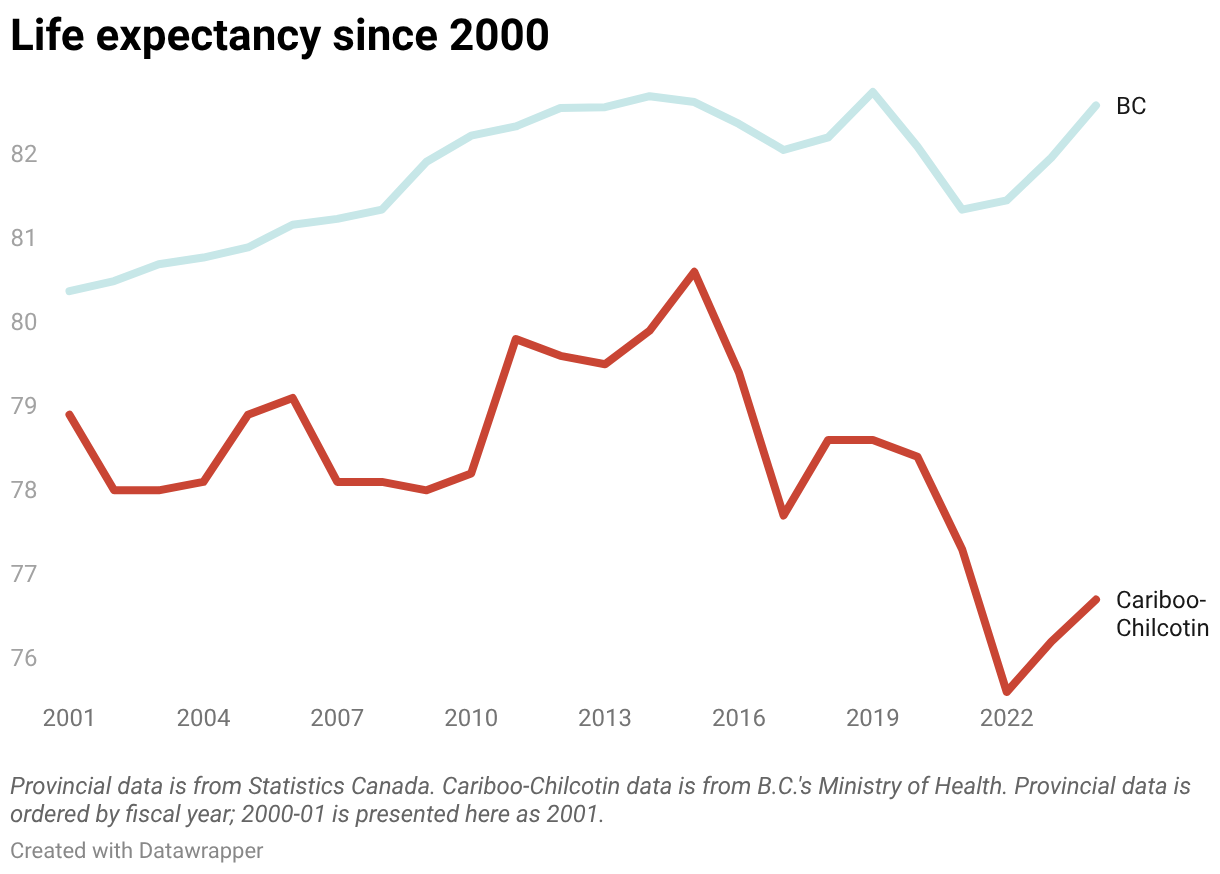
The figures, as The Tyee reported in the first part of this series, are a broad measure of community health and can’t be pinned on any single factor. They reflect the accessibility of health care, community demographics, income and the prevalence of toxic drugs. Many factors are interrelated, but the more issues a community has, the more likely any one resident might encounter one that contributes to a shorter life.
Across B.C., life expectancy plateaued and started to dip around 2020. The local data suggests, however, that the provincial decline was driven by significant downturns in places like the Cariboo-Chilcotin and other regions with high rates of illicit drug overdoses.
“In British Columbia, there’s a very strong consensus that the toxic drug crisis — the public health emergency — has impacted populations at the level that it’s reduced and reversed the life expectancy gains in the province,” Interior Health medical health officer Andy Delli Pizzi told The Tyee.
The Cariboo-Chilcotin has had a relatively high rate of unregulated drug deaths, according to provincial data. But the figures don’t fully account for the region’s declining life expectancies. Other central Interior health regions such as Prince George and Quesnel had more drug deaths, per capita, but a less dramatic drop-off in life expectancy.
Delli Pizzi pointed to a 2024 report outlining the diverging life expectancy gap between Indigenous and non-Indigenous B.C. residents. About 20 per cent of the Cariboo-Chilcotin’s population is First Nations, and health-care challenges in those communities persist.
Down the road, at Williams Lake First Nation
The new office of Williams Lake First Nation is located just a couple of kilometres west of Williams Lake’s downtown. The First Nation has about 1,000 members, and its office is a two-storey, modern building decorated with stunning sculptures of animals made out of metal and other materials. Inside, health director Keira Dolighan spends much of her time trying to figure out how to improve members’ well-being.
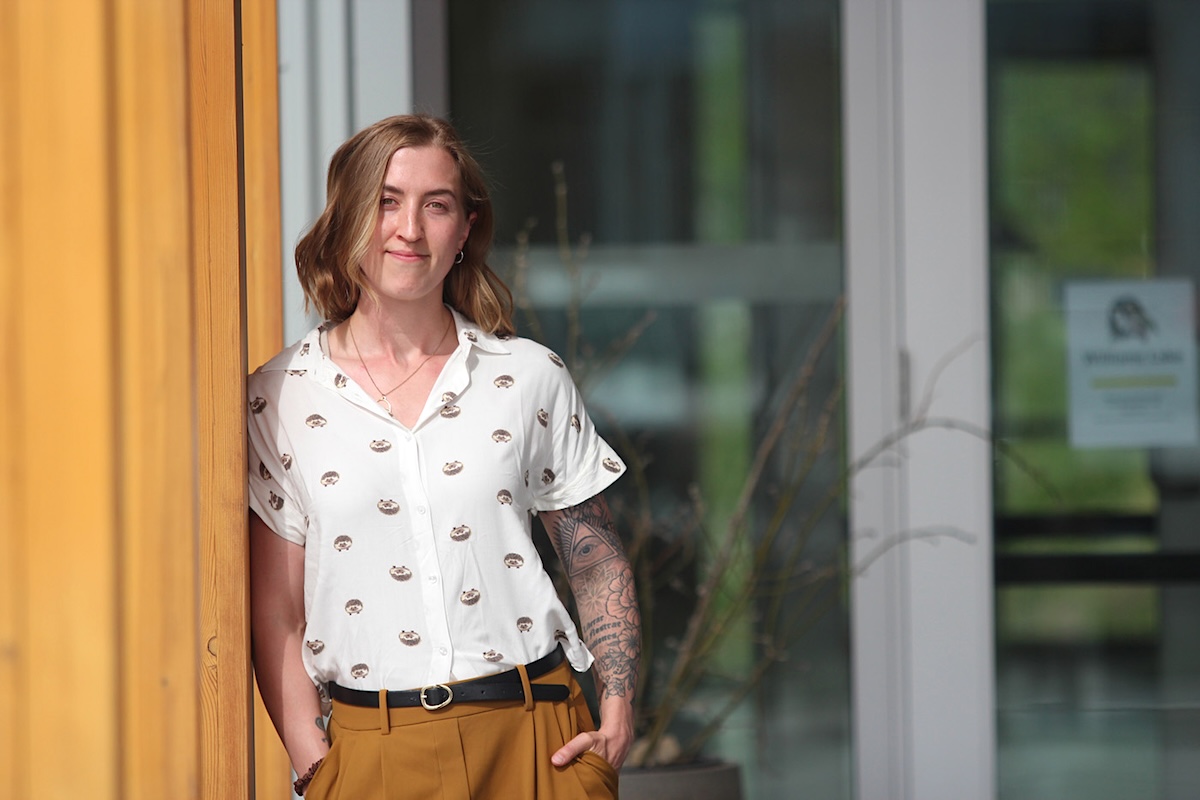
Raised in Williams Lake, though not Indigenous herself, Dolighan left town to attend university to the south, at Thompson Rivers University in Kamloops. After encountering mental health challenges, she went through treatment and emerged wanting to help people who had gone through similar situations.
“I felt very motivated to work with people who are like me, almost like a return of service,” she said, “because I was so grateful to the people who had helped me get through what I had gotten through.”
Trained as a social worker, Dolighan started in the band’s social development department. Today, as health director, she oversees both the social development and health departments. The combined role recognizes the fundamental links between social and health issues.
“We wanted to integrate all those aspects of health and wellness — the social determinants of health and wellness — with the more western definition of health, which is physical health and very ailment focused, diagnosis focused.”
In recent years, the Williams Lake First Nation, like many around the province, has begun to take more of a lead role in direct delivery of services aimed at improving members’ wellness. The First Nation has assumed responsibility for preventive health work, treatment referrals, and mental health and addiction support.
The changes reflect a growing understanding that community health is fundamentally tied to social conditions, and that programs to assist people economically, emotionally and socially are needed to improve residents’ well-being.
“We need to look at the person as a whole,” Dolighan told The Tyee. “We need to look at culture and language, at food access, their home conditions, their social supports, all of the things that truly promote ongoing health and wellness of an individual. Those are left out of the western model of care — it’s like ‘We’ve treated the issue, now away you go.’”
On a practical level, that means trying to remove barriers that prevent people getting the care and help they need. In the Cariboo-Chilcotin, and many rural places, that includes economic challenges but also cultural, historic and physical realities that affect people’s lives.
“Transportation is a huge one,” Dolighan said. “If someone’s needing to get to and from appointments and they don’t feel comfortable relaying health issues to family and friends, we’re kind of the middleman — we can help provide that access.”
Poverty, homelessness and polarizing debates
Increasingly, officials across Canada recognize the importance of addressing the social root causes of poor health, and barriers to getting care.
Katie Matuschewski, Interior Health’s director of clinical operations for rural communities, told The Tyee that she and her colleagues regularly ask themselves, “How can we provide lower-barrier service that is client driven, that looks very unique to everybody's journey?”
Much of that work now involves partnering with and supporting First Nations communities with programs and events aimed at improving wellness, Matuschewski said, pointing to a recent food security forum.
Interior Health, like other B.C. health authorities, now also employs Indigenous patient navigators who offer cultural and emotional support and can help connect patients to Elders and spiritual care. Matuschewski said the navigators facilitate a two-way exchange of information by both helping clients understand the health system and helping health officials understand what can be done to better support patients.
As community health moves beyond simply the application of health care, however, politics and polarizing discussions can arise.
The region’s health challenges are partly linked to poverty and difficulties finding affordable, adequate housing.
Between 2006 and 2021, the population of Williams Lake grew by 200 people but the region shed 500 jobs, many in the forestry, farming and manufacturing sectors. Meanwhile, the cost of housing ballooned, and visible homelessness has increased. As community organizations work to intervene and connect people with shelter and resources, they’ve found themselves facing pushback from residents who link increased homelessness to crime in the city.
The city’s crime severity index, a Statistics Canada measure of the overall level of disorder, has long been twice as high as the British Columbia average. And although the index peaked in 2022 and declined through 2024, the most recent year for which data is available, discussions about crime have dominated much of the local discourse.
Last year, Williams Lake Coun. Scott Nelson asked his colleagues to enact a state of emergency to address “street disorder.” He suggested the city provide one-way bus tickets for people “wreaking havoc” in the city. While some of his colleagues called the ideas reactionary and suggested a review of existing programs and funding sources, the issue made provincial news and has heightened sensitivities among Williams Lake service providers about how the community and at-risk populations are portrayed.
Angelika Sellick, a facilitator of a poverty reduction program called Revive Thrive, moved to Williams Lake a decade ago to start a family. She is adamant that improving community wellness means tackling the root causes of poverty, crime and poor health, and she is proud of the efforts of those trying to do so.
“Lots of seeds are being planted, but seeds often take time to grow,” she said.
The challenges aren’t just local. In May, Kamloops-based Thompson Rivers University announced it was considering closing its Williams Lake campus. TRU’s budget has faced major problems following the restriction of student visas by the federal government. In response, it has looked to slash costs and targeted its Williams Lake outpost.
Sellick and others in the community say the potential loss of the university campus would have impacts far beyond the availability of post-secondary education.
“Education is a pathway out of poverty,” Sellick said.
TRU is also a major local employer, and Sellick compared its potential closure to that of a mill. Revive Thrive was part of a community-wide mobilization to push for the campus to be preserved; a few weeks later, the city and the university signed a deal to develop a post-secondary plan that worked for both public bodies. TRU has since postponed a decision on whether it will sell its campus.
Even as she and neighbours battle to keep the university, Sellick sees progress, pointing to the opening of a new Foundry location with services for youth, increased child-care spots and continued work on the redevelopment of a mall into a new rental housing building. But she says that progress is also subject to resources.
“We've had so much momentum in this area in the past 10 years,” she said. “Change on this scale does not happen overnight.”
“We can have all the good intentions in the world, but unless governments get behind what we're doing and support us, it's very difficult to do the work that needs to be done,” she said.
Meanwhile, at city hall
In a second-floor office at Williams Lake’s municipal hall, the city’s mayor, Surinderpal Rathor, walks behind his desk, pulls a handmade drum off the wall and proudly turns it over to reveal a dagger.
The drum represents local Indigenous culture, and the dagger is a marker of Rathor’s Sikh faith. The items were gifted to Rathor two years ago from Williams Lake First Nation Chief Willie Sellars as a sign of appreciation for his work in developing the relationship between the two local governments together.
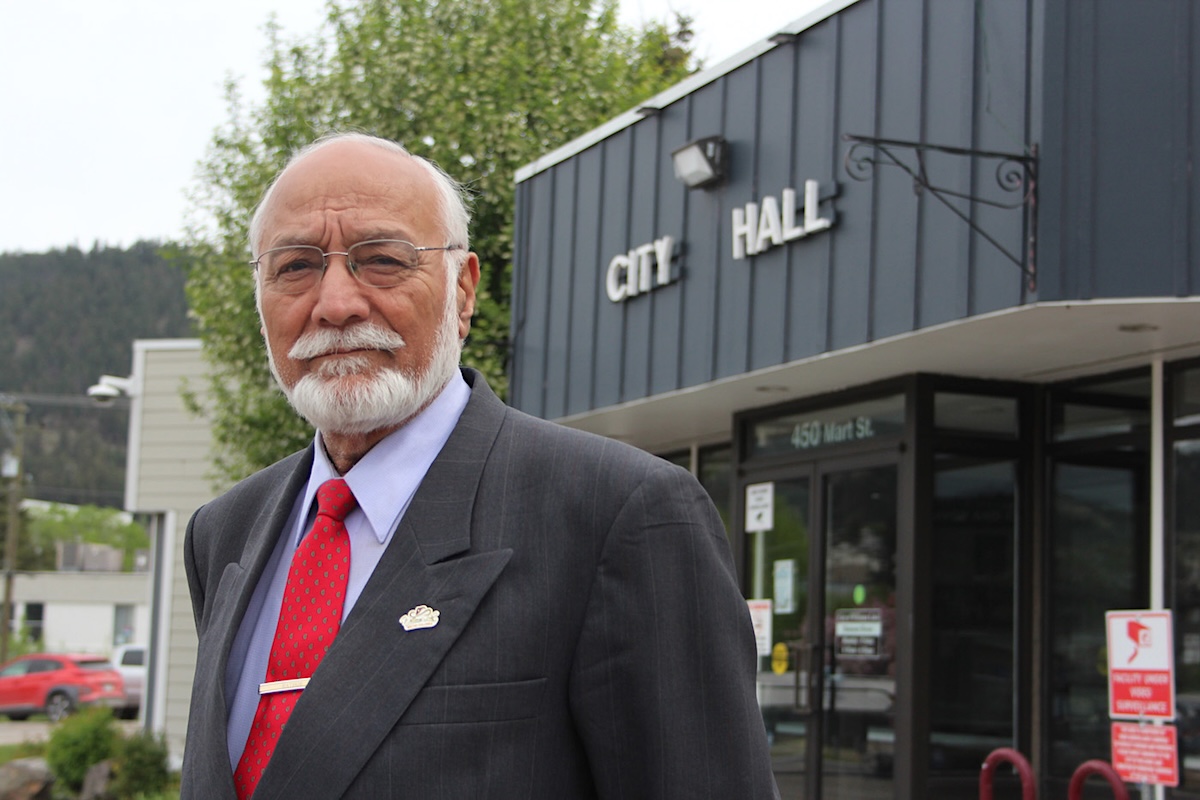
Rathor has his own tale of arriving in Williams Lake. Fifty years ago, he was an army officer seconded to work in Vancouver. With some downtime and a series of happenstance meetings, he ended up in a cab headed north to Williams Lake. One thing turned to another and he stuck around. He sold vacuum cleaners, drove a taxi, freelanced for the newspaper and took photos for a local photography studio. Eventually he got a job at a local mill, trained as an electrician and progressed up the employment ladder.
Rathor sees individual choices playing a major role when it comes to his community’s health.
“The lifestyle needs to be changed,” he says, pointing to higher rates of alcohol consumption and smoking in more rural areas.
But he stresses the need for a broad response to helping people in poor health and preventing smaller issues from becoming big ones.
“When you are not healthy, you need to see the doctors and the medical assistance is not available, what’s going to happen to your body?” he asked.
It’s Rathor’s job to make the case for Williams Lake to the officials in Victoria and Ottawa who control most of the money that pays for Canada’s health care and social programs.
“Every Canadian should be considered equal,” he said. “Regardless if you live in the Cariboo-Chilcotin or you live way up north, it doesn’t matter where you live. Every service should be made available economically to every citizen equally.”
Rathor is adamant that the advocacy is best done with a friendly face.
“Nobody’s ever happy with the money — I don’t think Bill Gates would say ‘I don’t want more money,’” he says. “But I’m very happy that Premier [David] Eby and Ottawa, from time to time, has given me my share. I would love to have more, but they have done pretty good.”
Soon, Williams Lake will see at least one major advancement aimed at helping improve local health.
Just north of city hall, Cariboo Memorial Hospital is in the midst of a large expansion that will nearly double its number of beds, add a new mental health and substance use unit and create a new emergency room. The $367-million project, which has been in the works since 2019, will wrap up in 2029, though a three-storey addition could be finished by the end of this year.
Back at the Tim Hortons
Back at the bustling doughnut shop, Robert finishes his coffee. His hearing has partially recovered in recent months, and he can withstand the din of the surrounding conversation, but just barely.
It has been a decade since his family doctor moved back to South Africa. When he left, the doctor told him that he probably wouldn’t get a new one because he was healthy.
“Now I’m getting a little older, I’m not quite as healthy, and I can’t get a doctor,” he said.
Like thousands of people around B.C., Robert is now on a waiting list. He has been told it will take years to get a family doctor, though some hope may be in the offing. A local doctors group says it has recruited several new physicians to move to town.
The first new clients will be taken from a new provincewide database called the Health Connect Registry, according to Steve Forseth, a local regional district director.
Meanwhile, Robert keeps on keeping on, working at a local mine, tending his acre on the outskirts of town and hoping he may finally get answers about why he suddenly lost his hearing. Life in central B.C. might throw health curveballs at residents, but Robert doesn’t regret closing his eyes and pointing at that map 35 years ago.
“It is a great little town,” he said. “I'd love to see more people come up here and try and continue the community feel that Williams Lake had for me when I got here.”
This story is the second in a series about how life expectancy varies across BC. The first story in the series crunched the numbers on where life expectancy is rising, and where it’s declining, across the province. On Monday, The Tyee will publish a piece on Richmond, which has the highest life expectancy in BC, to glean lessons and examine contributing factors. ![[Tyee]](/design-article.thetyee.ca/ui/img/yellowblob.png)
Read more: Indigenous, Health, Rights + Justice







Tyee Commenting Guidelines
Please note that email notifications for replies are not currently working due to a software issue which may be resolved in a future update.
Comments that violate guidelines risk being deleted, and violations may result in a temporary or permanent user ban. Maintain the spirit of good conversation to stay in the discussion and be patient with moderators. Comments are reviewed regularly but not in real time.
Do:
Do not: