


 SHARE:
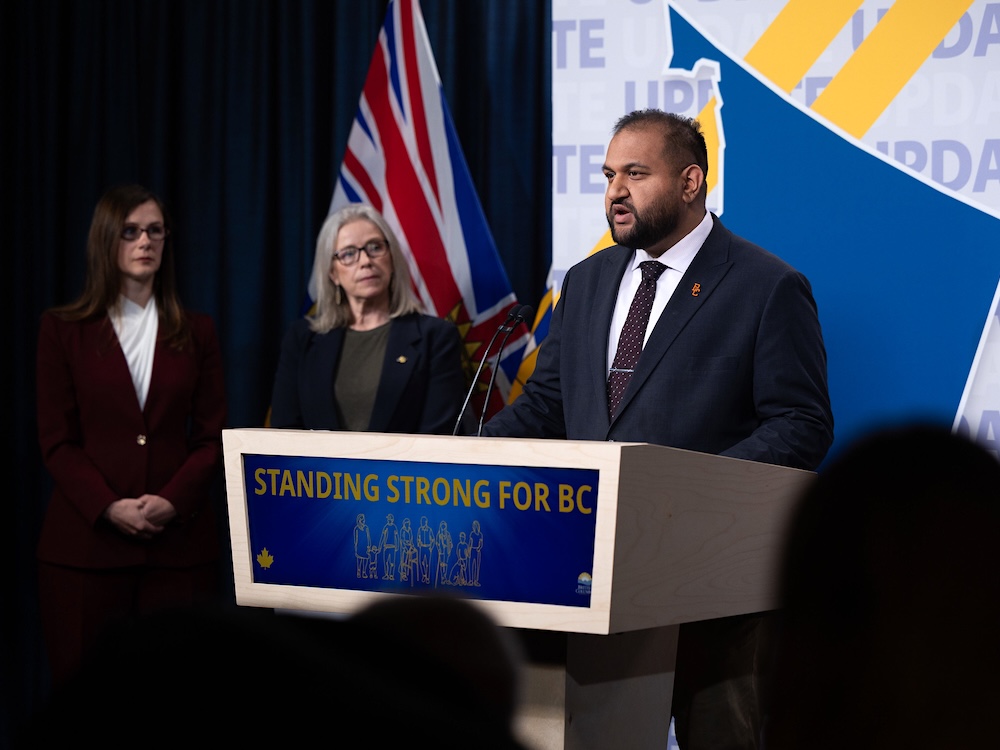
British Columbia Forests Minister Ravi Parmar said that despite already being several years into the process, the provincial government will take its time making changes to the Heritage Conservation Act, or HCA.
“It’s important that we get it right,” Parmar told reporters earlier this month after four industry groups and the Union of BC Municipalities said they wouldn’t sign non-disclosure agreements to participate in the next stage of consultation.
“We’ve been working on this piece of legislation for the last number of years, and again it is a complicated piece of legislation,” he said. “It is probably the most challenging work that I’ve ever done in my time in public office over the last 14 years.”
Calling the existing legislation “archaic,” Parmar said it has become clear to him one thing everyone agrees on is that the current act “is not meeting the interests of British Columbians.”
The act’s purpose is “to encourage and facilitate the protection and conservation of heritage property in British Columbia,” including by setting the rules for designating heritage sites and issuing permits to allow developments.
Referencing issues that have arisen around heritage as the town of Lytton rebuilds after a 2021 wildfire, Parmar said changes are needed.
“There are communities that are going to go through very difficult challenges with wildfires and floods in the years ahead,” he said. “I don’t want any community to face the challenges that Lytton has faced over the course of the last number of years.”
At the same time, it’s been essential that the government work in partnership with First Nations on the changes, Parmar said. “I think it’s really important to recognize that we’re talking about their ancestors. These are very difficult conversations, these are complicated conversations.”
In March the government released a 37-page technical policy paper on the third phase of consultation with First Nations, local governments, stakeholders and the public.
According to the paper, the government hopes to “make permitting faster and easier”; “help people and communities rebuild quicker after disasters such as wildfires and floods”; “protect heritage more effectively, reducing the risk of accidental damage to sacred or other significant sites”; and “strengthen the role of First Nations in decision-making about their own heritage and ancestors, in alignment with the Declaration on the Rights of Indigenous Peoples Act.”
The paper outlined key changes from earlier versions, including removing references to “intangible heritage,” dropping a proposal for “heritage management zones” that would have added regulations near established heritage sites, adding clarity on the scope of agreements with First Nations, and removing language about “consent-seeking” in making permit decisions.
Parmar said the government received detailed feedback in some 80 submissions, including from organizations and individuals involved in major projects like mines, gas or forestry, as well as those building homes or additions.
The Union of BC Municipalities’ four-page submission, signed by president Cori Ramsay, said that while the organization appreciated the steps taken to address some of the concerns raised by local governments, the paper “lacks clarity and detail on key permitting elements that are at the root of construction delays, costs to landowners, and administrative burden.”
The Urban Development Institute, which represents the real estate development industry, took eight pages to outline concerns that included economic uncertainty, implications for private property rights and unresolved issues related to the Declaration on the Rights of Indigenous Peoples Act, or DRIPA. The changes could risk reducing development as builders pursue projects in more stable jurisdictions instead, it said.
The Association for Mineral Exploration, in a submission signed by president and CEO Todd Stone, said the process should be paused until the province makes the reforms to DRIPA that Premier David Eby has said are needed.
“Legislative certainty is the cornerstone of a competitive investment environment,” it said. “A newly reformed HCA enacted atop an unsettled DRIPA framework would fail to deliver that certainty and could materially undermine British Columbia's standing as a destination for mineral exploration capital at a time when global competition for critical minerals investment is intensifying.”
The Independent Contractors and Businesses Association said the government’s direction “creates a framework that is inconsistent with the process certainty and efficiency your government has promised to builders, property owners, and local governments.”
And the Mining Association of BC’s president and CEO, Michael Goehring, offered detailed comments on 11 aspects of the policy paper and observed, “The HCA is a source of considerable time delay and frustration for advanced mine development companies and operators.”
Nuu-chah-nulth Tribal Council president Judith Sayers, Cloy-e-iis, has been involved in the process to rewrite the HCA since the start. In an opinion piece for The Tyee, she argued that the government should ignore the noise and move ahead with new legislation in the fall as planned.
“The groups are playing politics with this process in order to claim a greater role at the expense of other stakeholders,” she wrote, noting that they are each working to advance the special interests of their members. “Their refusal to sign NDAs stops any further involvement by them in the process. They likely think the government will bow down to them and stop the process.”
Parmar said that as minister it’s his job to bring everyone together and he has been meeting with all of the groups that have refused to sign non-disclosure agreements, with the exception of the Independent Contractors and Businesses Association, which his office has not reached out to.
The next stage is to share a three-column document, which would lay out side by side the current legislation, the proposed amendments and the final text. It’s a cabinet document that needs to be kept in confidence, he said, which is why the government is seeking NDAs.
The government is committed to updating the legislation, Parmar said, citing the $80 billion in major projects proposed for the province. “I can’t have the Heritage Conservation Act get in the way.”
At the same time, he declined to reiterate a previous commitment to introduce the new act during the fall session of the legislature. “We have to get this right.” ![[Tyee]](/design-article.thetyee.ca/ui/img/yellowblob.png)
Read more: Indigenous, BC Politics










Tyee Commenting Guidelines
Please note that email notifications for replies are not currently working due to a software issue which may be resolved in a future update.
Comments that violate guidelines risk being deleted, and violations may result in a temporary or permanent user ban. Maintain the spirit of good conversation to stay in the discussion and be patient with moderators. Comments are reviewed regularly but not in real time.
Do:
Do not: