


 SHARE:
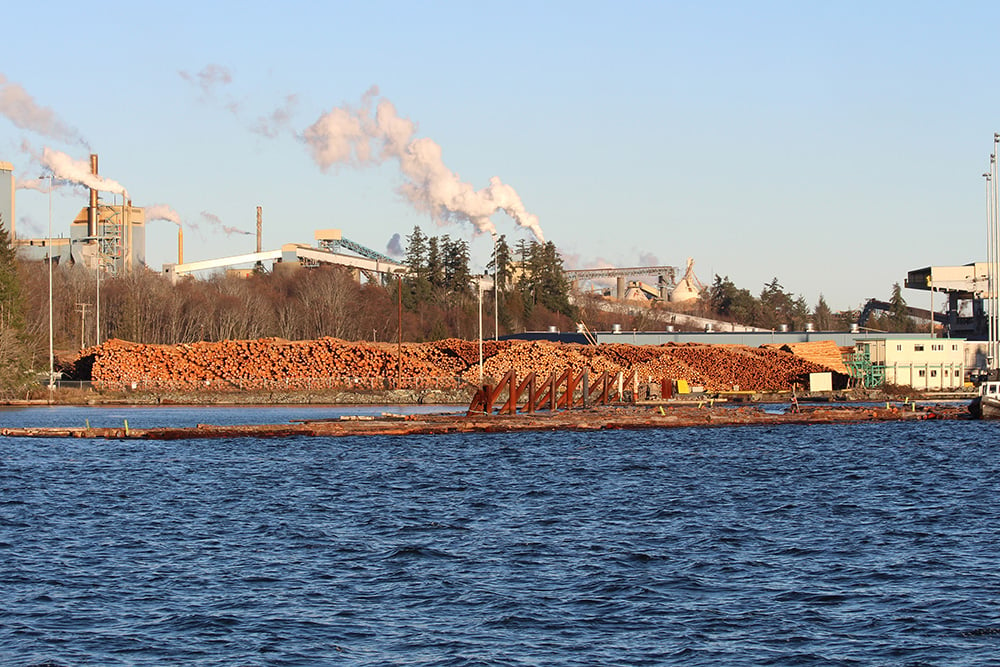
As pulp mill and sawmill jobs plummet in number, British Columbia’s Forests Ministry is opening the door to more exports of unprocessed logs, including those produced from trees cut down in old-growth forests.
Under current rules, companies wanting to ship raw logs from B.C. to buyers in China, Japan, Korea and elsewhere pay a “fee in lieu of manufacturing” — a penalty designed to encourage more domestic log manufacturing.
But in February, the provincial government quietly lowered those fees. The reduced fees will make it more profitable to ship logs away, and although the government says it will incentivize more logging, others warn that the change risks undermining already precarious manufacturing jobs in the province’s struggling forest industry.
Lower export fees
Under the old rules, companies exporting hemlock, balsam and spruce logs paid a penalty that ranged from 10 to 35 per cent of domestic log prices. The revised rules will knock the in-lieu-of-manufacturing fee down to a flat 10 per cent.
More-valuable Douglas fir logs will continue to be assessed a fee of 15 per cent of the value, while cedar logs for the most part will be forbidden from export.
The Ministry of Forests confirmed in an email that the new fee structure lowers what would-be exporters will pay the province when raw, unprocessed logs are shipped from B.C.
Arnold Bercov, a former worker at the Harmac pulp mill north of Crofton and former president of the Pulp, Paper and Woodworkers of Canada, warns that the move will hurt B.C.’s forestry sector.
Bercov played a pivotal role in saving hundreds of jobs at the Harmac pulp mill in Nanaimo in 2008 when he and other workers bought an ownership stake in the mill, which had filed for bankruptcy, preventing its permanent closure.
He said the Harmac mill would not have made it through that trying period without the firm supply agreements that ensured wood chips continued to be delivered to the mill.
While Harmac survived thanks to its workers, Bercov watched as numerous other mills closed and log exports increased from 2.6 million cubic metres in 2008 to a high of 6.3 million cubic metres in 2016 under BC Liberal governments led by premiers Gordon Campbell and Christy Clark. In response, he and other union members banded together with environmental organizations to stage protest marches calling for a complete ban on log exports.
A year and a half after he became premier in 2017, John Horgan and the NDP government announced that they would make it less financially attractive for companies to export logs from the province. Log exports then began to decline. In Hogan’s first full year as premier, exports stood at 5.1 million cubic metres. Two years later, the number had been essentially halved.
Still, exports have remained stubbornly high. Last year, one of every five trees logged in coastal B.C. left the province without being processed. Now the government could be setting the stage for increased log exports ahead by reducing the cost to send them abroad.
“I can honestly say — and I never thought I would say it — they are worse than Clark and Campbell,” Bercov told The Tyee. “They’re making it easier to export.... It’s a betrayal of everyone working in the forest.”
In an emailed response to questions from The Tyee, the Ministry of Forests said that log exports from B.C. have declined significantly over the past decade, particularly on Crown forest lands, with a 70 per cent reduction in exports since 2017.
In explaining why changes have been made to make it more financially attractive to export logs, the ministry said the objective is to “increase logging, which will increase the supply of preferred log species for domestic mills.”
The ministry did not elaborate on why it is necessary to increase logging rates, but Forests Minister Ravi Parmar was directed in his initial 2025 mandate letter from Premier David Eby to push logging rates beyond current levels, with Eby calling on Parmar to aim to log 45 million cubic metres per year.
The ‘surplus’ log question
The ministry said the fees will apply only to logs deemed to be “surplus” to domestic needs.
To meet the surplus test, would-be log exporters must first advertise logs for sale to domestic buyers, and only after no domestic buyers step forward can the logs be exported.
The ministry said that in the most recent fiscal year, which concluded at the end of March, the government collected $9.7 million in fees.
But Bercov said the government’s surplus test is “a trap.”
“The more logs you export, the more mills that shut down,” he said. “And the more mills that shut down, the more exports you have.”
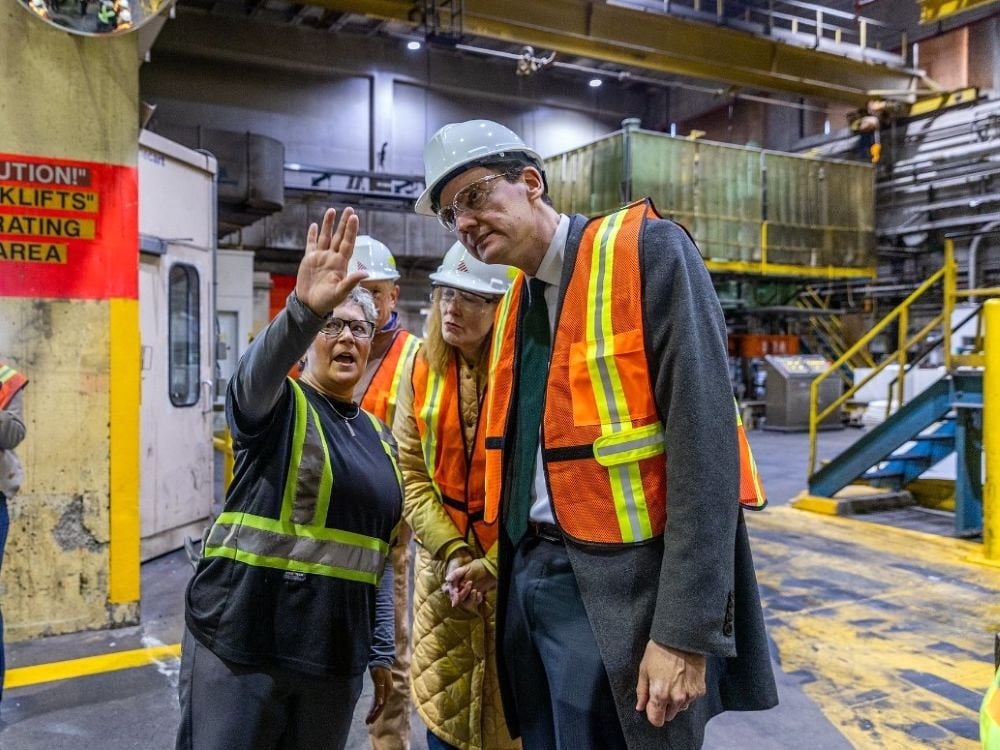
Without a full-scale ban on all log exports, Bercov said, more mill closures are certain.
A Tyee examination of both provincial export data and provincial logging data shows that log exports have, indeed, fallen dramatically since 2017, when more than six million cubic metres of raw, unprocessed logs left the province.
Almost all of those logs originated from public and private forest lands on the coast, with exports from the province’s vast interior being negligible.
In 2025, the most recent year for which there are records, exports stood at 2.45 million cubic metres, an overall decline of 59 per cent since 2017.
During the same time frame, overall logging rates also fell dramatically. In 2017, nearly 19 million cubic metres of trees were felled in B.C.’s coastal forests, many of which were irreplaceable old-growth trees of exceedingly high commercial value. By the end of 2025, logging rates on the coast had plummeted to 11.2 million cubic metres, a decline of 41 per cent.
But the figures show a sizable proportion of all the trees cut down in B.C.’s coastal forests continue to leave the province to be processed overseas.
As of last year, more than 20 per cent of trees logged in coastal B.C. were exported. The percentage has declined significantly from 2017, when nearly one-third of logged trees were exported, but the question now is whether the lowering of the penalty fees will see export numbers climb once again — and where those trees might come from.
Although a government-appointed panel identified 2.6 million hectares of old-growth forest with high biodiversity values where logging should be deferred, the province has since approved logging in some of those proposed areas. They include the Tsitika Valley on north Vancouver Island.
Not only may those old-growth trees soon be logged in the Tsitika, but biologist Rachel Holt, who served on the government’s Old Growth Technical Advisory Panel, told The Tyee it is highly likely those trees will fall “just so they can be exported from the province.”
Holt said future exported trees could easily come from the Tsitika watershed.
“That Tsitika block is 93 per cent hemlock/balsam and only seven per cent cypress or yellow cedar,” Holt said. “That comes straight from the timber sale licence. Effectively, it's all eligible for export at the reduced rate.”
She questions whether the logging in the Tsitika’s remaining old-growth forests would be economically viable were it not for the government’s decision to reduce the penalties on exported logs.
“We’re logging the best that’s left while also encouraging raw log exports,” Holt said.
Holt noted that it was only a few years ago that Eby was talking about the need to transition away from logging old-growth trees and to shift the forest industry’s focus from maximizing the number of trees logged to getting more value from each one of them.
But in his mandate letter to Parmar, Eby pushed for logging increases.
Holt said the drive for volume means the industry is pushing into the ecological and economic “guts and feathers” — remnant old-growth forests that once gone will not be seen again.
“We’re doubling down on timber volume with the change in the minister’s mandate,” Holt said. “We’re not promoting a long-term sustainable industry. We’re just propping up very short-term logging jobs.”
Increasing calls for a log export ban
In mid-April, members of North Cowichan’s municipal council debated a motion calling on the provincial and federal governments to review and strengthen policies governing raw log exports from both public and private forests on Vancouver Island. The motion was defeated after council heard from concerned parties, with four of seven council members voting to oppose the motion. But the debate highlighted the increasing precariousness of forestry jobs on the Island and highlighted concerns about the industry’s economic underpinning.
Underscoring that precariousness, 350 workers at the Crofton pulp mill on southern Vancouver Island lost their jobs in December. Just steps away from the mill, raw logs continue to be shipped from one of the province’s busiest log export terminals. With the closure of the Crofton pulp mill and the shuttering of the Chemainus sawmill, which has not operated for most of the year, North Cowichan is down 500 high-paying jobs.
In a letter to North Cowichan council in advance of the raw log vote, Coastland Wood Industries president Doug Pauze said that many companies on Vancouver Island would not be in business if it were not for log exports.
“If access to export markets is restricted or weakened, harvesting quickly becomes uneconomic,” Pauze warned. “When that happens, contractors leave the industry, harvest volumes decline, and fewer logs reach domestic mills. In practice, restricting exports would not increase fibre availability or protect jobs — it would reduce both.”
Others told council that the biggest problem on the coast is not exports but the dramatic overall decline in logging rates, which some attributed to the provincial government’s failure to issue logging permits fast enough.
But Bercov told The Tyee that he believes the closure of the Crofton mill may be partly behind the government’s decision to relax the export rules.
He noted that with so many coastal sawmills already closed, pulp mills like Crofton were forced to buy more wood fibre produced from the chipping of whole logs.
With Crofton now closed, hundreds of thousands of logs each year are no longer being chipped to make pulp and companies may be looking to export those logs instead — something Bercov fears will further reduce the prospect of new mills being built.
“We have the best fibre in the world,” Bercov told North Cowichan’s council members. “Let’s stop treating a priceless resource like a 7-Eleven store.” ![[Tyee]](/design-article.thetyee.ca/ui/img/yellowblob.png)
Read more: Labour + Industry, BC Politics, Environment








Tyee Commenting Guidelines
Please note that email notifications for replies are not currently working due to a software issue which may be resolved in a future update.
Comments that violate guidelines risk being deleted, and violations may result in a temporary or permanent user ban. Maintain the spirit of good conversation to stay in the discussion and be patient with moderators. Comments are reviewed regularly but not in real time.
Do:
Do not: