


 SHARE:
A B.C. Supreme Court justice ordered contractor J. Cote & Son Excavating to pay $575,000 Monday after ruling the company’s criminal negligence caused the death of one employee and injured another.
The sentence comes more than 13 years after the employees were crushed while replacing a Burnaby storm sewer.
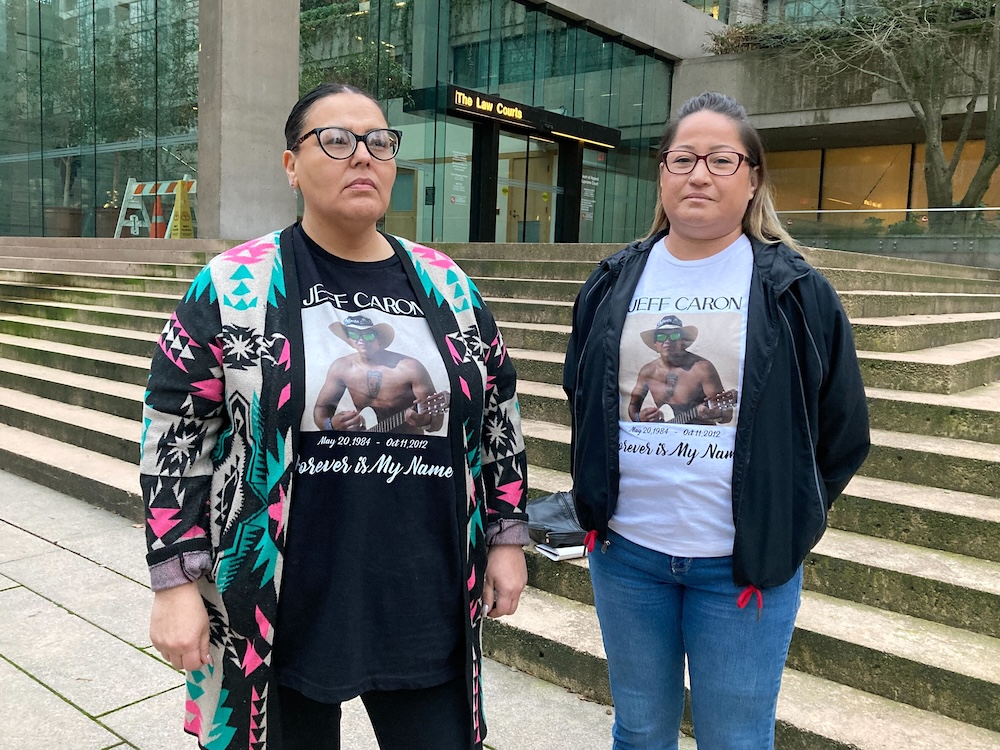
On Oct. 11, 2012, pipe layers Thomas Richer and Jeff Caron were working in a newly excavated trench when a nearby retaining wall collapsed on them. It crushed Caron to death and seriously injured Richer.
The construction company was found guilty of one count each of criminal negligence causing bodily harm and criminal negligence causing death.
On Wednesday Justice Michael Brundrett ordered the company to pay $100,000 on the first count and $400,000 on the second, plus a 15 per cent surcharge that funds victim services.
The $575,000 penalty falls far short of the $1-million fine prosecutors had called for.
Caron’s sister Cheyanna Kamahkoostayo said the penalty was inadequate.
“I’m upset,” she said, while she wiped away a tear outside the courtroom. “He’s been swept under the rug again.”
Company president Jamie Cote declined to comment.
University of Regina occupational safety professor Sean Tucker said the fine was a significant penalty and is being closely watched by prosecutors and companies across Canada.
Still, he said, the rarity of such convictions hints at the larger issue — that hundreds of Canadians die in workplace incidents each year despite the deterrence of court-ordered penalties.
“The system just isn’t working,” he said after a sentencing hearing last month. “We still have more work to do. This case is a part of it, but we still have more work.”
Sussanne Skidmore, president of the BC Federation of Labour, said in an email to The Tyee that while it’s good to see a significant fine, the case underlines how rarely negligent employers face criminal prosecution.
“We hope it sends a message: workplace deaths are preventable, and employers need to live up to their crucial responsibility to prevent deaths and injuries,” Skidmore said. “There are far too many instances where employers face little or no accountability, while workers pay a terrible price.”
The maximum penalty for an individual convicted of criminal negligence causing death is life imprisonment. But for a corporation, the maximum penalty is a fine up to the court’s discretion.
In 2016, a B.C. court charged Stave Lake Quarries with criminal negligence causing death and fined the employer $100,000 after employee Kelsey Anne Kristian died on her second day on the job.
A year later, northern Ontario mining company Detour Gold was fined $1.4 million, after it admitted millwright Denis Millette’s cyanide poisoning death was linked to criminal negligence at the mine.
The J. Cote criminal case is the result of amendments to the Criminal Code made in 2004, after 26 miners were killed in an explosion at the Westray coal mine in Nova Scotia in 1992.
Commonly called the “Westray amendments,” the change means courts can hold a company responsible for the actions of its senior officers.
“The promise of Westray was justice and accountability for criminal negligence by companies,” Tucker said. “With this case, we’re reminded again that the promise of Westray has still not been realized.”
That’s partly because only a fraction of workplace deaths are investigated for criminal negligence, Tucker said.
United Steelworkers found in a report last spring that between 2004 and April 2025 there have been only 12 successful prosecutions under the Westray amendments — not counting the J. Cote & Son Excavating case.
Meanwhile, the report estimates that 900 to 1,000 people die each year from work-related injury or illness in Canada.
Approximately one-third of those deaths are from traumatic workplace incidents, according to Tucker, who analyzes workplace death statistics annually.
“The fact of the matter is, in many more cases [companies] have equal level of culpability or more than what we’re hearing about in this case,” Tucker said. “I would expect we'd have hundreds of criminal prosecutions for workplace serious injuries and fatalities, easily.”
United Steelworkers’ report attributes the low number of prosecutions to governments cutting red tape, a lack of communication between safety regulators and police and a tendency by law enforcement to not investigate workplace deaths.
“The consequences and criminal significance of serious workplace injuries and fatalities have not penetrated the consciousness of police, Crown attorneys and provincial health and safety regulators,” the United Steelworkers report said.
“There is a prevalent belief that serious workplace injuries and deaths are matters for provincial regulatory response and not criminal sanction.” ![[Tyee]](/design-article.thetyee.ca/ui/img/yellowblob.png)
Read more: Rights + Justice, Labour + Industry










Tyee Commenting Guidelines
Please note that email notifications for replies are not currently working due to a software issue which may be resolved in a future update.
Comments that violate guidelines risk being deleted, and violations may result in a temporary or permanent user ban. Maintain the spirit of good conversation to stay in the discussion and be patient with moderators. Comments are reviewed regularly but not in real time.
Do:
Do not: