

 SHARE:
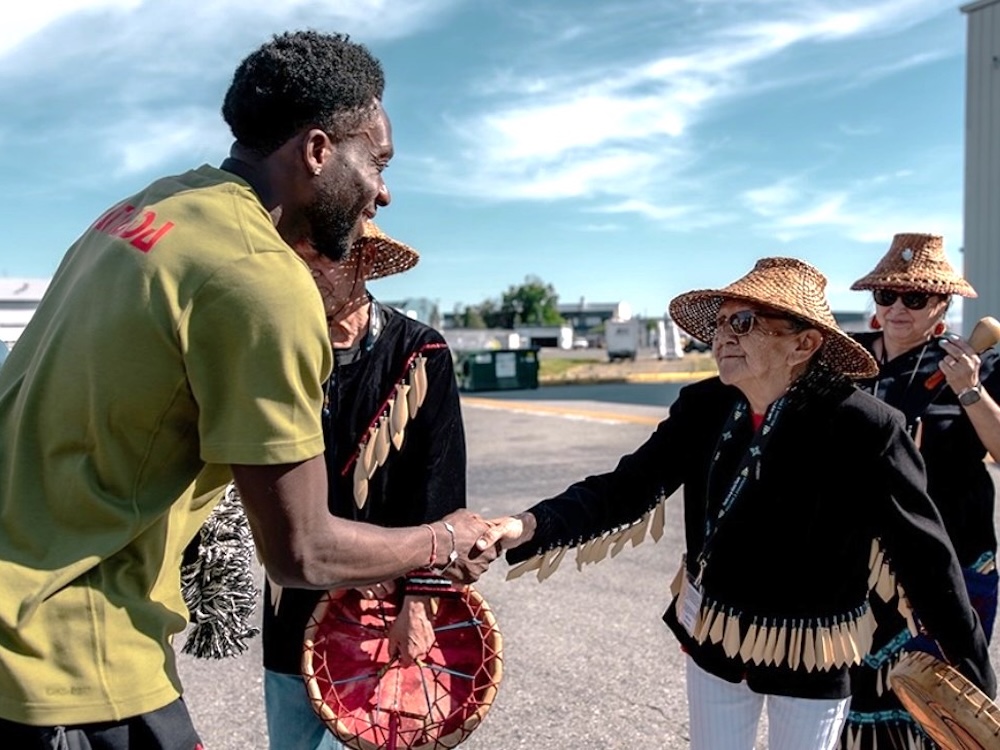
During the 2026 FIFA World Cup matches in Toronto and Vancouver, Canada showcased Indigenous cultures to a global audience.
An opening ceremony to mark the first day of the World Cup in Canada at Toronto Stadium on June 12 featured Indigenous dancers in traditional regalia. Peguis First Nation singer-songwriter William Prince offered a land acknowledgment to recognize the matches were taking place on Indigenous territories.
When soccer teams arrived at Vancouver International Airport for their matches at BC Place, they were often greeted by members of the Musqueam, Tsleil-Waututh and Squamish nations, who were designated co-hosts of the World Cup in Vancouver.
But some Indigenous scholars and rights advocates argue that Indigenous presence at the World Cup presented an image of reconciliation at odds with the realities many Indigenous communities continue to face.
Inclusion or branding?
“It looks to me like an updated version of a 19th-century exposition.”
That is how Carmen Robertson, a Lakota-Scottish Indigenous scholar, saw the presentation of Indigenous Peoples during the World Cup opening ceremony at Toronto Stadium.
She describes the spectacle as an example of how “representations of Indigenous Peoples continue to serve colonial purposes.”
Robertson examined the media’s portrayal of Indigenous Peoples in Seeing Red: A History of Natives in Canadian Newspapers, a 2011 book she co-authored.
She said the 2026 World Cup applies a familiar “colonial playbook,” a modern version of “a roadmap established in the mid-20th century for how colonial nations represent Indigenous populations.”
“They say, ‘Yes, you’re included. But we need you to dress up in traditional regalia.’ What viewers end up seeing is a ‘frozen in time’ or ‘stuck in the past’ version,” Robertson said.
The tournament provided several examples of this approach.
Indigenous Tourism BC released a welcome video featuring members of the Musqueam, Squamish and Tsleil-Waututh nations. Meanwhile Canadian officials commissioned Jamin Zuroski, an artist with ’Na̱mǥis First Nation ancestry, to design Vancouver's official host city poster.
For Robertson, these initiatives illustrate how the “colonial playbook” continues to operate. “It’s subtle today, obviously, but at the same time, it’s being reproduced at these international or global stages.”
This global visibility, however, masks a deeper debate over whether symbolic recognition translates to real political power.
Sanjana P. Rahman, a researcher in comparative politics at York University, sees these initiatives less as substantive inclusion than what she describes as “branding” and an effort to present Canada as a fully inclusive country.
“This inclusion of Indigenous Peoples, not just in the opening ceremony, but also through the portrayal of their art and festivals, or the Indigenous language welcome, functions more as branding rather than a governing principle,” she explained.
For Rahman, meaningful inclusion requires fundamental shifts in state decision-making structures, an evolution she suggests is missing from Canada’s World Cup strategy.
“Sure, Indigenous cultures have been televised on the international stage during the opening ceremony, but does either involvement or visibility necessarily amount to meaningful inclusion? I would say it doesn’t,” she said.
Looking more broadly at Canada’s approach to inclusion, Rahman describes these efforts as an “illusion.”
“These are a part of the broader trend of this illusion of inclusion on the part of host countries and FIFA; this illusion of Canada being a multicultural country, and being inclusive of people of different cultures,” she said.
A host of contradictions
The contrast between symbolic inclusion and the systemic crises facing Indigenous Peoples came into focus two weeks before the World Cup opening ceremony, when an international human rights body investigated Canada’s treatment of Indigenous Peoples.
On May 29, the Permanent Peoples’ Tribunal, an independent global forum founded in 1979 to examine human rights abuses, concluded that Canada’s current policies constitute an ongoing genocide against Indigenous Peoples.
“Canada's responsibility towards its Indigenous Peoples for genocide and crimes against humanity is not only historic but also contemporary and continuing,” the tribunal declared.
Lynn Gehl, an Algonquin author, artist and advocate, agrees with the tribunal’s conclusion.
“It is a genocide, and it was also mentioned in the Missing and Murdered Indigenous Women and Girls legal analysis on genocide, but I think many avoid speaking about it because they think by saying this, Indigenous Peoples will lose hope about their situation,” she said, referring to the landmark 2019 report that concluded Canada's treatment of Indigenous women and girls amounted to genocide.
Pointing to the living conditions in many Indigenous communities in Canada, including the lack of basic services and high suicide rates, Gehl said official claims that Indigenous Peoples were equal partners in hosting the World Cup ignore many of their material realities.
Some First Nations leaders, particularly those part of nations that co-hosted the World Cup in Vancouver, expressed support for how events played out.
The Tsleil-Waututh Nation shared excitement about the festivities in a special countdown post on their website in March.
In a June 2026 interview with CBC’s Wawmeesh Hamilton, Squamish Nation council chair Wilson Williams expressed pride for his nation’s involvement with Vancouver’s World Cup preparations “right from the start.” At the same time, he added, “We were kind of, I felt, invited at the last minute, to be honest.”
Hamilton asked Williams how he wanted Squamish culture to be involved in World Cup proceedings in a meaningful way. Williams responded by noting that his nation aimed to move beyond a tokenistic presence at the World Cup.
“We want to share our story, the pinnacle of it, where people [come away] saying ‘Hey, I know the Squamish people, I want to come back and visit, I want to learn more about their territory and history,’” Williams told Hamilton. “We will be hosting with our arms up and open to guests to share our culture, share performances.”
For her part, Algonquin author Gehl did not criticize them for their decisions, but said Indigenous leaders often have little choice but to operate within the political and economic systems imposed upon them.
“I can’t blame the Chiefs. They want to serve their First Nations, they want to take care of their people,” she said. “Today, human culture has been conflated with the economic paradigm; the Chiefs also need to enter that paradigm.”
Projecting an ethical image, avoiding real action
The 2026 World Cup is part of a broader pattern of what critics call “Indigenous-washing,” or “red-washing.” Those terms describe the practice of institutions, corporations and government entities showcasing Indigenous symbols and cultures in highly visible ways.
Critics say they have the effect of allowing governments and corporate institutions to project an ethical image while avoiding substantive action on Indigenous rights.
Riley Yesno, an Anishinaabe rights advocate and writer, said “red-washing” allows governments and businesses to bypass the systemic changes that Indigenous communities are calling for.
She said public recognitions, including FIFA’s pledge to recognize “truth, reconciliation and Indigenous engagement in Canada,” hold little weight without concrete accountability.
“I don't know what that means,” Yesno said about FIFA’s statement. “I don’t care if you recognize it so long as you do not use your power and institutional leverage to do what is beneficial for Indigenous communities.”
For Yesno, recognition should not be treated as the achievement itself, but as a starting point for meaningful engagement.
She compared the World Cup’s representation of Indigenous Peoples to the land acknowledgments shared frequently in Canada.
She describes those moments this way: “Institutions say, ‘We recognize these territories belong to Indigenous Peoples, but we’re also not going to give them back.’” ![[Tyee]](/design-article.thetyee.ca/ui/img/yellowblob.png)
Read more: Indigenous, Rights + Justice, Sports










Tyee Commenting Guidelines
Please note that email notifications for replies are not currently working due to a software issue which may be resolved in a future update.
Comments that violate guidelines risk being deleted, and violations may result in a temporary or permanent user ban. Maintain the spirit of good conversation to stay in the discussion and be patient with moderators. Comments are reviewed regularly but not in real time.
Do:
Do not: