


 SHARE:
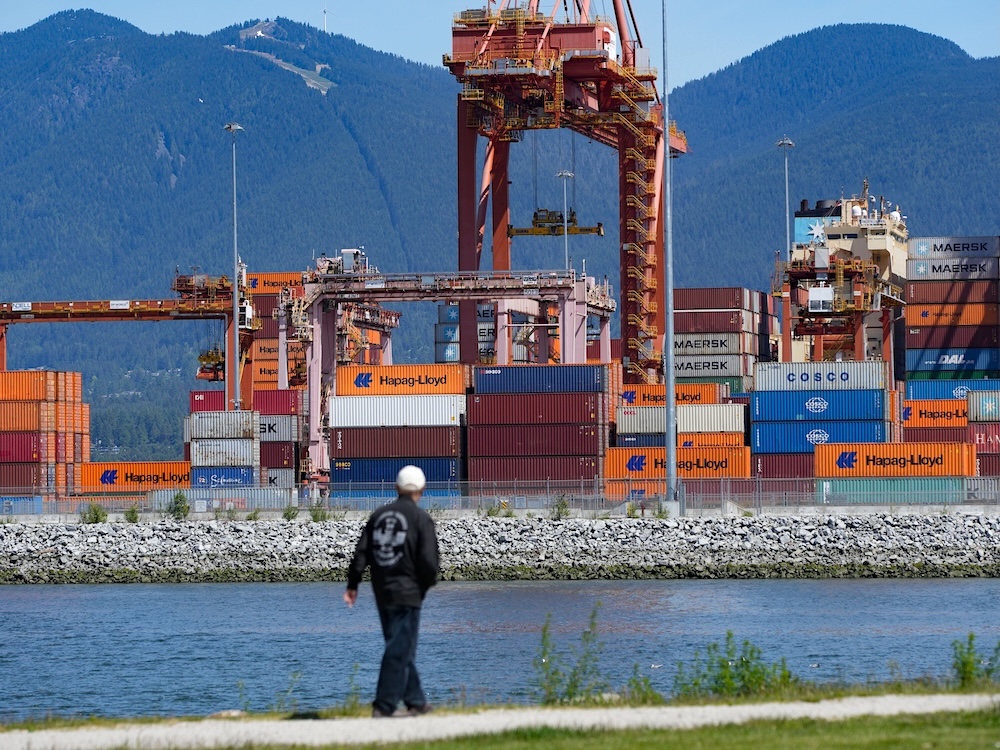
Nearly every week for more than eight years, longshoreman Veetesh Rup has looked over the mess of dates and rates that make up each pay stub.
Rup, formerly an accountant, is one of Vancouver’s approximately 1,200 “casual board” longshore workers, who are hired as needed to fill in shifts each week.
That means his pay stubs are often irregular, complicated and difficult to double-check for mistakes like missed overtime.
“Because it's such a complex pay structure, companies often will make mistakes,” Rup said. “So as a worker, if you're not tracking that, then you know the employer is not going to notice.”
Rup used artificial intelligence to create PortPal — a free app designed to help dockworkers keep track of complicated shift schedules and pay rates.
The app isn’t perfect, he said. And there have been some hiccups — after Rup partnered with his cousin to pay $14,000 to advertise the app on a billboard near Vancouver’s port, the BC Maritime Employers Association complained about the wording of the ad, and the billboard company removed it.
Still, Rup hopes his app can help Canada’s more than 8,000 dockworkers make sure they’re able to catch payroll errors.
The app promises to empower shift workers to fight back against wage theft — but only if it’s credible, said Kendra Strauss, a labour studies professor at Simon Fraser University.
“It's a really innovative approach from somebody who has the skills and experience to notice those errors when other people might not,” she said.
The BC Maritime Employers Association did not respond to repeated requests for comment.
Before starting as a longshoreman at the port, Veetesh Rup worked as a chartered professional accountant for three years before quitting in 2016.
“There was just not enough problem solving,” Rup said. “I wouldn't say being a longshoreman was the answer to that, but it was a good transition for me to do something that made decent money.”
Rup said he found work at the ports more rewarding. He and other casual board dockworkers are managed by the BC Maritime Employers Association and the International Longshore and Warehouse Union, but are not full members of the union.
Part of being a casual board worker means showing up to “plug in” to a wide range of shifts as needed across the ports.
Workers operate on three different shifts — day, night and graveyard — which offer different rates of pay. They are asked to do a range of jobs, which also have their own unique rates. And workers bring a variety of experience and training to the job, which also affects their pay.
There are approximately 300 different combinations a casual board longshore worker could be asked to work on any given day before even considering overtime, Rup estimates.
“When you get your pay stub a week later, you're just seeing a bunch of numbers and dates, and you don't really know if the pay rate or the hours are accurate,” he said.
He added that while he believes the employer aims to pay workers in good faith, managers can slip up. For example, some might forget to approve overtime after a longshore worker agrees to work through lunch.
At first, Rup started tracking his own hours on his phone’s Notes app. Then, he tried tracking his own hours in Excel.
“Pay tracking sucks,” he said. “It was never just that accurate.”
But Rup realized there might be a better way. He saw his friends using generative artificial intelligence to create simple apps and started experimenting with the tools to build something he could use.
By January 2025, he had created a prototype of an app that would help him independently track his hours — PortPal.
“It was a really crappy, ugly version then,” he said. “But I just gave it to some friends, and it grew from there.”
More than a year later, Rup has refined the app. It’s still free to use. Once users log in, the app lands on a dashboard with a worker’s pay to date per week and per year.
It gives users a digital form, letting them enter which shift they worked and at what pay rate. Once each shift is logged, the app displays a day-by-day breakdown of which shifts they have worked and at what pay rates.
Rup said he’s used the app himself to catch payroll errors — which he said the employer quickly resolved without a hassle. According to Rup, his friends and colleagues at the port have used the app to track more than 80,000 shifts.
Non-payment of wages — often called wage theft — is a persistent issue across the province, according to labour researcher Strauss.
“We know that it's pretty pervasive across industries,” Strauss said. “So I think that this is a response to the widespread issue.”
A 2017 report by research group BC Employment Standards Coalition found wage theft was the most common issue reported by B.C. workers.
Nearly a decade later, Strauss said it’s still common across the province. She said that while wage theft is most common in low-wage service jobs, like retail and restaurants, port workers’ complex, irregular shifts open them up to a higher risk of payroll errors.
She said that while the PortPal app might empower individual workers to fight instances of wage theft, it highlights how widespread wage theft needs to be addressed with policies that don’t let employers miss payments.
“These new tools can be helpful, and workers can do much more in terms of being able to monitor these things themselves,” Strauss said. “But the underlying structural problem doesn't really get addressed or changed.”
Strauss added it’s currently unclear to what extent the app can be used to hold employers accountable in a regulatory context, for example as evidence in an employment standards board dispute over wages.
“If this becomes more widespread, the chances are that it will get challenged in some way,” she said.
PortPal isn’t fully polished yet. Rup admitted it sometimes makes mistakes, and he said he’s still fixing the app to make sure edge cases with rare combinations of shifts, jobs and experience levels are tracked correctly. But Rup said the app is accurate at tracking the common shifts casual board workers pick up.
Meanwhile, the union hasn’t been quick to start using it. John Urrico, secretary-treasurer of ILWU Local 500 in Vancouver, said he hadn’t yet heard of PortPal.
But Rup has high hopes.
“I hope to solve this problem for every longshoreman in the world,” he said. “I know the problem really well, and I think that if I can make it work here first, I can go to other places in Canada and then North America.”
A billboard dispute
Last month, Rup decided to try to boost PortPal’s profile. He asked his cousin, who runs an accounting firm, to collaborate on a billboard at the Vancouver port. Together, they paid nearly $14,000 to run an ad for one year.
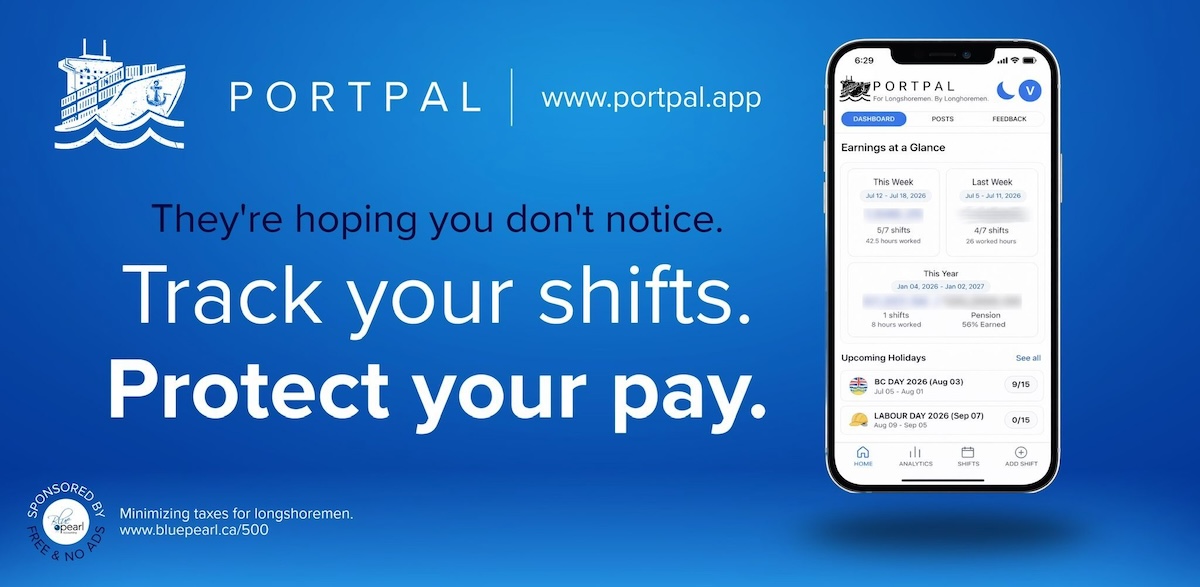
The billboard went up on Feb. 6. But it didn’t last long.
Before noon that same day, Rup said the billboard company, the Jim Pattison Group-owned Pattison Outdoor, called to say they were taking the billboard down and cancelling their service contract.
Pattison Outdoor did not respond to requests for comment. But an email exchange between Rup and Pattison Outdoor provided to The Tyee shows the property owner, BC Maritime Employers Association, or BCMEA, alleged the ads were defamatory.
“We are happy to accept this advertising,” senior retail executive Sean-Christerfer Longhi told Rup in a Feb. 9 email.
“We simply can not re-post your ads on BCMEA's property now. The only possible way we could consider posting ads at that spot is if you provided written agreement from BCMEA that would allow you to run.”
Rup offered to change the wording of the billboard to be more neutral and work with BCMEA to find a resolution that would let him continue to run the billboard. Still, Pattison would not put the billboard back up.
“I can appreciate that the ad was a little cheeky,” Rup said. “But the part that really irked me was that Pattison and the BCMEA were not willing to just remove that line.”
He said the advertising company offered to put the ad somewhere else.
“But I don't want to,” Rup said. “I specifically chose that location because it's a billboard right in front of the hall where all of my brothers and sisters congregate.”
Now, Rup is back to the drawing board. He said he’s trying to figure out how to get his billboard back up — and in front of the ports.
“My goal is to get more workers to know about the app and start to leverage this thing.” ![[Tyee]](/design-article.thetyee.ca/ui/img/yellowblob.png)
Read more: Labour + Industry, Science + Tech








Tyee Commenting Guidelines
Please note that email notifications for replies are not currently working due to a software issue which may be resolved in a future update.
Comments that violate guidelines risk being deleted, and violations may result in a temporary or permanent user ban. Maintain the spirit of good conversation to stay in the discussion and be patient with moderators. Comments are reviewed regularly but not in real time.
Do:
Do not: