

 SHARE:
When Tiq Milan relayed the story of his coming out to his parents as both queer and trans to a rapt audience of educators and students at the University of British Columbia’s Marine Drive Ballroom on Feb. 10, he said his self-confidence is built on the foundation of his parents’ unconditional love and support.
Teachers, noted Milan — who was delivering his speech as the 2025-26 UBC faculty of education global speaker on sexual orientation and gender identity inclusion — can’t and shouldn’t try to replace their students’ parents.
But the love and support a teacher can give a student at any age helps build a foundation of confidence and self-worth for the rest of their lives, he said, especially for LGBTQ2S+ kids and youth.
“An educator's love is about creating conditions where [students] are allowed to discover themselves, without fear, without shame, without being rushed,” said Milan, a Black queer and trans educator, facilitator and advocate based in New York.
“Your love shows up in the spaces you create: the space to think deeply, the space to ask questions, space to express in different ways through language, through play, through dialogue, through disagreement. The space to be expansive.”
Many of the educators in the audience knew this first-hand.
Milan’s talk unofficially opened the UBC education faculty’s first Safeguarding SOGI Summit, a one-day professional development, networking and collaboration event held on the Vancouver campus with 40 educators from British Columbia, Yukon, Alberta, Saskatchewan and New Brunswick.
Both the speaker series and the summit were hosted by the Robert Quartermain Centre for SOGI-Inclusive Excellence in Education, a first-of-its-kind Canadian university sexual orientation and gender identity education centre that launched last year.
“A lot of the work around SOGI is the understanding that when you teach about sexuality and gender, it’s not just a single lesson; it’s part of the full year, it’s part of every day,” Julia Sinclair-Palm, director of the centre and an associate professor of teaching at UBC, told The Tyee.
Introducing SOGI education and policies in kindergarten to Grade 12 schools over the last decade has faced continual backlash and protest from so-called parents’ rights advocates, socially conservative politicians and religious groups.
In Alberta and Saskatchewan, governments have introduced policies and legislation targeting trans and gender-diverse students’ name and pronoun preferences, school sports participation, locker room assignment and gender-affirming medical care access.
Both provinces have used the notwithstanding clause, which allows a government to override protections under the Canadian Charter of Rights and Freedoms for a period of five years, to protect themselves from legal challenges.
As well, Alberta politicians are deciding what books students can access in schools and whether outside organizations can be brought in to provide students with sexual health education.
In New Brunswick, a decision by the then-Progressive Conservative government to introduce similar restrictions on name and pronoun changes was rejected by voters when they elected a new government in 2024.
“I’m really interested in having these educators... be able to build networks and relationships, share strategies and resources for how to respond, combat these really anti-trans and limiting policies for educators,” said Sinclair-Palm on the reasons for holding a summit.
In an interview with The Tyee, Chris Billingham, the inclusion, diversity, equity and accessibility or IDEA co-ordinator in School District 33 in Chilliwack, noted that while government may emphasize that SOGI 123 materials are “optional” to assure those who push back on the education, she doesn’t see it that way.
“Because we actually owe this to the kids,” Billingham said, adding that youth will grow up to work in places with anti-homophobia and anti-transphobia policies and codes of conduct, not to mention will likely be interacting with trans and queer people.
“They are going to grow up and live in a world that isn’t going to mirror the world that their parents want it to be.”
No one involved with the SOGI summit, in the works for months, could have predicted the tragedy that would befall Tumbler Ridge, a 13-hour drive from the Vancouver campus, earlier on Feb. 10 when a teenager murdered seven children and two adults. Seven of the victims — six youths aged 12 to 13 years old and a teacher — were killed inside the town’s high school.
News of the mass shooting trickled into the audience after Milan’s talk, bringing fear and uncertainty into a room otherwise filled with love, unity and a passion for inclusive and intersectional education.
Even though the suspected shooter’s trans identity wasn’t confirmed by the BC RCMP until the next day, transphobic rhetoric and misinformation was already spreading online that evening, spurred in part by a B.C. MLA’s social media post.
This forced the summit to shift some of the day’s focus from supporting kids and championing their right to a full age-appropriate SOGI education, to mourning lives lost and discussing tactics for defeating misinformation and hate directed towards trans people.
The pushback and protesting against SOGI education, as well as against the very existence of trans, queer and Two-Spirit people, come from fear, said Bellingham, who uses she/they pronouns.
“The mis- and even disinformation will eat people alive,” they said. “If people open their eyes and ears to the truth of what SOGI is, I don’t actually think it would be a problem.”
Impact of Alberta and Saskatchewan legislation
The Safeguarding SOGI Summit was facilitated by and designed in collaboration with the non-profit ARC Foundation, which co-developed the SOGI 123 grade school learning, professional development and policy resources with B.C. school districts, the B.C. government and UBC.
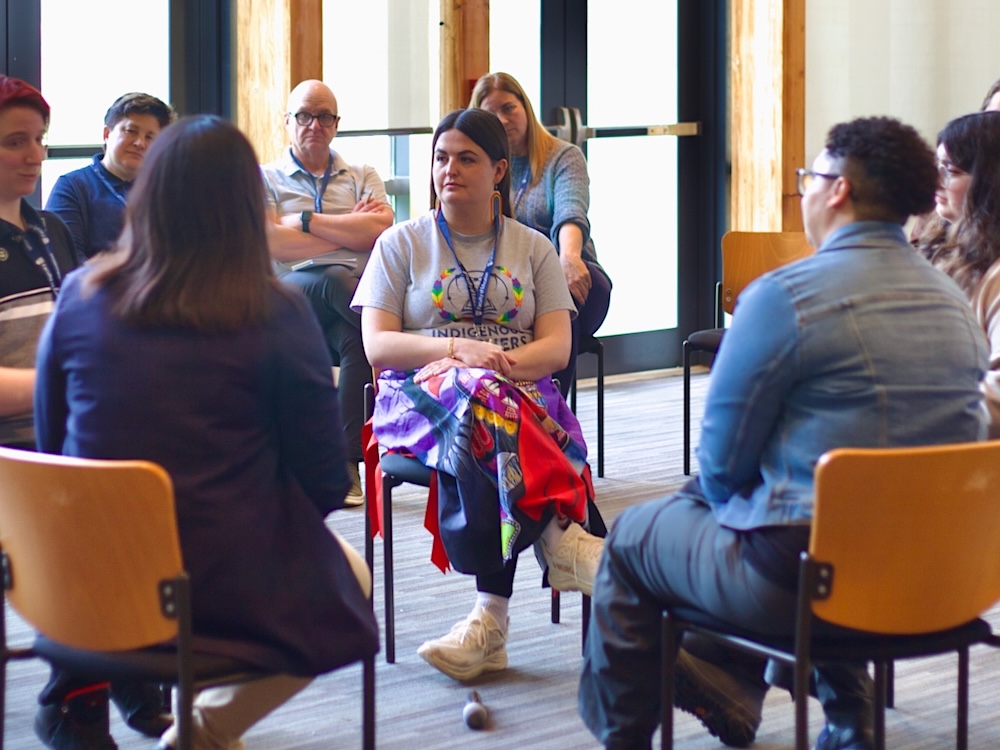
The first of three facilitated sessions that day, led by Scout Gray, ARC’s director of national programs, was a “fishbowl” setup where the educators sat in a circle, surrounding three chairs placed in a smaller circle in the middle.
Gray sat three educators, one each from New Brunswick, Alberta and Saskatchewan, in the centre chairs to talk to one another about the legislation and government policies that ban SOGI materials and restrict students’ rights.
“There’s been a general consensus amongst all of the lawyers that I’ve talked to that there’s a clear case that this goes against the students’ human rights,” said Gray about the policies and legislation.
The Alberta and Saskatchewan teachers spoke of the uncertainty teachers and school districts face about whether they can ignore these rules without penalty when the policies and laws face ongoing court challenges.
“No one can answer that question,” said Rin Lawrence, an Alberta educator.
“We’re sitting in this space of like, ‘How do we protect teachers, so that safe teachers are in the schools for the kids? And how do we push back on this policy?’”
The teacher from New Brunswick shared that before the government rescinded the policy banning students from changing their names and pronouns without parents’ permission, schools were required to contact parents for all students whose preferred name did not match their birth certificate.
They relayed the story of their niece, who is straight but has gone by the name DJ since birth.
“With this new policy, one of her teachers called her over to the desk and said, ‘I’m no longer going to call you DJ. I’m going to call you Donna Jean because that is what is on your legal documents,’” they said.
Tanzy Janvier, a Two-Spirit elementary teacher from the Dene First Nation, brought an extra chair into the inner circle to remind the room that these discussions cannot take place without Indigenous people at the table.
Because First Nations have the right to self-determination and the province did not consult with them on these policies, Janvier noted, Saskatchewan’s government violated First Nations treaties and sovereignty with its transphobic policies. As well, because on-reserve schools fall under federal, not provincial, jurisdiction, those schools are exempt from the changes.
But there are thousands of Indigenous children in public schools, Janvier said, and statistically speaking at least one in 10 of them is queer. And Indigenous youth as a whole have a much higher rate of attempting suicide because of historical and ongoing colonization and racism.
“In my language ‘queer’ means ‘keeping the balance,’” Janvier said, adding that the first colonizers in North America murdered Indigenous Two-Spirit leaders to destroy their nations and enforce assimilation.
“The land is queer and we know that.”
‘Queerness is the blueprint to a better future’
Another session at the summit, led by Luke Mae, ARC Foundation’s SOGI 123 lead for Yukon, had educators meet in groups to discuss the importance of intersectional approaches to SOGI education.
“Intersectionality is different from diversity,” said Mae, who uses the pronoun nekm, which translates to “that person” in the Mi'kmaq language.
For example, nekm pointed to a table where only one educator, Jay Nickerson, was a man. Because of our patriarchal society, this gives him power over the women and non-binary people at the table, Mae said.
But because Nickerson is Black, his power was erased by the fact that his tablemates all appeared to be white.
“If as an educator you are not being intersectional, then you are doing a disservice to all of your students,” Mae said.
During his speech the evening before, speaker Tiq Milan relayed a story of trying to excite his students — queer and trans kids who were battling hunger, poverty and homelessness — over the news that the United States had finally legalized same-sex marriage.
“They’re looking at me like, ‘OK, you can get married, but I can’t eat. I cannot find a job.... I have to do sex work just to have a meal, and you’re talking about you getting married?’” he said.
“That’s why when I talk about intersectionality, it’s not just a theory; it’s a responsibility.”
In an interview with The Tyee between summit sessions, Nickerson spoke about his work as the equity, diversity and inclusion lead teacher in New Brunswick’s Anglophone South School District, which takes an intersectional focus on addressing racism, sexism and homophobia in the district.
“We definitely make sure we incorporate our Indigenous voices; as well we work very closely with our First Nations co-ordinator to make sure that we are having multiple voices at the table to make sure we have multiple perspectives,” said Nickerson, whose work includes facilitating the district’s Pride Week.
“I never had a teacher growing up who was queer, multiracial or Black. But there are students out there just like me.... If I can provide that for one student, where they can see themselves... I’m there.”
How young people in the school systems now have a more expansive view of gender and sexuality than previous generations was also an undercurrent of both the summit and Milan’s talk the evening before.
“Queerness is the blueprint to a better future,” Milan told his audience, noting he was talking not about sexuality, but as in being comfortable asking questions and living with complexity.
“It’s not about queerness as a thing that produces LGBTQ people. It’s about queerness as a way of looking at the world so that we can be more expansive,” he said to The Tyee in an interview after his talk.
“I think it makes us better people. I think it makes us more tolerant people.” ![[Tyee]](/design-article.thetyee.ca/ui/img/yellowblob.png)
Read more: Rights + Justice, Education, Gender + Sexuality




Tyee Commenting Guidelines
Please note that email notifications for replies are not currently working due to a software issue which may be resolved in a future update.
Comments that violate guidelines risk being deleted, and violations may result in a temporary or permanent user ban. Maintain the spirit of good conversation to stay in the discussion and be patient with moderators. Comments are reviewed regularly but not in real time.
Do:
Do not: