

 SHARE:
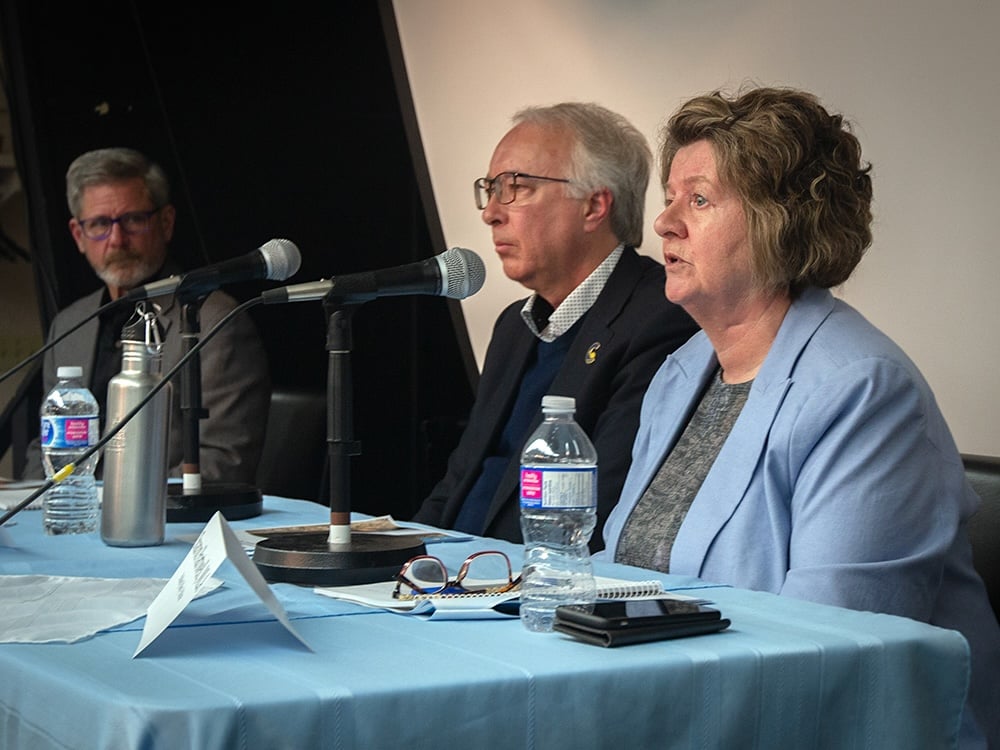
John Rustad was accused of fearmongering and spreading misinformation about Indigenous land rights at a town hall-style event he hosted in Smithers last weekend along with two fellow Conservative MLAs.
The former Conservative Party of BC leader was joined by Bulkley Valley-Stikine MLA Sharon Hartwell and Abbotsford South MLA Bruce Banman at a meeting billed as an opportunity to discuss B.C.’s Declaration on the Rights of Indigenous Peoples Act, or DRIPA.
But the panel was criticized over the lack of First Nations representation and the venue’s lack of space. About 100 people packed inside the Smithers legion and at least a dozen more were turned away after the hall reached capacity on Saturday evening.
Among those who did make it through the doors were many First Nations people, including hereditary and elected leaders from the Wet’suwet’en and other nations in the region.
They included Wet’suwet’en Hereditary Chiefs Na’Moks (John Ridsdale) and Dsta’hyl (Adam Gagnon), and Witset First Nation Chief Elgin Cutler. The region’s former member of Parliament, Taylor Bachrach, also attended while Nathan Cullen, who has served as both MP and MLA for the region, was turned away after the venue filled up.
Many took to the microphone to speak in favour of DRIPA — groundbreaking legislation that passed unanimously in the B.C. legislature in 2019 and is meant to provide a framework to guide reconciliation in the province.
Although Rustad voted for DRIPA, the Conservative Party of BC has now promised to repeal the legislation if it forms government.
Banman, who moderated the event, recently announced his intention to run in the Conservative leadership race this spring. Rustad also recently signalled he may try to regain the position from which he was ousted late last year.
Rustad did most of the speaking Saturday, with his introduction lasting nearly a half-hour.
An early comment that First Nations “wouldn’t exist” without Canada elicited gasps and some comments from the packed hall.
“In many ways, Canada wouldn’t exist without that partnership with First Nations and, equally, First Nations wouldn’t exist without Canada,” Rustad said five minutes into his introduction. He added that Americans would have invaded Canada and that without British support, “it would have been a pretty one-sided fight.”
He said he was given “no choice” by the BC Liberals when he voted for DRIPA six years ago.
While the town hall was meant to focus on DRIPA, Rustad said Section 35 of the Constitution, which protects Indigenous rights in Canada, has “created two classes of people.” He also said that work to address historic harms against Indigenous communities could “tip the balance” too far in favour of First Nations.
“Anywhere there has been laws put in place which give rights to one person that are not given to another person, it creates friction,” he said. “Section 35 was meant to try to resolve the long-standing history and the problems, but it has created two classes of people.”
Rustad also touched on two recent court decisions supporting First Nations land rights.
In December, the B.C. Court of Appeal ruled that DRIPA, which requires that the province consult with First Nations on mining operations, conflicts with B.C.’s Mineral Tenure Act. The provincial government has applied to the Supreme Court of Canada to hear an appeal of the ruling. Premier David Eby said he intends to amend DRIPA in the spring, saying that “British Columbians, not judges, have to decide our path forward.”
Rustad told the crowd in Smithers that DRIPA was intended to be a guiding principle and “not meant to be a veto.”
“Now we’re seeing that with court cases and other issues that are happening in the province today,” he said.
Rustad also took aim at a second ruling, Cowichan Tribes v. Canada, which determined last year that the nation’s Aboriginal title rights extend to some private properties. The B.C. Supreme Court directed the province to negotiate a solution with the nation.
The nation’s government has insisted that “the ruling does not erase private property.” Instead, it notes that Aboriginal title exists alongside private ownership.
Rustad disagreed, saying on Saturday that private property rights and Aboriginal title “cannot coexist.”
“Eventually the land will return to the nation,” Rustad said. “That means your land has no value. It means you’ve lost all the value of land. It means, basically, you can’t sell your land, because who would buy it?”
The Cowichan decision was based on Section 35.
Rustad recently suggested in an interview with CBC that the Constitution should also be changed. On Saturday, he told the crowd in Smithers that Canadians should be “talking about renewing Confederation,” given discussions about Alberta separatism.
“There are some people in the First Nation community who say the answer is ‘Everybody should just pack up and go back to Europe or whatever country you came from.’ That’s not an answer. We’re here to stay,” Rustad said.
As he spoke, Rustad faced heckling from some in the crowd as audience members accused him of fearmongering, using “hateful rhetoric” and spreading misinformation designed to sow division.
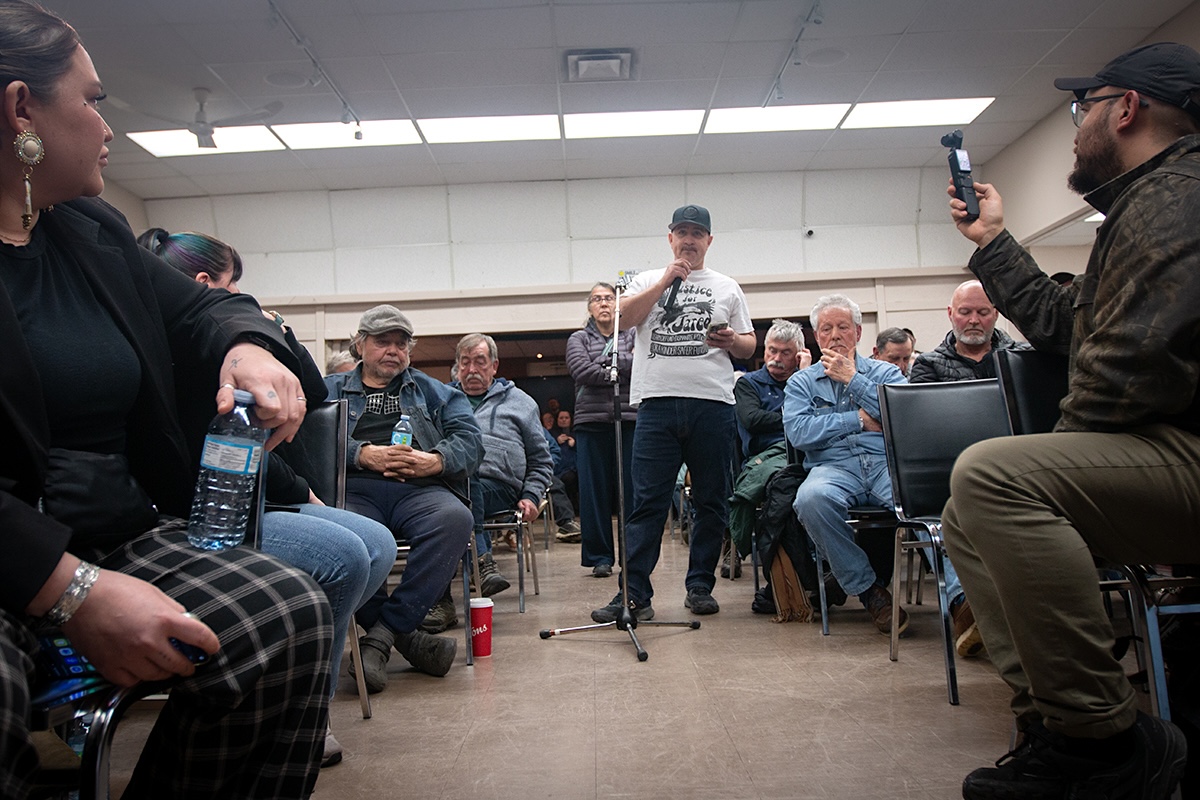
The town hall was held at the legion in downtown Smithers, which is located on Wet’suwet’en territory and the ancestral land of the Gidimt’en Clan. The nation’s Hereditary Chiefs, along with neighbouring Gitxsan leaders, spent more than a decade fighting the Delgamuukw v. British Columbia court case, which resulted in an acknowledgment by the Supreme Court of Canada that the nations’ Aboriginal title had never been extinguished.
Following Rustad’s introduction, Ts’akëzé Madeek, a Head Chief of the Gidimt’en Clan who also goes by Sheri Green, pointed out that the politicians had neglected to acknowledge the territory.
She also criticized the panel for its lack of Indigenous representation.
“There’s never been an intention, ever, to displace people,” she said. “You’re travelling throughout this province, starting these conversations in a horrible way, and it’s self-serving. That doesn’t do anything for reconciliation but cause further harms.”
There were cheers from the audience as she added, “I welcome all of you who are continuing to live among us. We work and play amongst each other.”
Many speakers focused on unity and the opportunity for dialogue. Wet’suwet’en members shared stories about historical injustices that forced them from their traditional villages and prevented First Nations from owning land in the region.
“This problem didn’t start with DRIPA. This problem didn’t start with Section 35 in the Constitution,” Sleydo’, a Wing Chief with the Gidimt’en Clan who also goes by Molly Wickham, told the panel. “The ‘issue’ you referred to around Native people is actually what everybody has called the ‘Indian problem.’
“[DRIPA] is supposed to help address the conflict that was created by colonization, that created these two tiers of people, that used racism as a tool to dehumanize us, to rationalize the theft and the forceful illegal occupation of our territory.”
The panel also heard from Smithers resident Nalaine Morin, a member of the Tahltan Nation and a senior vice-president of environment and social affairs for Skeena Gold + Silver. Last month, the Tahltan, the company and the province jointly announced the reopening of the Eskay Creek mine after the first-ever joint decision-making process under DRIPA.
“The collaboration that existed through that process demonstrated that we can work together,” Morin said. “I am absolutely 100 per cent opposed to repealing DRIPA. We need to move forward. We are an example that this can happen. This can be successful.”
Throughout the evening, Rustad continually returned to his own work as minister of Indigenous relations, a position he held under the former BC Liberal government, saying he had signed “many agreements” with First Nations.
“You were probably the first ones through the new process, but how you went through and did that has been done in the past, because I was there, I did those agreements,” Rustad said about the agreement that resulted in approval last month to reopen the Eskay Creek mine.
An audience member accused Rustad of “giving false information again.”
The agreement between B.C. and the Tahltan Nation, which was signed in 2022, was the first signed under Section 7 of DRIPA. The section allows the provincial government to sign agreements that give First Nations equal decision-making power over industrial projects on their traditional lands.
Rustad and his party have heavily criticized Section 7 agreements, saying they give First Nations the power to veto industrial development. Two years ago, as the provincial government attempted to amend the Land Act to facilitate more agreements like the one with the Tahltan, Conservatives accused the NDP of “returning all traditional lands” to First Nations.
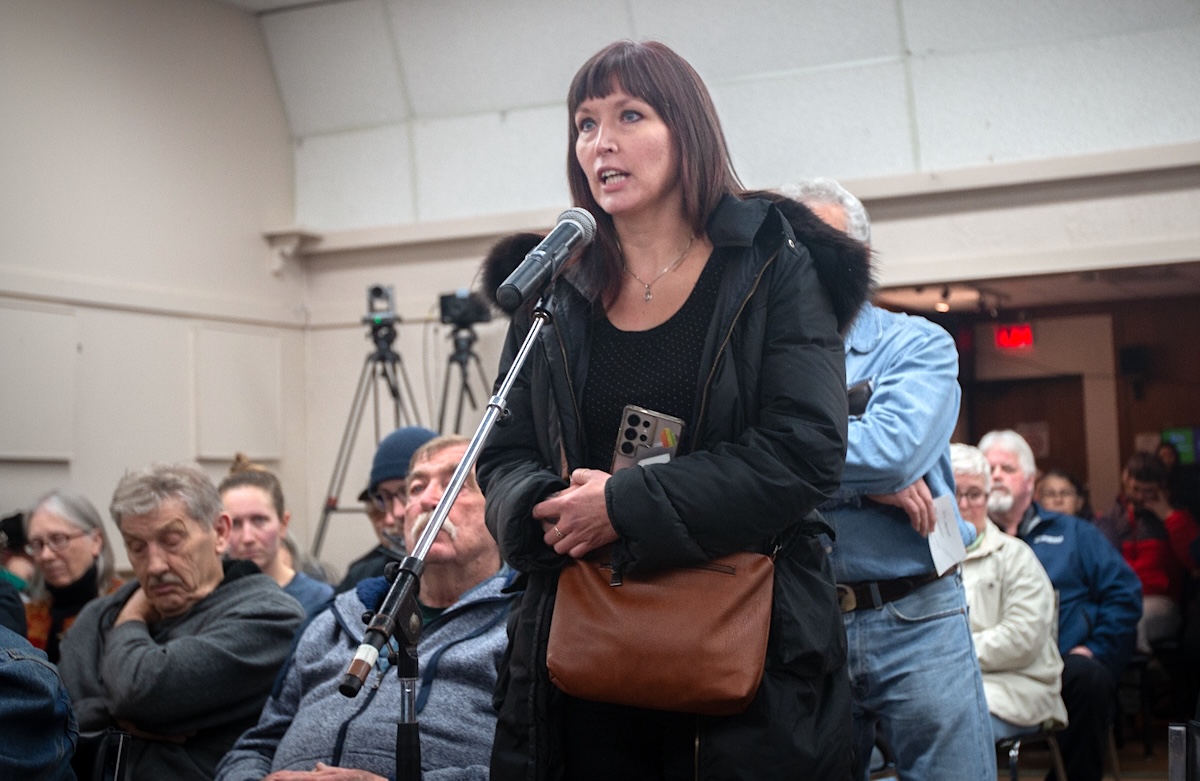
The event, which was scheduled to last two hours, went over time as other attendees took turns on the microphone. Most expressed support for DRIPA.
There were also Conservative supporters in the room, with several speakers thanking the politicians for hosting the discussion. They focused on the need for unity and expressed concerns about things like fishing rights.
None explicitly called for DRIPA to be repealed.
Rustad said the town hall had been requested by Hartwell, a rookie MLA who won the Bulkley Valley-Stikine seat in the 2024 provincial election and ousted veteran politician Nathan Cullen.
Hartwell said little during the event, which she described as “very intense” as it concluded.
“I would like to express my appreciation for the Chiefs and councillors from their respective bands and territories, and I’d like to meet all of them so I can find out who they are again,” she said.
Following the event, The Tyee asked Banman how the Conservatives would approach reconciliation if they were to repeal DRIPA. The Abbotsford South MLA suggested the party would hold “more fulsome discussions” like the one it hosted on Saturday evening.
“There was some passion in the room, but what I heard in here was people listening to one another, respectfully. Was there disagreement? Yes, there’s always going to be disagreement, but what I saw here tonight, I was impressed with.”
Asked whether the party would consider keeping the legislation if it continued to hear supportive comments like the ones shared in Smithers on Saturday evening, Banman was noncommittal.
“Whether DRIPA has to be repealed or whether parts of it have to be modified, again, I think that’s where you get people to the table, like you did tonight,” he said. ![[Tyee]](/design-article.thetyee.ca/ui/img/yellowblob.png)
Read more: Indigenous, Rights + Justice, BC Politics






Notice about commenting changes
The Tyee’s commenting system will be moving to a new platform on Nov. 12. If you’re already a Tyee commenter you must register with the new system on or after Nov. 12 with your preferred username.More information can be found here.