


 SHARE:
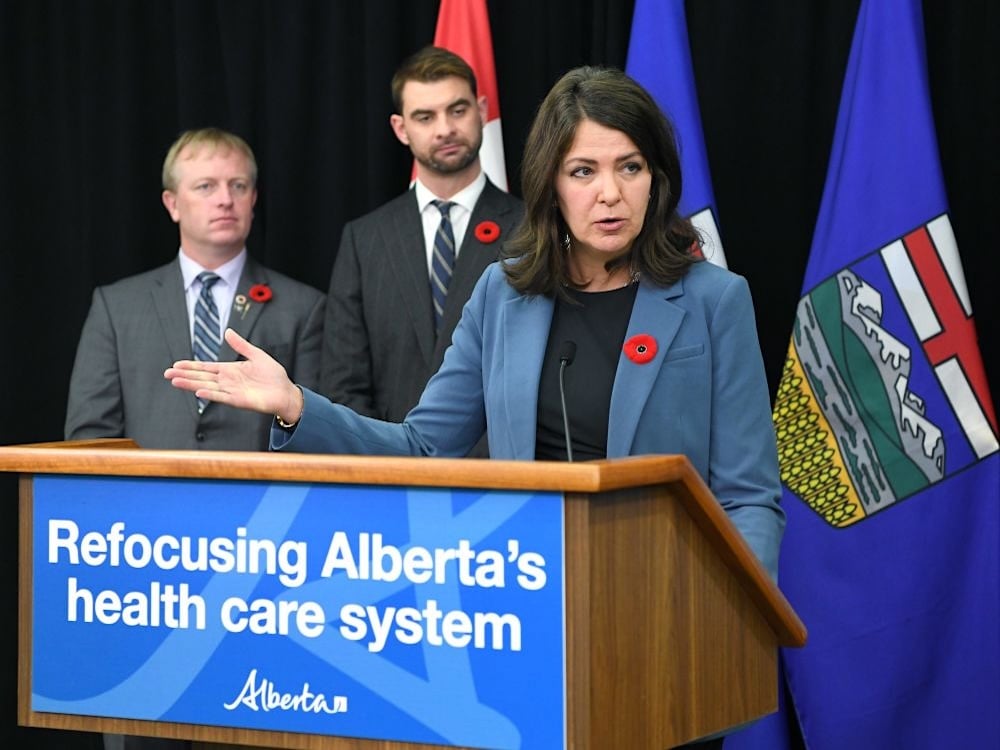
The campaign by Alberta’s United Conservative Party to remake the province’s health-care system has created chaos with patients dying in overcrowded hospital emergency rooms.
But there has also been a steep financial cost to the overhaul. A Tyee analysis of Alberta Health financial data found at least $30 million has been paid out in severance between 2019 and June 2025.
The data shows the government paid out about $29.45 million between 2019 and June 2025 to 150 former employees. But that figure doesn’t account for payouts made in the second half of 2025, nor does it capture the payouts for executives and others who opted out of the public reporting of their severance.
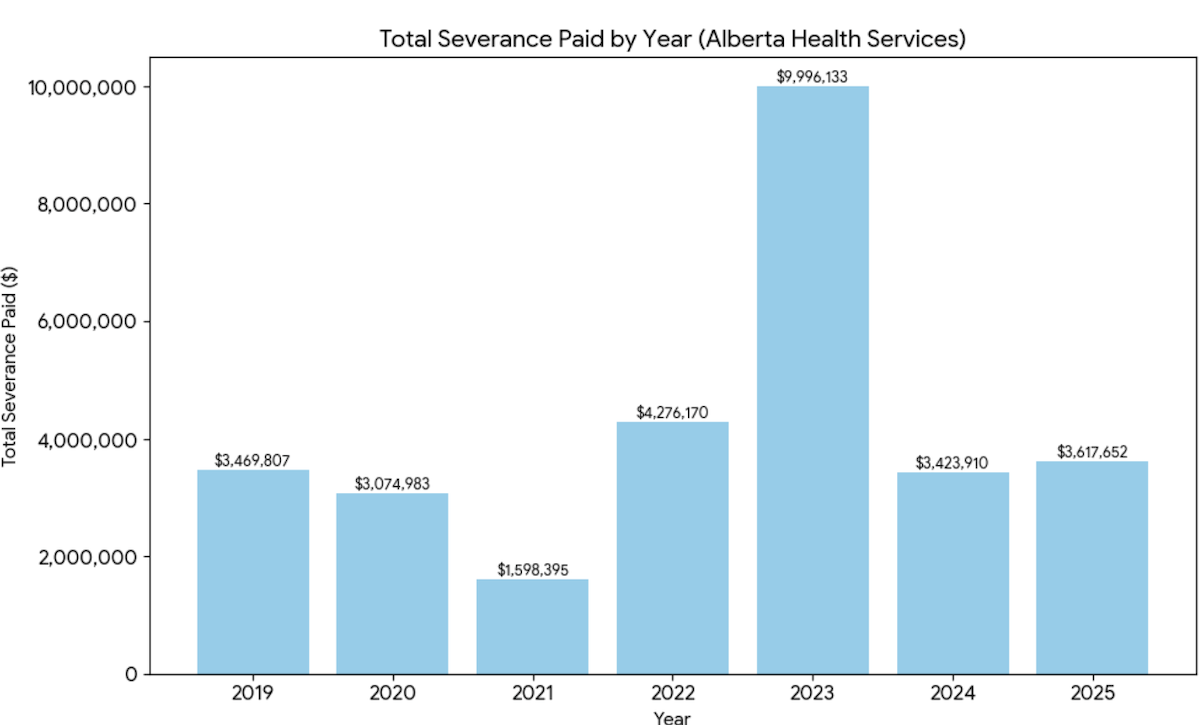
A third of that amount — nearly $10 million — was paid out in 2023 to 33 people as Smith made good on an election campaign promise to eliminate what she characterized as a bloated bureaucracy and ineffective executive managers.
Smith had made no secret of her animus toward officials at Alberta Health Services, or AHS, whom she accused of underperforming and of mismanaging the COVID pandemic by too stringently applying mandates.
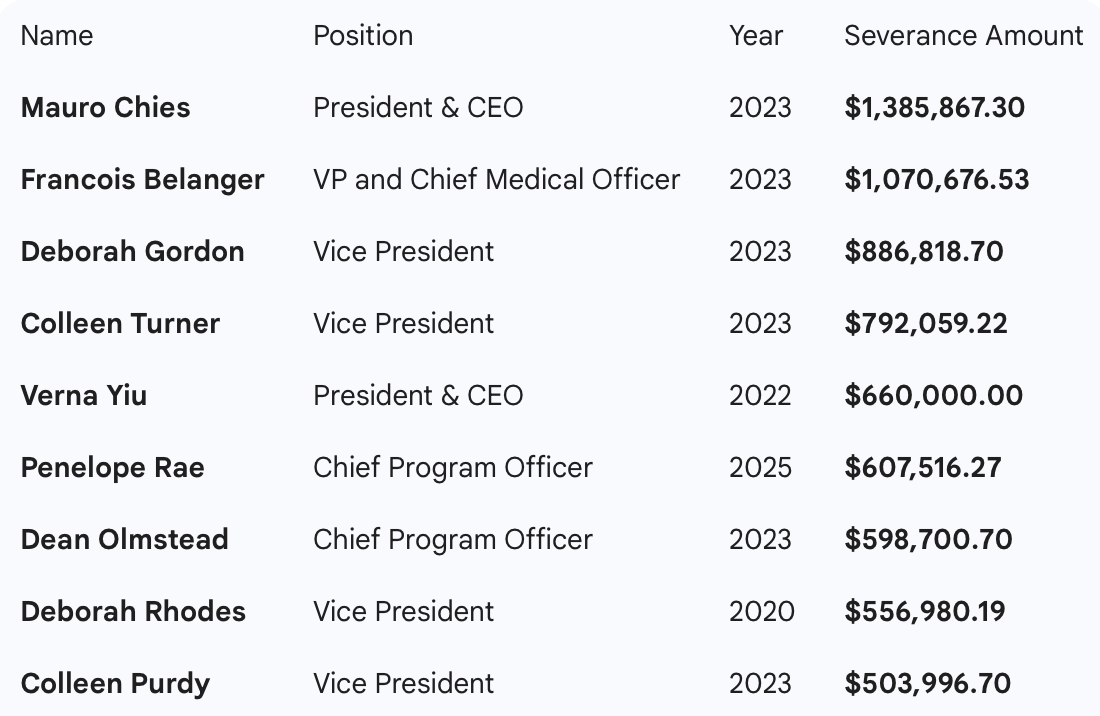
The data shows former AHS president and chief executive Mauro Chies received nearly $1.4 million while Francois Belanger, a former vice-president and chief medical officer, was paid $1.07 million. Another vice-president, Deb Gordon, who had decades of experience with AHS, received more than $886,000.
During the 2023 provincial election, Smith promised to fix the health-care system within 90 days. Beginning in November 2023, thousands of AHS staff were transferred to four new health agencies: Acute Care Alberta, Primary Care Alberta, Recovery Alberta and Assisted Living Alberta.
Each of the four new agencies is overseen by a minister and a newly created attendant bureaucracy.
But the blitzkrieg reorganization has yet to produce results. To the contrary, it has destabilized the system to the point where some frontline doctors claim it has at times collapsed, unable to provide care to patients even in life-and-death situations.
After compiling a list of potentially preventable deaths and numerous close calls, Alberta’s hospital emergency room doctors later called on the government to declare a state of emergency.
Minister of Hospitals and Surgical Health Services Matt Jones dismissed the call by doctors. He said he had all the powers he needed to respond to the situation.
A pattern of ‘costly misadventures’
Andrew Longhurst is a senior researcher and political economist with the Canadian Centre for Policy Alternatives. The severance payouts and the expatriation of experienced senior executives, he said, “shows this is a government that is more focused on restructuring and dismantling Alberta Health Services and the public health-care system in Alberta than actually improving care and being cost efficient with taxpayer dollars.”
Longhurst sees a pattern. The failed attempt to privatize laboratory services wasted more than $100 million. Alberta’s rapid privatization of surgeries has increased per-surgery costs, while failing to decrease wait times.
“Again and again we see that it's not actually about being prudent with tax dollars; it's quite the opposite.
“A lot of these misadventures are incredibly costly to the taxpayer and corrosive to a well-functioning public service,” he said, adding that any organization that hollows out its workforce “is going to lose an incredible amount of institutional knowledge and expertise.”
Speaking on condition of anonymity due to a non-disclosure agreement, a former senior AHS executive said it is ironic that the government has tossed aside highly experienced administrators like Deb Gordon when that experience is needed to address the near-daily crises created by the UCP government’s own haphazard restructuring of the health-care system and its failure to adequately provide or promote vaccines.
“Deb is a good example,” the former executive said. “She is a nurse by training. She has decades of experience at AHS. She was a major executive. She knew how to mobilize operations very quickly during COVID. There is just no one left to do that.”
The former executive said the government has replaced some experienced executives with former Alberta government bureaucrats who have no requisite health-related education and no operational experience, yet some are being paid 30 to 40 per cent more.
Even if the government attempts to replace terminated AHS executives with executives recruited from other provinces or countries, it will still have to pay the market-rate salary, which means there will be no net savings, noted University of Calgary health law professor Lorian Hardcastle.
And then there is the added cost of a “lull in production,” which is the time and cost Hardcastle said is required for a new leader to get up to speed. That period of inefficiency adds costs to taxpayers beyond the initial payout to the executive being replaced.
There is another hidden cost. Young professionals are witnessing the chaos that has been created, including the vaguely explained termination of respected senior executives such as former chief medical officer of health Dr. Verna Yiu, and are leaving Alberta for other provinces.
The former executive cited the recent example of a young couple who trained in Edmonton as surgeons — one as a pediatric neurosurgeon, an extremely rare speciality, and the other as a colorectal cancer surgeon. They now live and work in Kingston.
“They're driving people with experience out of Alberta,” the former executive said.
Hardcastle said the recent unprecedented scale of the severance payouts and the termination of numerous experienced senior executives merits comparisons to former premier Ralph Klein’s ill-fated attempt at health-care reform in the late 1990s.
“People have said the Klein government was the high-water mark for mismanaging the health-care system,” Hardcastle said.
“But honestly, I think that Premier [Danielle] Smith is giving him a run for his money in terms of failure to address obvious problems, and bringing in reforms that are not evidence based.”
“If we look back in history, she is certainly among the worst in the last many decades, if not the worst.”
If you have any information for this story, or information for another story, please contact Charles Rusnell in confidence via email. ![[Tyee]](/design-article.thetyee.ca/ui/img/yellowblob.png)











Notice about commenting changes
The Tyee’s commenting system will be moving to a new platform on Nov. 12. If you’re already a Tyee commenter you must register with the new system on or after Nov. 12 with your preferred username.More information can be found here.