


 SHARE:
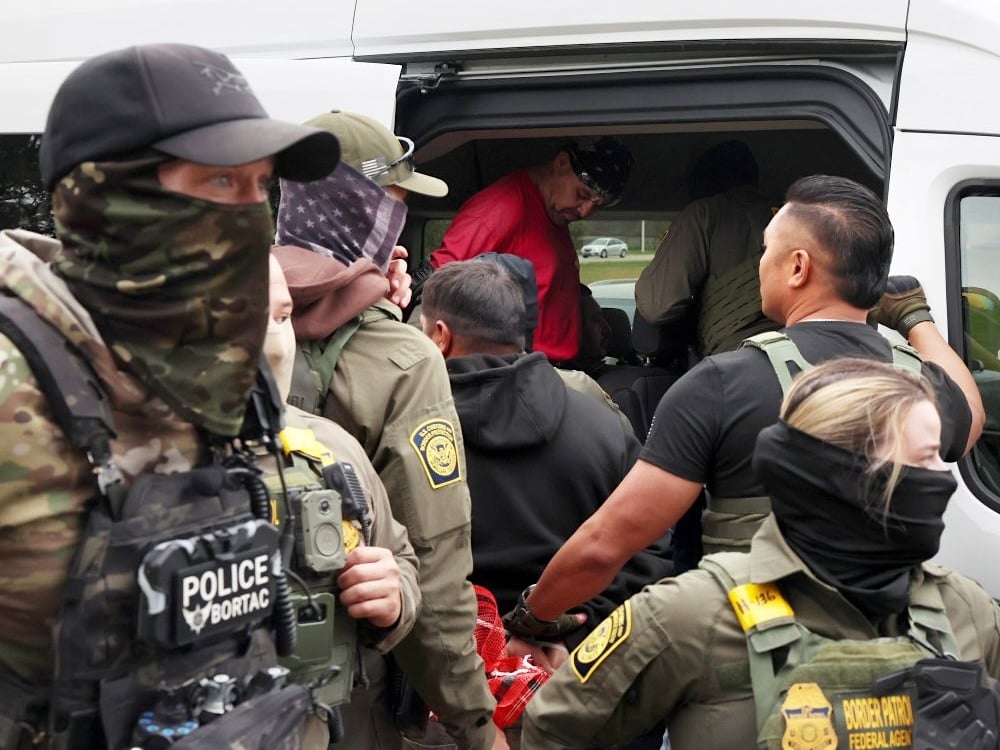
When Canada Border Services Agency and Calgary police descended on the city’s new arena construction site last month in a search for undocumented workers, there were immediate concerns.
The action came as reports of U.S. Immigration and Customs Enforcement agents’ raids on workplaces dominated the news.
The Oct. 15 action in Calgary saw workers lined up outside the construction site and required to show identification. Four workers without proper documentation were not permitted to return to work.
The Canada Border Services Agency, or CBSA, said in a statement to The Tyee that it had received a “tip indicating that a number of individuals might be working at the Calgary work site.”
Police were present as “an extra security measure in support of public safety and officer safety,” it said.
Workplace investigations “are an important tool to identify those who should not be in the country,” the agency said.
“In this instance in Calgary, four individuals were found to be working without authorization and therefore non-compliant with IRPA [Immigration and Refugee Protection Act],” the statement said. “The investigation remains ongoing and no further information specific to these cases will be shared.”
Between Jan. 1 and Oct. 22 the CBSA concluded 4,383 investigations into possible non-compliance with the Immigration and Refugee Protection Act, including workplace investigations.
But Irene Bloemraad, a sociology professor at the University of British Columbia and a co-director of UBC’s Centre for Migration Studies, noted the involvement of the Calgary Police Service.
She said it raises questions about whether police should be doing immigration enforcement. In the United States, she said, it’s common that police departments don’t want to engage with immigration enforcement because it destroys trust with immigrant communities.
“By destroying trust, it has been much more difficult to investigate crimes,” Bloemraad explained. “So if there’s a crime in a particular neighbourhood but that neighbourhood has people who might be out of status, those people are not going to come forward to be witnesses.”
She said that police aren’t required and aren’t recommended, except in very narrow circumstances, to assist in immigration enforcement.
Mario Bellissimo, a Toronto immigration lawyer, said that CBSA visits to job sites aren’t new, but they’re more publicized now, especially with immigration raids south of the border.
He noted, however, that Canada has been removing record numbers of people from the country. In 2024, CBSA removed 17,357 people. The agency reported 15,207 in 2023. As of Sept. 30 this year, CBSA has removed 12,697 people.
Bellissimo said this indicates that the agency is focused on enforcement. That’s a good thing if it targets bad actors, he said. But he worries there won’t be proper consideration for people who have tried to follow the correct pathways but have faced issues with the system.
Those pathways aren’t always clear for immigrants or refugees, and they’re narrowing.
The 2025 federal budget outlined further cuts to immigration. While the number of permanent residents is set to stabilize at 380,000 for three years from 2026 to 2028, the budget would halve the number of temporary residents and student visas.
The minority Liberal government has also introduced two bills in an effort to strengthen Canada’s borders. Bellissimo said the bills are attempting to modernize the immigration system, among other things.
The bills have been criticized by groups, including Amnesty International, for undermining immigrants’ rights.
The bills would allow the immigration minister to cancel already-issued immigration documents. They would also tighten the timelines for refugees to make claims.
“Any time we move towards more concentration in the hands of very few, it’s generally not a good development for the immigration system,” Bellissimo said.
Bellissimo said that rather than focusing on finding and deporting people working without legal status, the government could work at providing them a path to work in Canada. The workers are often delivering frontline services, he said, and they can include people who have been trafficked.
Bloemraad said the federal government previously supported a program to provide a path for construction workers in Toronto working illegally to gain legal status.
“The argument for that program was that Toronto really desperately needed construction workers,” she explained. “These people were already working in construction; everyone would be better off if they were legalized.”
Bloemraad said that Canadian policymakers have to decide how they will handle people working illegally.
“I understand why some people think that a logical reaction is to go the enforcement route,” she said. “However, I think a lot of research shows that there are probably many bigger significant negatives to hard-core enforcement than to moderate and well-thought-out regularization.”
As enforcement efforts increase, more work happens illegally under the table and the chances of exploitation increase, Bloemraad said. ![[Tyee]](/design-article.thetyee.ca/ui/img/yellowblob.png)
Read more: Rights + Justice, Alberta












Notice about commenting changes
The Tyee’s commenting system will be moving to a new platform on Nov. 12. If you’re already a Tyee commenter you must register with the new system on or after Nov. 12 with your preferred username.More information can be found here.