


 SHARE:
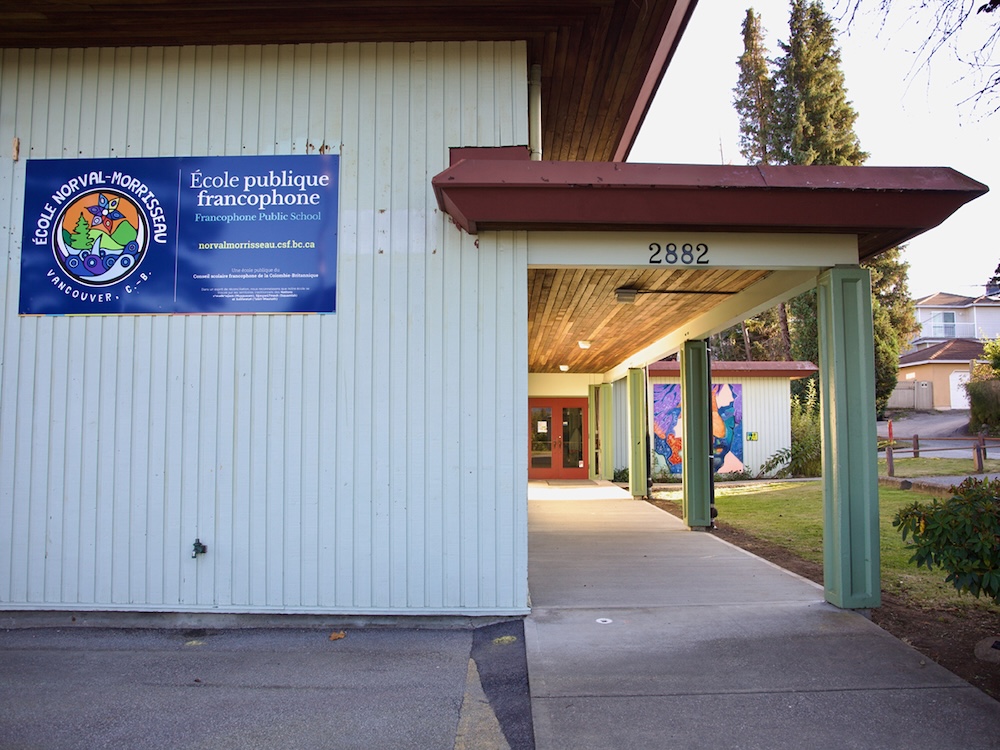
As of January, B.C.’s francophone school district will be launching a pilot pre-kindergarten program at schools in Chilliwack, Vancouver, Squamish and Port Alberni.
The program, which will operate out of École La Vérendrye in Chilliwack, École Norval-Morrisseau and Queen Elizabeth Annex (École Rose-des-vents) in Vancouver, École Les Aiglons in Squamish and École des Grands-cèdres in Port Alberni, will be full-day like regular kindergarten classes.
The pre-kindergarten program will be open to four-year-olds with at least one francophone or francophone-educated parent.
The Tyee requested an interview with Pascale Bernier, superintendent of the Conseil scolaire francophone de la Colombie-Britannique, or CSF, but she was not made available. Instead a spokesperson responded to questions via email.
“Early French instruction is crucial for students, especially those who are not exposed to French at home,” reads the spokesperson’s email to The Tyee.
“Through play-based learning approaches, we can focus on early intervention and social skills development to ensure a smoother transition to kindergarten.”
The pilot is a relaunch of a prior CSF pre-kindergarten pilot project, which operated from 2016 to 2021, the spokesperson added.
Nicolas Kenny is a history professor at Simon Fraser University whose research interests include B.C.’s francophone community and education. He’s also a parent with kids in the CSF school system. He says early exposure to French in an English-dominant society is important.
It’s “not just language acquisition, but identity formation more broadly,” he said.
Kenny thinks the pilot pre-kindergarten program “will be extremely popular” with parents.
“And the reason I say that is because the [francophone] school board has seen general growth over the decades since its creation in the late ’90s, early 2000s,” he said. “There’s been more and more demand.”
Benefits of language exposure
The initial schools selected for this pilot were based on the availability of early childhood education spaces in the region, as well as “feasibility,” the spokesperson’s statement to The Tyee read.
Enrolment will vary by location and demand. But if the pilot is successful, the district plans to expand access to all of its primary grade schools.
Henny Yeung, director of Simon Fraser University’s Language Learning and Development Lab, specializes in language acquisition for infants and toddlers.
Yeung said that, generally speaking, young kids learning a language need as much exposure to “high-quality language” — that is, “language that’s being used in ways that children understand,” spoken directly to them, and around them — as possible.
It’s also beneficial to hear the language from different groups of people, including their own peers, which pre-kindergarten programs would be helpful for, Yeung added.
“When there are multiple people around, other kids around you, you actually hear other kinds of language,” he said, such as third-person and plural pronouns. “Some types of language just aren’t as common in one-on-one parent-child [conversations].”
Unlike regular kindergarten taught by certified teachers, the CSF is hiring early childhood educators at $33.28 an hour, 30 hours a week, 10 months of the year.
That’s above the provincial median wage of $29 an hour for early childhood educators.
“The pre-K program was developed in collaboration with early childhood researchers and supported by data coming from other school districts in the country that already offer the K-4 program,” the CSF spokesperson told The Tyee via email.
Regions where universal pre-kindergarten programs are already in place include Ontario, Nova Scotia, Prince Edward Island, Quebec and the Northwest Territories.
In Quebec a universal program, which is taught by teachers instead of early childhood educators, was promised initially by 2024, later amended to 2029. Quebec’s program will be an expansion of an existing pre-K program launched in some lower-income neighbourhoods in 2010.
While Quebec Premier François Legault told media in 2019 that the expanded program would help identify students with learning disabilities earlier, a 2014 study of the existing pre-kindergarten program by Christa Japel, associate professor of education at the Université du Québec à Montréal, found less positive outcomes.
Although there were family and community influences on the outcomes of the children included in the study — one-quarter had mothers who hadn’t graduated high school, while one-fifth had an annual household income under $20,000 — Japel’s study found the program was under-resourced and the teachers were not always trained to work with four-year-olds.
“They learned about numbers and letters, but on the social-emotional level, it wasn’t that great,” Japel said. “You have to have a curriculum that prizes both cognitive gains and social-emotional gains.”
This is different from B.C.’s context, she acknowledged, where exposure to francophone culture and language outside of the classroom is much more limited.
Designing the ideal pre-K
One way for the CSF to avoid the mistakes of the Quebec system, Japel said, is having a play-based versus an academic curriculum for the pre-kindergarten program.
“Which we did not observe,” she said, “because our teachers here have very, very few classes in preschool education when they become teachers.”
Ideally, Japel told The Tyee, pre-kindergarten programs would be led by people with “at least a bachelor in early childhood education and care.”
The CSF’s early childhood educator job posting notes applicants are required to have a B.C.-based early childhood education diploma or certificate. Other than one master’s program at the University of British Columbia, all early childhood education training programs approved by B.C.’s Early Childhood Educator Registry are diplomas and certificates.
The classroom must also be suited to four-year-olds, Japel said, which means including space to take afternoon naps and having a child-sized bathroom either inside or close to the classroom, as it is unsafe to allow pre-kindergarten-aged children to leave the classroom unsupervised.
There could be an issue with paying early childhood educators less than their teacher colleagues, too, she added.
Teachers’ salaries in the CSF start at $59,978 and go up to $109,520. At $33.20 an hour, the early childhood educators would be making just under $52,000 per year.
Both Japel and Yeung agree that, generally speaking, it makes financial sense to offer a successful school readiness program, such as pre-kindergarten, that is fully resourced.
“In terms of ‘For every dollar that you spend on education, what are the long-term benefits?’” Yeung said, “those funds are best spent in the early years.” ![[Tyee]](/design-article.thetyee.ca/ui/img/yellowblob.png)
Read more: Education










Tyee Commenting Guidelines
Please note that email notifications for replies are not currently working due to a software issue which may be resolved in a future update.
Comments that violate guidelines risk being deleted, and violations may result in a temporary or permanent user ban. Maintain the spirit of good conversation to stay in the discussion and be patient with moderators. Comments are reviewed regularly but not in real time.
Do:
Do not: