


 SHARE:
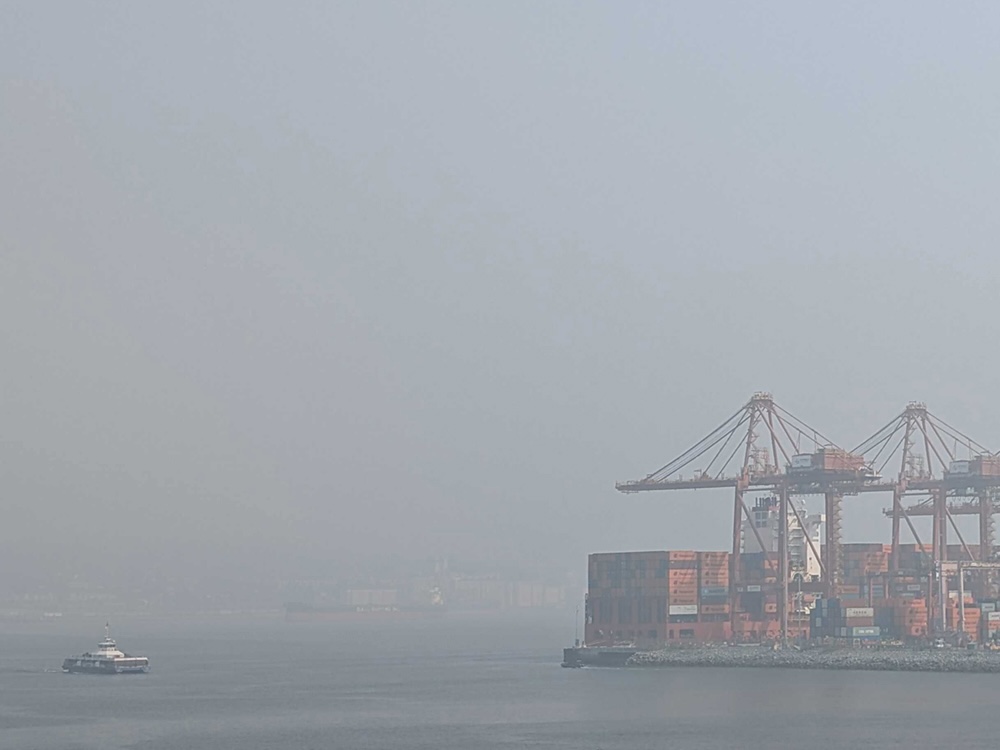
Wildfire smoke will continue to coat the southern half of the province over the next couple of days.
By this evening, smoke is forecast to blanket Fort St. John, Prince George, Quesnel, Squamish and Williams Lake, creating an air quality health index of 10-plus — on a scale that goes only from one (low risk) to 10 (very high risk), according to the federal government.
And that’s with the caveat that the air quality health index sometimes underreports health risks caused by smoky air.
Wildfire smoke is harmful for everyone. Seniors, young children and infants, people who are pregnant, people with pre-existing health conditions like asthma, chronic obstructive pulmonary disease, heart disease and diabetes, and people with respiratory infections like COVID-19 are considered more at risk from wildfire smoke and should take extra precautions during smoky periods.
What’s in smoke that makes it so bad?
Wildfire smoke is made up of a mixture of gases like carbon monoxide, nitrogen oxides, volatile organic compounds and fine particulate matter that is smaller than 2.5 microns wide. For comparison, a human hair is generally between 50 and 180 microns wide.
BC Air Quality’s goal is to have less than 25 micrograms of fine particulate matter in a cubic metre of air over a 24-hour period.
As of Wednesday morning, air quality measuring stations at Horseshoe Bay and Squamish Elementary were reporting 191 micrograms of fine particulate matter per cubic metre of air. Communities across the province were reporting poor air quality.
The mixture of gases and particles in wildfire smoke can vary depending on the weather, what’s burning and the proximity of the fire.
How wildfire smoke affects health
Exposure to wildfire smoke can cause minor and more serious health issues, and there is no “safe” level of exposure, according to Health Canada.
The BC Centre for Disease Control, or BCCDC, lists several negative ways smoke affects a person’s health.
First, wildfire smoke makes it harder for a person’s lungs to get oxygen into their blood.
Second, smoke irritates the respiratory system and can cause an immune response that can create inflammation that affects other parts of the body, like a sore throat. (That’s because tiny particles can get deep into a person’s lungs and enter their bloodstream.)
Third, smoke may increase the risk of some infections, such as pneumonia, COVID-19 and ear infections in children.
Common reactions to smoke, according to the BCCDC, include irritated eyes, runny nose, mild cough, phlegm production, wheezy breathing and headaches. These symptoms generally do not require medical attention.
But people should seek medical attention if they experience more severe symptoms, which can include shortness of breath, severe cough, dizziness, chest pain or heart palpitations, the BCCDC says.
How to protect yourself when it gets smoky
The best way to limit the harms of wildfire smoke is to minimize your exposure to it as much as possible, says WorkSafeBC.
One caveat: protecting yourself from extreme heat is even more important than protecting yourself from smoke. Heat can kill in a short time, so crack that window or hang out in a park to cool down even if it’s smoky out.
Staying hydrated helps the body deal with heat stress and wildfire smoke stress.
Adults can breathe 10 times more air when exercising than when resting, so the BCCDC recommends slowing down when outside during smoke to reduce the amount you breathe and therefore the amount of smoke you are exposed to.
A properly fitting N95 mask protects the wearer from breathing in fine particulate matter created by wildfires. Blue medical masks will not filter out smoke, according to WorkSafeBC. The Ministry of Environment and Climate Change Strategy also recommends wearing a fitted three-layer cloth mask to filter smoke.
When they are in areas that have poor air quality, people working in vehicles should roll up the windows and turn the air conditioning on recirculate mode, according to WorkSafeBC.
Indoor spaces can be turned into clean air shelters by sealing an area (such as a room, an office or a home) from wildfire smoke, by closing doors and windows and sealing any cracks, and then cleaning the air inside using indoor air purifiers, HVAC systems or heat pumps.
Indoor air purifiers like a Corsi-Rosenthal box can be built for around $75 and are relatively easy to make. The Tyee has a video showing how to assemble one, or you can follow instructions from the BCCDC.
HEPA air filters are best, according to the First Nations Health Authority, but if they are not available, running a conventional filter will still help clean indoor air.
Avoid smoking, burning candles, turning on gas or wood-burning stoves, frying food and vacuuming in the shelter space, and make sure the air purifier is up to the task of cleaning all the air.
Many municipalities also operate clean air shelters at local libraries or malls, where the buildings have HEPA filtration systems. Most of these shelters and their hours can be found on local government websites — here’s Vancouver’s, for example.
How BC’s outdoor workers are doing
Employers in the construction and agricultural industries are not doing enough to protect workers from wildfire smoke, Byron Cruz, a longtime advocate for migrant farmworkers and a member of the Sanctuary Health collective, told The Tyee.
Cruz said he had to help take an agricultural worker to the hospital because they were in respiratory distress after not being given a mask at work, and previously he’s heard from construction workers who said the smoke made them feel dizzy and sick.
Cruz said the provincial government needs to create regulations that protect workers from smoke. Right now there are just recommendations from WorkSafeBC, he said, and inspections that employers know about ahead of time.
“Inspections right now are not real,” he said. “They’ll speak with a supervisor but they don’t have anyone who speaks Spanish or Vietnamese. When WorkSafe arrives on a farm, the farm is prepared. They’ll give out the nice masks. But then the inspector leaves and they go back to the $1 masks, if they even give out masks. There is no PPE for the smoke.”
He added that he isn’t aware of any recommendations, let alone regulations, about workplace exposure to wildfire smoke.
WorkSafeBC says wildfire smoke likely isn’t enough of a danger for a worker to refuse unsafe work and that the Occupational Health and Safety Regulation does not specifically cover wildfire smoke. However, the Workers Compensation Act and regulation more generally require employers to ensure the health and safety of their workers.
Unfortunately, Cruz said, most temporary foreign workers do not feel like they are able to complain about unsafe work or advocate for better working conditions.
Their work permits are generally tied to a single employer who can send them home if they rock the boat, Cruz said.
Some work is being done in the agricultural sector to improve workplace safety around extreme heat, like having workers start at 3 a.m. when it is cool and finishing work by 11 a.m., Cruz said.
But 80 per cent of housing is inadequate and doesn’t have air conditioning, so there’s nowhere for workers to safely sleep after starting work at 3 a.m., Cruz said.
Most construction sites don’t have cooling centres either, he added. ![[Tyee]](/design-article.thetyee.ca/ui/img/yellowblob.png)
Read more: Health, Environment







Tyee Commenting Guidelines
Please note that email notifications for replies are not currently working due to a software issue which may be resolved in a future update.
Comments that violate guidelines risk being deleted, and violations may result in a temporary or permanent user ban. Maintain the spirit of good conversation to stay in the discussion and be patient with moderators. Comments are reviewed regularly but not in real time.
Do:
Do not: