


 SHARE:
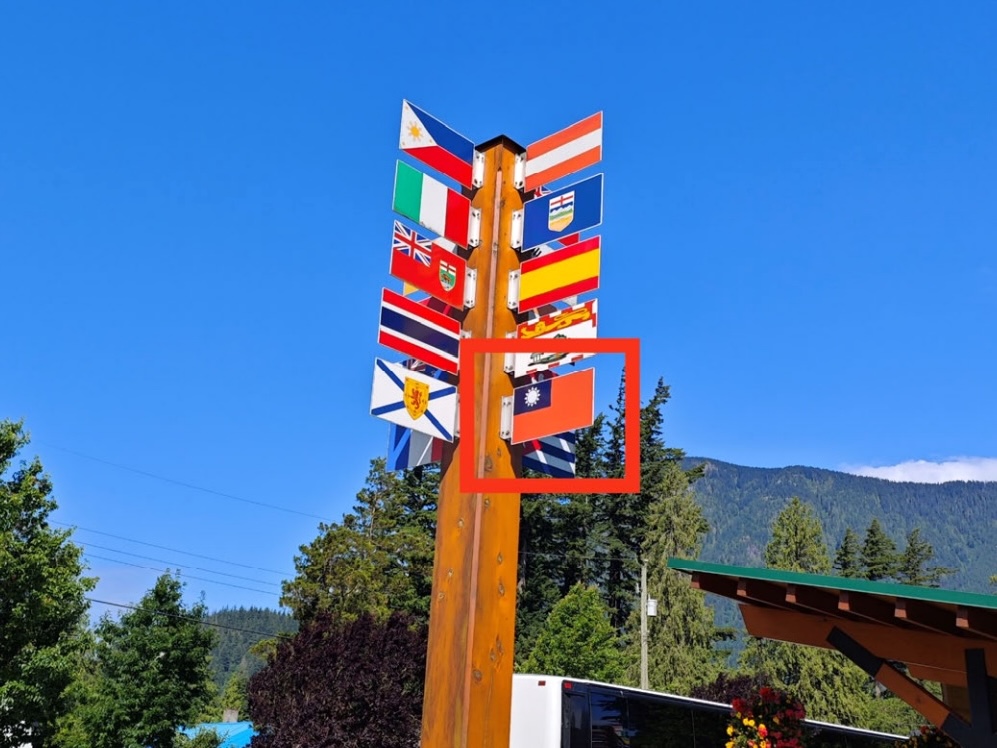
A new front has opened up in the diplomatic battle between China and Taiwan: the small town of Hope and its welcoming central bus stop.
Consuls from each government have contacted Hope about the “serious” situation, leaving the small municipality facing the prospect of upsetting either a global superpower or an upstart democracy.
Having initially agreed to meet China’s demands, Hope’s mayor and council have now reversed course to satisfy the Taiwanese. China had warned that the move flies in the face of its “core interests” — and Canadian policy.
The problem: a single, hand-sized metal flag installed more than a decade ago.
The flag flap
Hope’s foray into global politics began innocently and accidentally 16 years ago, when the municipality hired a builder to construct a new central bus stop. The spot, which is frequented both by local BC Transit vehicles and by charter coaches, is located at Memorial Park, the district’s main central green space. It’s also within a stone’s throw of the town hall. To decorate the bus stop’s new wooden benches, the project’s builder erected two wooden poles. Each pole was adorned with 20 tiny metal flags no larger than an adult’s hand. One of those was the Taiwanese flag.
A total of 40 flags were placed on the two poles. They included the emblems of each Canadian province and territory, as well as an array of flags from around the world. There seems to have been little thought given to the potential ramifications of including the Taiwanese flag.
The foreign flags were chosen for “nations where Canadians have laid down their lives for liberty,” the project’s co-ordinator, Jim Engiles, told the Hope Standard in 2009, when the project was completed. Other flags were chosen because they were trading partners or sources of tourists.
The small flags clung to the poles without controversy for more than a decade until an email came thudding into Hope Mayor Victor Smith’s inbox last July.
“I am writing to express the Chinese Consulate General’s concern about the improper use of a so-called ‘national flag’ at the Memorial Park of the District of Hope,” the email began. (A lone copy of the email was sent to B.C.’s Ministry of Forests. It seems likely the Chinese Consulate confused the email address — [email protected] — with that of a foreign ministry.)
The email was written by Liu Diyi, the vice-consul of the Chinese Consulate in Vancouver, and said the inclusion of the Taiwanese flag on the pole flew in the face of Canada’s One China policy, which officially asserts that only one Chinese nation exists. That policy is deliberately ambiguous; Canada acknowledges China’s claim to Taiwan but also maintains diplomatic ties with Taiwan. China, meanwhile, publicly interprets the policy to reinforce its claim that Taiwan is not an independent state.
“The Taiwan question is the very core of China’s core interests,” Liu wrote. “In view of this, the flag of the so-called ‘Republic of China’ or ‘Taiwan’ can never be used in public places in Canada, especially when it appears together with national flags of other countries.”
Liu asked Hope to “pay attention to this serious issue, fully recognize the highly sensitive nature of the Taiwan question, and take effective measures to correct the mistake.”

The day after Liu’s email was sent, Smith replied, promising that Hope would remove the Taiwanese flag.
“Thank you for your email indicating a necessary correction is required,” he wrote. “The flag referred to at our central bus stop (Memorial Park) was obviously emplaced in error and the District of Hope will replace it with the correct People’s Republic of China flag as soon as possible. We do this out of respect and to adhere to Canada’s official one ‘China’ policy. We are glad you pointed this out.”
The Taiwanese flag was then quickly removed (though it wasn’t replaced by the flag of China because that emblem was already on the post).
In July, someone noticed.
Last month, Smith received another email — this one coming from a Taiwanese visitor named Chuyun (Yoco) Lin, who pointed out that their island’s flag had disappeared from the centre of town.
Lin wrote that many Taiwanese tourists visited the town each year and that “seeing our national flag represented would be a meaningful gesture of welcome and recognition.”
They even volunteered to donate money to help create a new Taiwan flag for the pole.
“It would be an honour to contribute in this small way to a town that has inspired so many of us to travel and connect with Canada.”

Two weeks later, a second email arrived, this one from the Taipei Economic and Cultural Office in Vancouver. The director general of that office, which functions as Taiwan’s B.C. consulate, wrote that “a number of Taiwanese Canadians across the province have reached out to our office, expressing serious concerns about the removal of Taiwan’s national flag from the district’s international signpost.”
Lihsin Angel Lieu wrote that the removal of the flag “runs counter to the current trajectory of our bilateral relations, which has been going from strength to strength.”
Whereas their Chinese counterpart had cited Canada’s One China policy to strengthen their argument, Lieu wrote that Taiwan is a key partner in Canada’s Indo-Pacific Strategy and that the absence of the flag during B.C.’s first Taiwanese Heritage Month was “deeply disturbing for Taiwanese Canadians who live here.” (The province had proclaimed July to be Taiwanese Heritage Month.)
The Taiwanese response left Smith and the District of Hope in a no-win situation.
Displaying only the China flag could be seen as politically motivated, staff warned council in a report tabled this week. Removing both might be seen as a neutral move but could also “lead to diplomatic repercussions as governments residents and visitors may view the absence of their respective flags as a lack of recognition or support,” staff wrote. And reinstating the Taiwanese flag would just return the poles to the state that had originally upset the Chinese.
Staff recommended restoring the Taiwanese flag, noting that Canada maintains unofficial ties with Taiwan, and arguing that displaying the flag may be possible and would be “grounded in the principles of respect, open dialogue, and international engagement.”
The flag, staff continued, would “symbolize commitment to democratic values, the right to self-expression, and the fostering of people-to-people connections without implying formal diplomatic recognition or contravening Canada’s official policies.”
Council agreed at its Monday meeting.
‘Not our battle’
Smith spoke to The Tyee the following day. Smith, who was born in Hope and owned an industrial equipment supply company before being elected mayor, said the episode had prompted him to read up on 20th-century Chinese history and the relationship between China and Taiwan. But when it came to making a decision on flags, he favoured an equal approach.
“We’re going to put both up because this is not our battle,” he said.
Smith’s town is known as a key highway gateway between the Lower Mainland and the rest of British Columbia and Canada, and the mayor’s priority is tourism, not geopolitics. He was keen to talk up a well-attended free concert last weekend and this weekend’s chainsaw carving event, a massive biennial production (as events in Hope go).
“We want everybody to feel welcome,” he said.
Smith, one senses, would much rather listen to the roar of chainsaws than to diplomats.
“They can deal with Ottawa if they wish, but it’s not our battle.” ![[Tyee]](/design-article.thetyee.ca/ui/img/yellowblob.png)
Read more: Politics










Tyee Commenting Guidelines
Please note that email notifications for replies are not currently working due to a software issue which may be resolved in a future update.
Comments that violate guidelines risk being deleted, and violations may result in a temporary or permanent user ban. Maintain the spirit of good conversation to stay in the discussion and be patient with moderators. Comments are reviewed regularly but not in real time.
Do:
Do not: