


 SHARE:

[Editor’s note: Autism and Autistic have been capitalized in this piece at a source’s request, in recognition that many Autistic people understand Autism as a core part of their identity.]
Adulthood is full of paperwork. If you want to obtain a driver’s licence, apply for post-secondary schooling, renew a passport, buy a house, file your taxes, access a loan or income supports, you will have to fill out a form. Sometimes several.
Maybe you also need to track down supporting documents, like a notice of assessment. Perhaps you have to create online accounts, or access accounts you’ve been locked out of.
Bureaucratic processes like these can be complicated, time-sucking tasks that at best leave many people frustrated. But what is it like for neurodivergent people?
An umbrella term, neurodivergence includes diagnoses such as Autism, attention deficit and hyperactivity disorder, obsessive compulsive disorder and dyslexia.
Broadly speaking, neurodivergence is seeing and interpreting reality differently than the majority of people who are seen as “neurotypical,” says Anne-Marie Pham, CEO of the Canadian Centre for Diversity and Inclusion, a national charity advocating for inclusive workplaces through education and training.
“There’s no hierarchy, we’re just different,” Pham said.
But designers behind everyday bureaucratic forms tend to create their processes with neurotypical people in mind. And these processes and forms can be poorly designed: providing unnecessary information, using inconsistent or confusing terminology, and burying deadlines and expectations that should be clear from the start.
Take, for example, Larissa’s experience registering for the micro certification in equitable systems design program at UBC, using the provincial government’s future skills grant of up to a $3,500 lifetime amount. Larissa, who uses she/they pronouns and whose last name The Tyee is withholding to protect their privacy, is Autistic.
When Larissa applied for both last August, she didn’t know it would involve almost three months of back and forth with the university, creating six different online accounts and being charged a $75.50 application fee in error.
The convoluted, maze-like experience, which included interactions with staff where Larissa’s questions were not answered or they were provided contradictory advice, “had a serious impact on my quality of life and created a lot of stress,” said Larissa.
The stress contributed to a panic attack, landing Larissa in the emergency room last September.
While UBC confirmed Larissa’s experience was an error on the university’s part, it is not unusual for neurodivergent people to struggle when completing tasks designed for neurotypical people like applying for school, says Vancouver Island based consultant and advocate Lara McLachlan.
McLachlan created the Neurodiversity Change Network to advocate for workplace adaptations and accommodations for neurodiverse people.
There are many strengths associated with neurodivergence, including increased attention to detail, greater focus, creativity, the ability to think outside the box, and being more likely to act when errors are noticed.
“It’s the environment that makes it difficult to get things done, be successful, and be integrated as easily as other people,” McLachlan said, adding neurodivergence is a spectrum, with challenges varying from person to person, as well as over a person’s lifetime.
The barriers
While neurodivergence is not a monolith, some of the common issues neurodivergent people experience when doing things like applying for school or filing taxes — especially if the processes and paperwork are poorly designed — include experiencing challenges with requests and processes that are neither straightforward nor clear, vague deadlines, and when their requests for clarification or assistance are not met.
When a neurodivergent person secures help to assist in problem areas of an application, they may struggle, like Larissa did, if they are not provided with clear answers that fully clarify their questions.
“I would want [UBC] to have said, ‘If you can’t see where to input your course, then you are in the wrong application portal,’” Larissa said.
But instead of answering Larissa’s question directly, they say a UBC staffer instead copied and pasted information from the university’s website. The link to the page Larissa needed was embedded in the text, alongside many other unnecessary links and a visually confusing layout.
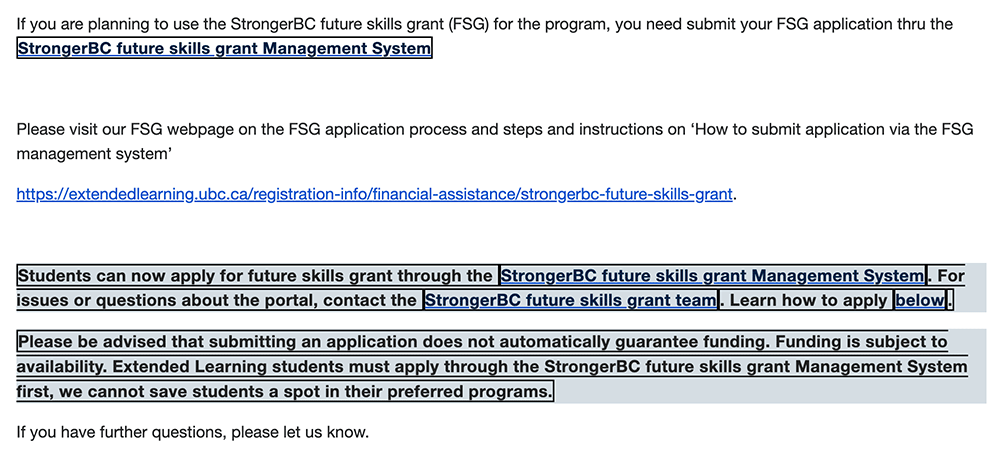
Roadblocks like these can lead to frustration, says Pham, and delays in finishing the task. As a result, people can miss deadlines.
“Whether it’s access to a grant or to a health-care benefit, these can really impact someone’s ability to get the support that they need,” she said, adding designing bureaucratic tasks around neurotypical thinking leads to a systemic underrepresentation of neurodivergent people in schools, workplaces and society.
The solutions
In an interview with The Tyee, UBC extended learning executive director Larry Bouthillier said Larissa’s case was a rare situation of someone falling into gaps in the university’s system.
“In some cases, and this happened with the student in question here, a help request gets routed accidentally,” said Bouthillier, “to a team that’s not really prepared to deal with it.”
Part of the issue was also that in 2023, students could apply for the future skills grant through the school. Now students must apply through the province.
“We look for the most frictionless experience possible for students,” Bouthillier said of the application process. But UBC extended learning doesn't design their application process with neurodivergent people in mind.
Instead they used Universal Design for Learning concepts, offering accommodations that are helpful for both people with disabilities and without.
Pham recommends every organization undergo a neurodivergent accessibility audit, as well as getting feedback from neurodivergent people they work with and serve.
The Canadian Centre for Diversity and Inclusion provides webinars and information sheets on accommodations and adaptations for neurodivergent people.
McLachlan, whose Neurodiversity Change Network is developing a knowledge portal for employers to adapt their workplace for people with ADHD and other neurodivergencies, also has recommendations.
Key recommendations from Pham and McLachlan include:
- Form and website language should be clear, consistent and easy to understand, stating at the top what information the process collects, the information required to finish and what happens after submission.
- Timelines, including step by step deadline information, should be very obvious,
- Clear contact information where people can get live support.
The form should include something “like a bar [at the top] with ‘Step 1, Step 2, Step 3.’ Not tiny wording that you might not see,” McLachlan said.
Pham adds that having a real person to talk to, instead of a robot, is important. Videos explaining the bureaucratic processes step by step could also be helpful.
Beyond adaptations, McLachlan would like to see organizations invest in training staff to work with neurodivergent people and create workplace cultures focused on acceptance and connection.
“It’s better if the approach of the organization considers the possibility that people who are neurodivergent will apply or use the bureaucratic services,” she said, adding that neurodivergent people should provide this training.
“So that they do develop an awareness, but one that is based in lived experience, social justice and equity.”
If neurodivergent people continue to experience roadblocks, Pham recommends they seek out local neurodivergent support and advocacy organizations.
“They’re there to help individuals navigate the system, fill out forms for them, and if needed, advocate for them,” she said.
The irony of Larissa’s experience was the program they were trying to register for is focused on making workplaces more accessible for everyone.
“I have learned a lot about white supremacy culture and systems of oppression and how to identify those things” in my life, Larissa said of their interest in the program. "I want to be able to design inclusive systems of affirmation."
Their experience with applying for the UBC program and the future skills grant was just one more example of inequitable design to add to their list. ![[Tyee]](/design-article.thetyee.ca/ui/img/yellowblob.png)












Tyee Commenting Guidelines
Comments that violate guidelines risk being deleted, and violations may result in a temporary or permanent user ban. Maintain the spirit of good conversation to stay in the discussion and be patient with moderators. Comments are reviewed regularly but not in real time.
Do:
Do not: