



 SHARE:

Natalie Jatskevich’s 78-year-old mother woke up in the Ukrainian city of Kharkiv at 5 a.m. yesterday and heard explosions in the distance.
She called a friend who lives on the outskirts of the city of 1.4 million in northern Ukraine. Russian tanks were moving into the area, her friend said, and the Ukrainian military was trying to fight them off.
Jatskevich, who has lived in Canada since 2002, said the Russian invasion has shattered life for her mother, and many others.
“The windows are rattling there, and there are many, many people down in the bomb shelter.”
Jatskevich was one of around 200 people who gathered outside the Vancouver Art Gallery on Thursday, around 13 hours after Russia invaded Ukraine in a military campaign that has shocked the world.
It was an impromptu rally, with Ukrainians and Canadians of Ukrainian heritage waving blue and yellow flags, singing and trying to get their message out: We don’t want war.
“We love Russian people, we have family on both sides — both Russia and Ukraine — and what’s happening is crazy,” said Natasha, who did not want her last name to be published because of safety concerns. Standing on the sidelines of the rally in a yellow raincoat and wearing a wreath of blue and yellow flowers over her toque, Natasha said she feels helpless.
Her mother and 15-year-old sister are trapped in their apartment in Kherson, a city north of the border with Crimea, an area near the Black Sea that was illegally annexed by Russia in 2014.
“They’re just hearing the bombs all of a sudden, all of a sudden the city’s on a lockdown, no trains, no buses, nothing is moving,” she said. “They’re scared for their lives.”
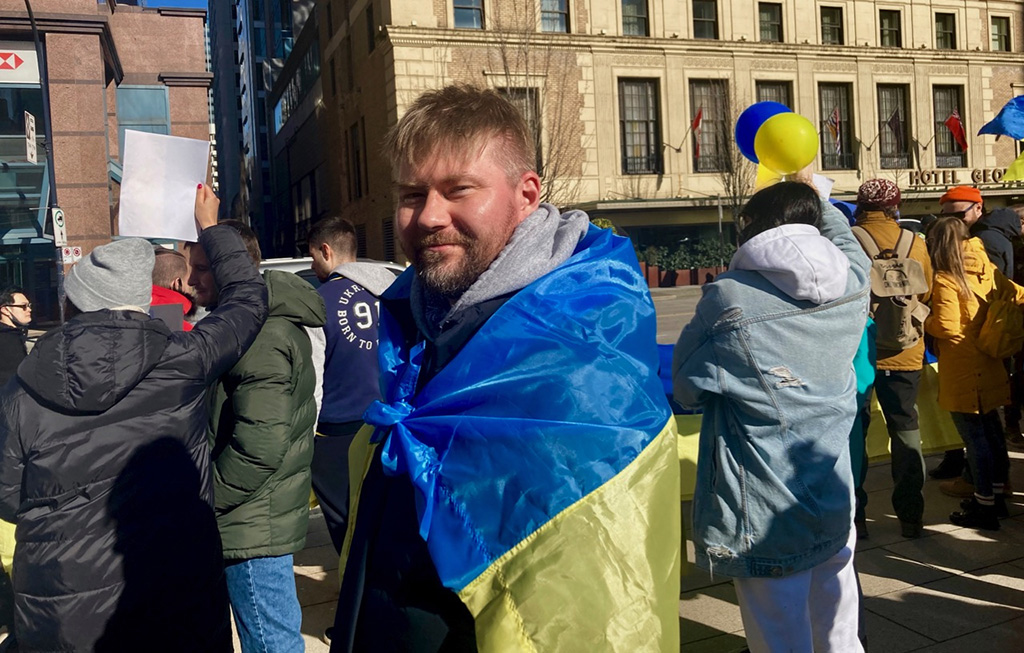
Volodymyr Krasnikov is an IT worker who has lived in Canada since 2017. He took part in protests in Kyiv in 2004 and again in 2014. The 2014 protest ultimately ended Viktor Yanukovych’s presidency. Yanukovych had moved closer to Russia and away from participation in the European Union.
“I woke up in the middle of the night, read the news, and [thought], we need to act somehow,” Krasnikov said. “We’re not there and I cannot join the Ukrainian forces, to start shooting enemies. But we need to attract the attention of other people to show it’s not right.”
Like Jatskevich and Natasha, Krasnikov had spent hours on the phone with his parents, trying to convince them to go to find a safe place to shelter in case they are bombed.
“I did my best to persuade them to go to a basement, to shelter in place, to have a deposit of water,” Krasnikov said. “Just suggesting to them if they hear the alarms sounding, to keep away from windows — basic stuff.”
Krasnikov said Ukrainians want to be a part of the European Union and live in a country where democracy and human rights are safeguarded.
Olga Gogoleva grew up in Novosibirsk in Russia and lived in St. Petersburg for years. She came to the rally to show support for Ukraine, holding a sign that read, “I am Russian and I am against the war.”
“I’m very ashamed for what’s going on in my country, the decision that’s been made by my government,” she said. “Russians don’t want this.”
Gogoleva said she has taken part in protests against Russian President Vladimir Putin in St. Petersburg, and it gave her hope to see people marching in the city against war — despite harsh laws that have been enacted in Russia to prevent such protests.
“I’ve never been arrested, but a lot of my friends have been arrested and it’s not easy. It can take 10 days in jail, stuff like this — that’s why people are afraid,” she said.
Over 1,700 people in Russia have been arrested so far for protesting the war.
Gogoleva said she’s also worried about the war’s impact on her family in Russia, including how new economic sanctions imposed in reaction to the attack on Ukraine will affect people.
Outside of Russia, Canada has the largest diaspora of Ukrainian people. Canada has already supported Ukraine with weapons and a $500-million loan, and has partnered on military training for years.
Jatskevich, a member of the Ukrainian Canadian Congress, said it’s important that support continues.
First-generation Ukrainian Canadian Eugene Lupynis said many people here with a connection to the Ukraine are taking a walk in the sun, turning off the news, praying and heading to rallies. These are the only small comforts they can find right now.
“There seems to be no reprieve from the news… as much as that feels like a burden it’s also a relief, because we know the plight of our Ukrainian brethren is being broadcast to the world,” said Lupynis, who is on the board of the Ukrainian Canadian Society of Ivan Franko in Richmond.
Many are worrying about loved ones in Ukraine and also grieving their home away from home.
Laisha Rosnau, a second-generation Ukrainian Canadian living in Coldstream, said family friends who once expressed optimism about their futures in Ukraine are now fleeing their homes in Kyiv.
On Thursday, she pulled over to the side of the road to hear from two family friends were able to get in touch for the first time since the invasion.
“There’s nothing really that we can do from here as individual Canadian citizens, but at the same time I feel emotionally invested not only in the health, happiness and safety of friends and family in Ukraine, but also very emotionally invested in the notion of free and open democracy for them too,” said Rosnau in a phone interview.
It’s too early to tell what supports the communities need, Lupynis said, because everyone is just in shock.
“We’re praying for our cultural brethren and for our family and friends right now,” he said, including many in regions where communication has been shut down.
Ukrainians have been through many plights before, which gives Lupynis hope they will make it through this as well.
“There is huge concern, but Ukrainians for the most part will push forward and look to the good and to see the light at the end of the tunnel.” ![[Tyee]](/design-article.thetyee.ca/ui/img/yellowblob.png)
Read more: Politics




Tyee Commenting Guidelines
Comments that violate guidelines risk being deleted, and violations may result in a temporary or permanent user ban. Maintain the spirit of good conversation to stay in the discussion.
*Please note The Tyee is not a forum for spreading misinformation about COVID-19, denying its existence or minimizing its risk to public health.
Do:
Do not: