


 SHARE:
Last year school boards in Surrey, Burnaby, Maple Ridge and Merritt eliminated Grade 7 band programs to save money. Those blows came after the Vancouver School Board 10 years ago cut funding for band and strings programs in elementary schools.
Meanwhile, the cost of private music lessons keeps going up.
As secondary students who value creative arts, we are concerned that music education is increasingly inaccessible to youth in Metro Vancouver.
It worries Andrea Unrau, too. She first saw the strong connection between learning music and mental health when studying developmental psychology at McMaster University. “That’s how I learned about a field called music neuroscience or music psychology. From that point on, I became really interested in the benefits of music education.”
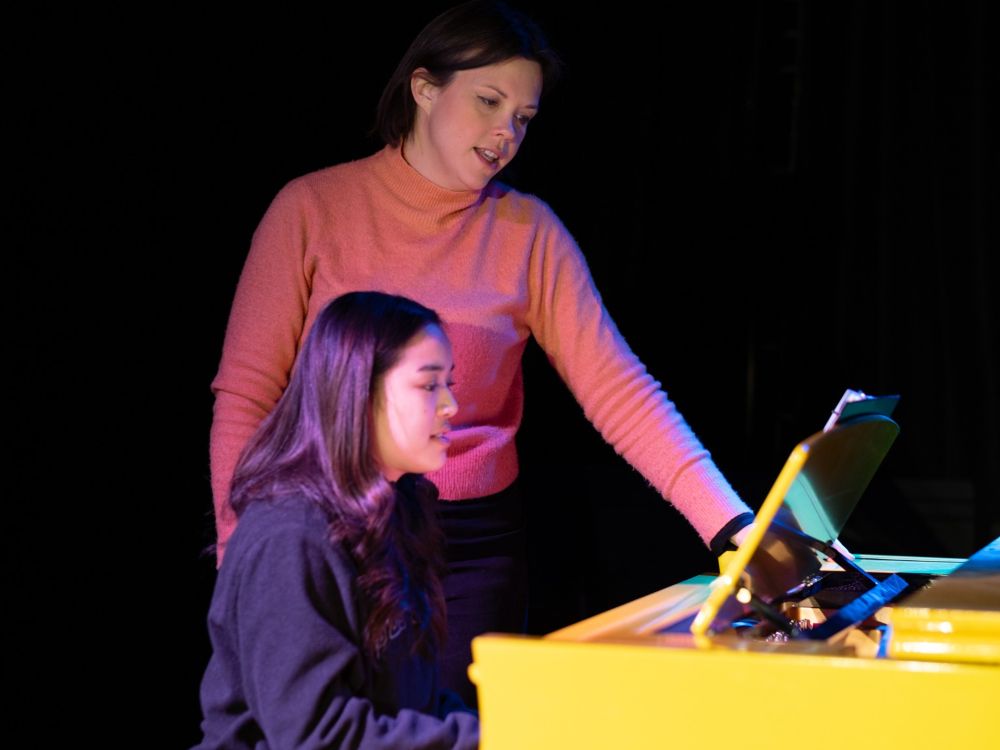
She went on to teach music and since 2019 has served as director of programming at the Sarah McLachlan School of Music, or SoM, where the focus is on making “community music” — an approach to learning that Unrau told us more about in an interview.
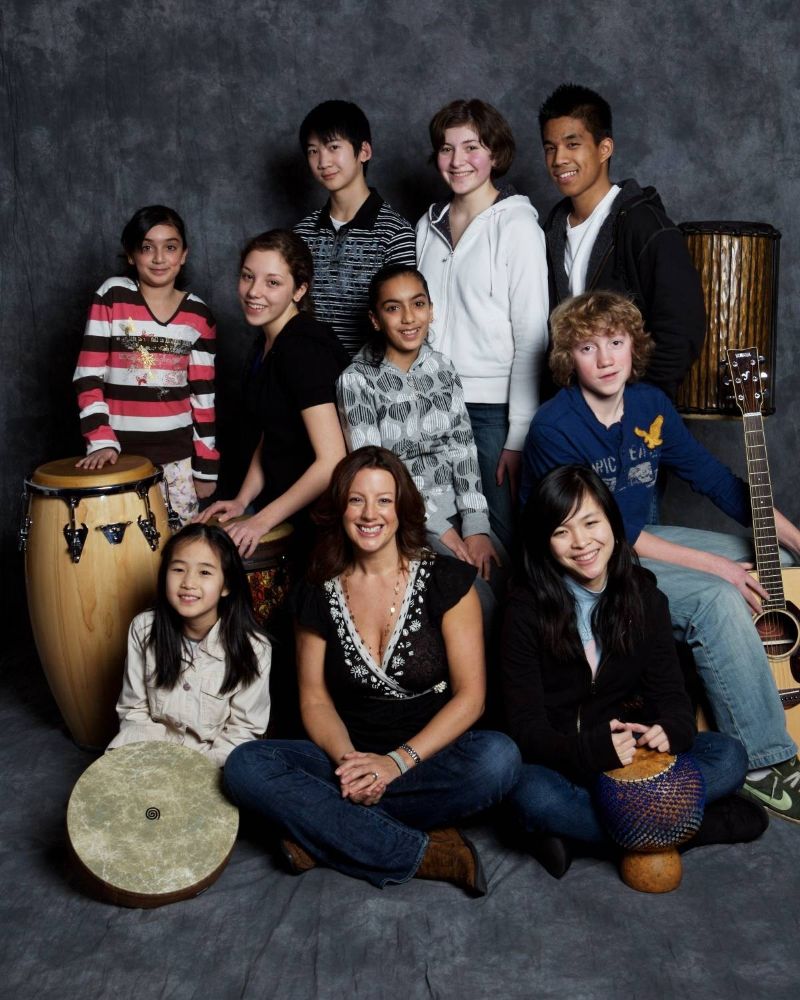
In 2002, Grammy-award-winning singer and songwriter Sarah McLachlan founded a program that provided music teachers opportunities to be “artists in residence” in elementary schools. She “really wanted to address the problem of music being cut in schools and of music only being accessible outside of schools,” explained Urau.
In 2011, with help from the Wolverton Foundation, the singer opened the first location of the Sarah McLachlan School of Music in the Mount Pleasant neighbourhood of McLachlan’s hometown of Vancouver. The school now provides free music education to more than 1,200 youth in Vancouver, New Westminster and Edmonton.
That achievement interested us as participants of a UBC research project on “future-focused journalism” that, in partnership with The Tyee, helped secondary students interview people making positive change.
We spoke with Unrau over Zoom from her Mount Pleasant office about the school’s approach to teaching “community music,” the good effects it can have for economically disadvantaged youth and the heightened need for human-to-human creative collaboration during the rise of artificial intelligence. Our conversation has been edited for length and clarity.
What attracted you to work at the Sarah McLachlan School of Music?
One of the things that really drew me was the fact that it was all tuition-free. I had learned about how kids learn music and how it affects how they learn, and it just felt terrible to me that all those benefits were increasingly being accrued only by people who could afford private lessons.
What do you find most satisfying about the work you’re doing now?
Sarah made the motto “find your voice.” I think it’s really, really relevant now.
When you can see a youth who’s maybe a bit disconnected or comes from a bit of a tougher background or has had a tough time making friends, when you see them find their voice, express ideas through writing a song, make a friend in an unconventional way through working together and playing a song.
When you watch somebody who, by the end of that period is able to write a scholarship application, apply for a job, perform something for a bunch of people, have the confidence to tell their story on a stage. It’s like this real sense that you’ve gone from being, like, “here’s some stuff you could learn” to them being able to express themselves and go out into the world with their own voice and their own perspective.
What is different about how the school involves young people in learning and playing music?
I think this was always a community music program. Community music is a term used around the world, and there’s a lot of research on it.
Essentially, community music is process-centered rather than certification-centered. Our approach encapsulates everything that isn’t a traditional academic or certification-based model.
The way that we structure our programs is that there isn’t a defined curriculum or defined programs. You’re put in a group with peers who are around your age, have similar interests as you. That group then gets to make their own goals. They can say, “we want to learn these songs, we want to play as a band, we want to write or record a song,” and then all those people are empowered to go and reach those goals.
A recent example of how community music making can connect people was visible at Surrey Steps Up, an annual showcase that highlights the positive impact youth have on the city of Surrey. There, in March, some of our music students shared some hip-hop and Latin percussion, as well as spreading awareness about the school and its impact.
What are some of the benefits for kids?
The benefits that we see are in three different areas.
One is the musical and creative benefit that you get from being able to go straight after what you want to do.
Next are the personal benefits. We see that there’s an increase in things like self-motivation, the willingness to practice, to do something that’s hard and doesn’t come easy right away if you’re working towards a goal that you stated yourself.
And then the third one is the social and community benefit. Learning how musical language allows people to create together, to jam together, to write together. That is a big benefit to youth who maybe don’t connect socially the same way their peers do.
If we keep going down the road where music education is inaccessible except for families who can pay to access it, then inequalities will worsen, because you’ll have all these benefits accruing only to families who can pay for increasingly expensive lessons.
How did the school develop its model of accessibility over time?
For Sarah, the most important accessibility piece was just that it not cost money. And there’s another deeper piece. Often youth activities not only have tuition, but then they keep having hidden costs. Even if you get a scholarship to attend a program, there are books and there are recitals, and there are shows.
So, if they are facing significant financial barriers, a lot of kids will have to drop out of those programs because those additional costs just keep piling up.
How do you navigate finances since you offer this program for free?
We realistically, as a non-profit, have to rely on fundraising, and fundraising is really hard. Having the connection to Sarah McLachlan just allows our profile to be big enough to be able to connect with donors who are interested in this kind of work and so we are able to bring our message to the people who need to hear it so that we can have sustainable funding.
You have these three campuses in Vancouver, New Westminster and Edmonton. How do you manage all of them?
The Vancouver campus is the biggest one. We serve about 800 students here and run over 40 hours of programming throughout the week. The programs in New Westminster and Edmonton are a little bit smaller. Each serves about 200 students.
I think I’ve learned that each program has to be its own thing. You can’t just take one model and make it work for everybody because the kids in downtown Edmonton are different from the kids in New Westminster or kids in downtown Surrey are different from the kids in Vancouver.
And then also kids change from year to year, and so you have to be adaptable and change the program to serve the current needs.
What are some ways that you and others helping to run the school determine how well you’re doing? Do you have measures for that?
The main one is that all our students complete an interview and a survey every year. The student check-in process involves a quantitative survey where we ask them a bunch of questions about musical development, personal development, social development. And then later we have interviews where they’re able to tell us what they liked learning, what they wish they did more of, what they’d rather do next year.
In addition to that, we’re part of a large-scale research project of community music schools across Canada, with whom we have been able to do three phases of research. One was looking at the structures of community music programs and how they help support vulnerable populations. Then we were able to do a phase where we talk to the teachers about what they do to accommodate different needs or what they do that they feel is different than traditional education.
And then the third one is the one that we’ve just been doing this past year, which is to survey hundreds of students about the impacts that they’re seeing. We were also able to survey families about the impacts that they’re seeing. And so that data is currently being analyzed, but it’s kind of our best measure yet.
And we’re starting to learn a lot from this research. For example, 87 per cent of students and 92 per cent of parents say they feel a sense of belonging and community in our programs. Importantly, 82 per cent of students and 94 per cent of parents say our programs support overall well-being. So, students and families are seeing an impact not just musically but in their lives generally.
Is there anything else that you wanted to share?
Just this idea that there is great power and value in being creative with other people, being able to react in the moment when you’re playing music in synchrony with others, being able to take your ideas and then communicate them for other people.
This is just a very human activity that I think we should all have some access to. I think it’s urgent that we prioritize it in the age of AI, because doing these things has all of these benefits baked right in. Benefits that AI can’t offer. Learning music in community has got the social, it’s got the personal, it’s got just this enjoyment factor of trying something and then getting better.
And I just think it’s very crucial that everyone have access to it, especially when young, so that they can take those skills with them as they become adults.
This story is part of a series by secondary school students, ‘Reporting on Better Futures.’ ![[Tyee]](/design-article.thetyee.ca/ui/img/yellowblob.png)









Tyee Commenting Guidelines
Please note that email notifications for replies are not currently working due to a software issue which may be resolved in a future update.
Comments that violate guidelines risk being deleted, and violations may result in a temporary or permanent user ban. Maintain the spirit of good conversation to stay in the discussion and be patient with moderators. Comments are reviewed regularly but not in real time.
Do:
Do not: