

 SHARE:
It’s just after 2:30 a.m. when my phone wakes me up.
The evening duty officer is calling. I don’t immediately recognize the caller, but my phone is set to let a few preprogrammed numbers break through my nightly “do not disturb” setting. There’s been a fire, she tells me. I’ve trained for this, and I’m ready. Still, it takes me a minute to shake the sleep off and get my kit together.
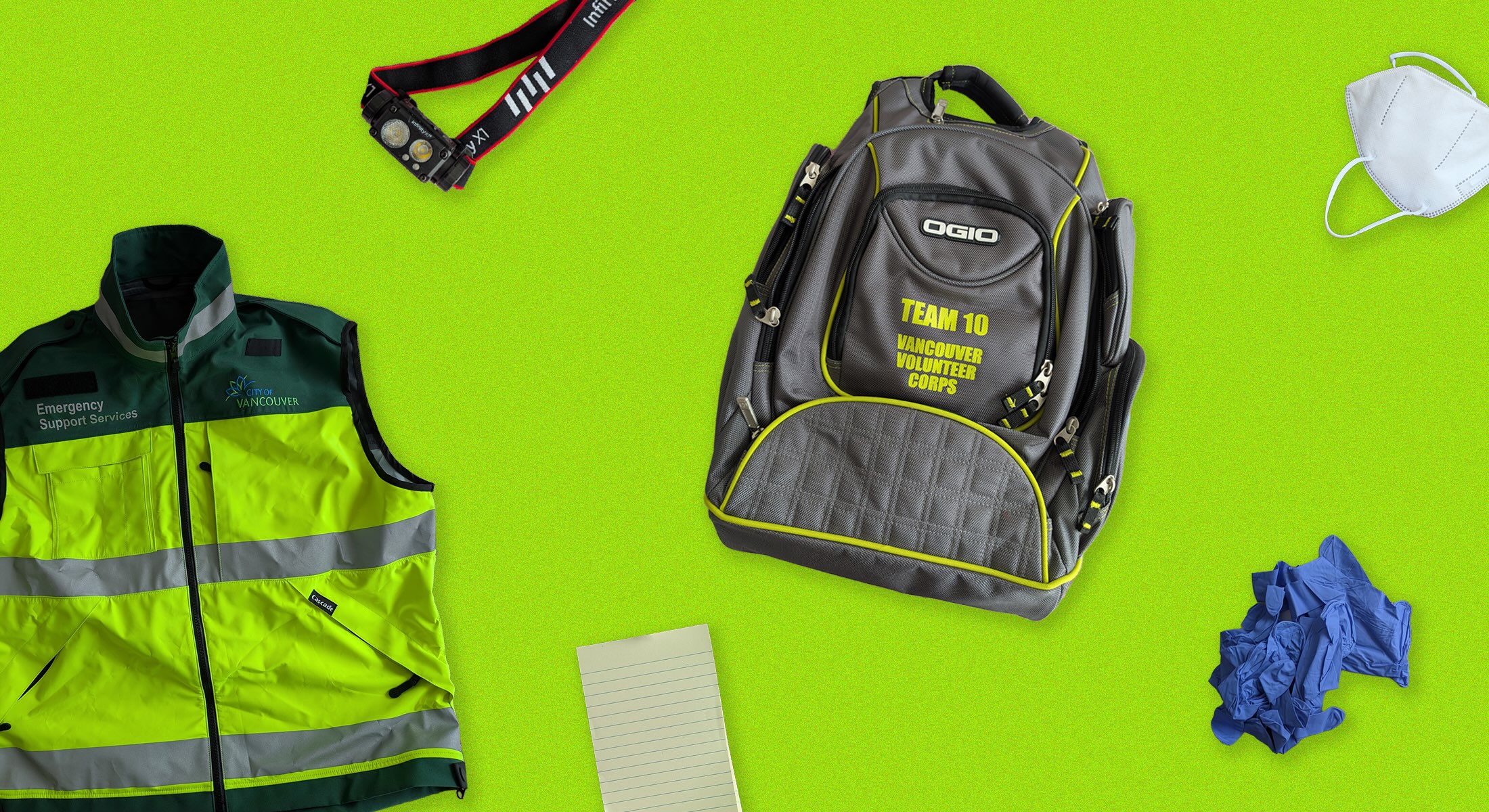
I splash water in my face and head for the closet near my front door. I have a backpack with what I’ll need. Or what I might need. I have a safety vest, pens and notebooks, a headlamp, registration forms, latex gloves and N95 respirator masks. I’m encouraged to add things as I see fit, too. Granola bars, naloxone, menstrual products. Anything that could come in handy.
This is pretty much a textbook deployment for an Emergency Support Services, or ESS, volunteer like me. I’m on a rotating list of Vancouver residents who have signed up to offer support when things go haywire. It could be flooding, an earthquake, a power outage. Whatever might force people out of their homes. Mostly it’s fires. At night, when most people are fast asleep and emergency services staff is reduced, we’re on hand to help.
My partner Max wakes up with me. We joined the ESS team together. We’re one of two couples on the team typically available to deploy together — it’s not required, but we work well together, and it’s a nice way to encourage each other while adding an extra set of hands in the field.
We’re on the road about 15 minutes after I pick up the phone. We hop into a car share about two blocks from home, amid the sounds of the neighbourhood nightlife. We live near a lot of bars, so it’s still pretty busy around us. About 15 minutes after that, we’re on site.
The fire department is already there when we pull up. The fire is out. Police are handling traffic.
We’re not first responders. We’re somewhere around second or maybe third or fourth responders. Our team captain arrived a bit before us. He’s ready to give us an update on what happened. We’ll be checking in with the folks who have evacuated their home. We’ll register them first.
There’s a digital form we can access when we’re at larger reception centres, but for small-scale responses like this, we use paper forms to gather some basic information.
After that, we can provide referral forms that will cover everything from hotel accommodations to clothes and toiletries. These forms are like cheques to be cashed for goods at businesses ESS has partnered with across the city. We can offer this kind of support for a few days on behalf of the province, so that initial registration will help the team at the city stay in touch going forward.
Tangible help, and support that’s harder to track
Max and I joined the team a little over a year ago. We had just returned to Vancouver after a few years away, and we wanted to feel more connected to the city. A bit more grounded. As hikers, we were already interested in first aid and search and rescue, so we looked for opportunities to volunteer as part of emergency responses generally.
That’s how we discovered Emergency Support Services. We had no idea anything like this existed, and I’ve realized on deployments that a lot of the people we help didn’t either.
We have regular meetings with the team where we debrief on past deployments and go through training exercises. Some of that is just understanding basic processes and the various forms we have to fill out, but a lot of it centres on soft skills, or the interpersonal tools for dealing with people who, in some cases, have just lost everything.
The material support is crucial, no doubt, but that human connection feels just as important sometimes. I can’t fully wrap my mind around what it must feel like to have one’s life rocked by something like a house fire or flood. I do know that I’d want people around me who care and want to help me through it, though. It’s rewarding to be able to take even just a fraction of the stress out of disaster for someone.
A way to engage with the world when hope feels lost
The world feels increasingly large and unwieldy. The challenges we face are so complex, and it’s easy to feel powerless or alone. We’re seeing an economy seemingly in free fall, whether it’s officially called a recession or not. Almost every day, we learn of yet another business guilty of horrendous labour abuses, or with deep financial investments in the rise of fascism and genocide. The U.S. president casually threatens our sovereignty as he invades other countries at will. The billionaire class protects its own at our collective expense.
When David Suzuki rang the alarm bells that the fight against climate change was already lost, it felt like a gut punch. After decades of governments and industry ignoring the problem and making it worse for financial and political gain, “now, it is too late,” Suzuki told iPolitics last year.
Responses ranged from denial to outrage to quiet resignation. But Suzuki did offer a path forward of sorts. A way to engage with this world at a time when hope seems lost.
Let’s think smaller, Suzuki suggested. Let’s have a look at the people around us. Let’s get to know our neighbours. When calamity reaches us, let’s meet it together, he said.
“The units of survival are going to be local communities, so I’m urging local communities to get together,” he said.
“Find out who on your block can’t walk because you’re going to have to deal with that. Who has wheelchairs? Who has fire extinguishers? Where is the available water? Do you have batteries or generators? Start assessing the routes of escape. You’re going to have to inventory your community, and that’s really what we have to start doing now.”
“Solutions are here,” he added in a followup post for the David Suzuki Foundation. “We just need to shift our priorities, hunker down and actualize them. We must all get involved.”
More recently, he told CBC, “It is true that we are now headed in a catastrophic way, and it's unavoidable."
Suzuki is right, as he so often is. There’s still so much we can do in the face of the oncoming catastrophe.
It won’t be a David and Goliath story. David chose one seemingly invincible foe and stood alone. We can’t afford to wait for such a hero to fight for us.
Our problems are too complex, and our abilities too stratified. We must meet the many small challenges as they come, together.
It’s time to rethink civic engagement
There’s no telling what kinds of emergencies I may be called on to respond to as a volunteer. Flooding and heat domes are an ever-increasing risk. Power outages could hit us for a number of reasons as we rely on an overburdened grid. And what might our earthquake responses look like?
Farther inland, wildfires have become a yearly inevitability. The FIFA World Cup is just around the corner. For more than a month, Vancouver will have most of its resources extended nearly to their breaking point. The hotels that evacuees might otherwise rely on will be booked solid — not to mention the nearly guaranteed displacement of unhoused folks downtown. Emergency responses will have to adapt.
Writing for The Tyee, public engagement leader Peter MacLeod has argued for a modern civil defence program, a more formal, wide-scale approach to these questions “fundamentally about national participation” that would involve “mobilizing the talents and capabilities of an entire population.”
MacLeod goes on: “In Sweden and Finland, civil defence is built around training, community preparedness and personal responsibility. Every adult is expected to have the knowledge and basic skills to help in an emergency — whether that’s first aid, defending critical infrastructure or organizing local response teams.”
This would be an excellent step towards building precisely what Suzuki calls for, with a scope even greater than climate catastrophe and including, among other things, potential military attacks in an unstable geopolitical landscape. Canada would undoubtedly benefit from such a program.
But we have the power to prepare ourselves now, too.
From bystander to citizen
I can’t control the bigger picture, whether that be the global causes of our changing climate or the choices of governments at home and abroad. I can’t will comprehensive social programs into existence, much as I would like to.
But, as Suzuki says, I can look out for my neighbours. I can act when I see an opportunity to help.
I can learn the skills needed to reduce harm and make myself available when a response is needed. Working with ESS has given me a new perspective. I have supplies at home to keep me safe in the event I’m stuck here. Food and water to last at least a few days. First aid supplies. Flashlights.
I also move through the world differently now — quite literally sometimes.
As I walk down the street, I notice my surroundings in a more active way than before, not as a bystander but as someone invested in the well-being of my community.
It’s easy to feel powerless in the face of overwhelming challenges, as global and national crises pile up, from war to rising grocery prices.
But there are ways for us to come together and face challenges not as abstract global citizens but as members of real, tangible communities of people who share a common fate.
Those with money and material possessions can donate to organizations making change locally, but we all have a role to play if we choose to.
That might mean volunteering with an emergency response team, or maybe your local food bank or shelter. It could mean learning CPR or familiarizing yourself with your neighbourhood’s muster points.
Carrying naloxone and learning to use it literally saves lives. It could mean forming stronger bonds, attending events at community centres, the library or local businesses. Maybe volunteering with a local scout or girl guide group. Or giving blood. It could just mean asking “Are you OK?” at the right time, or giving your neighbour’s car a boost when it won’t start.
The world is big, and its problems are even bigger. But our own place in it doesn’t have to be. We can look around us and consider our more immediate surroundings. We can make the world smaller.
The streets are quiet as we drive home. It’s around 4 a.m., so the city is still mostly asleep. The bars have cleared out.
Despite the late hour, I feel chatty. An adrenalin high, maybe. Everything went well tonight. Everyone got out safely and has a warm bed to sleep in. Someone will check in and try to help with next steps in the morning.
Our deployment is complete, save for the text message we’ll send the duty officer letting her know when we get home safely.
It’s Friday, so neither of us has to work in the morning. We’ll sleep in.
Next time may be different. We can’t always predict how people might need help.
But we can build a network of supports and be there for each other when the call comes. ![[Tyee]](/design-article.thetyee.ca/ui/img/yellowblob.png)
Read more: Health, Rights + Justice, Environment









Tyee Commenting Guidelines
Please note that email notifications for replies are not currently working due to a software issue which may be resolved in a future update.
Comments that violate guidelines risk being deleted, and violations may result in a temporary or permanent user ban. Maintain the spirit of good conversation to stay in the discussion and be patient with moderators. Comments are reviewed regularly but not in real time.
Do:
Do not: