


 SHARE:
Women and gender diverse people are tough. Not because they want to be, but often because there is no other choice in a harsh world that can feel as though we’re making two steps forward, then a dozen back. As the films featured at the 21st annual Gender Equity in Media Festival, or GEMFest, make abundantly clear, thus was it always.
With 35 films, shorts and features from over a dozen countries around the world, GEMFest takes an expansive approach to telling the stories of women and gender diverse people.
Some of the most powerful films are also the most personal.
Teresa Alfeld’s mid-length documentary Hearse Chasing opened GEMFest last night with Özgün Gündüz’s Burcu’s Angels, a short film about the community surrounding a beloved vintage clothing store run by a queer elder in Vancouver’s Mount Pleasant neighbourhood.
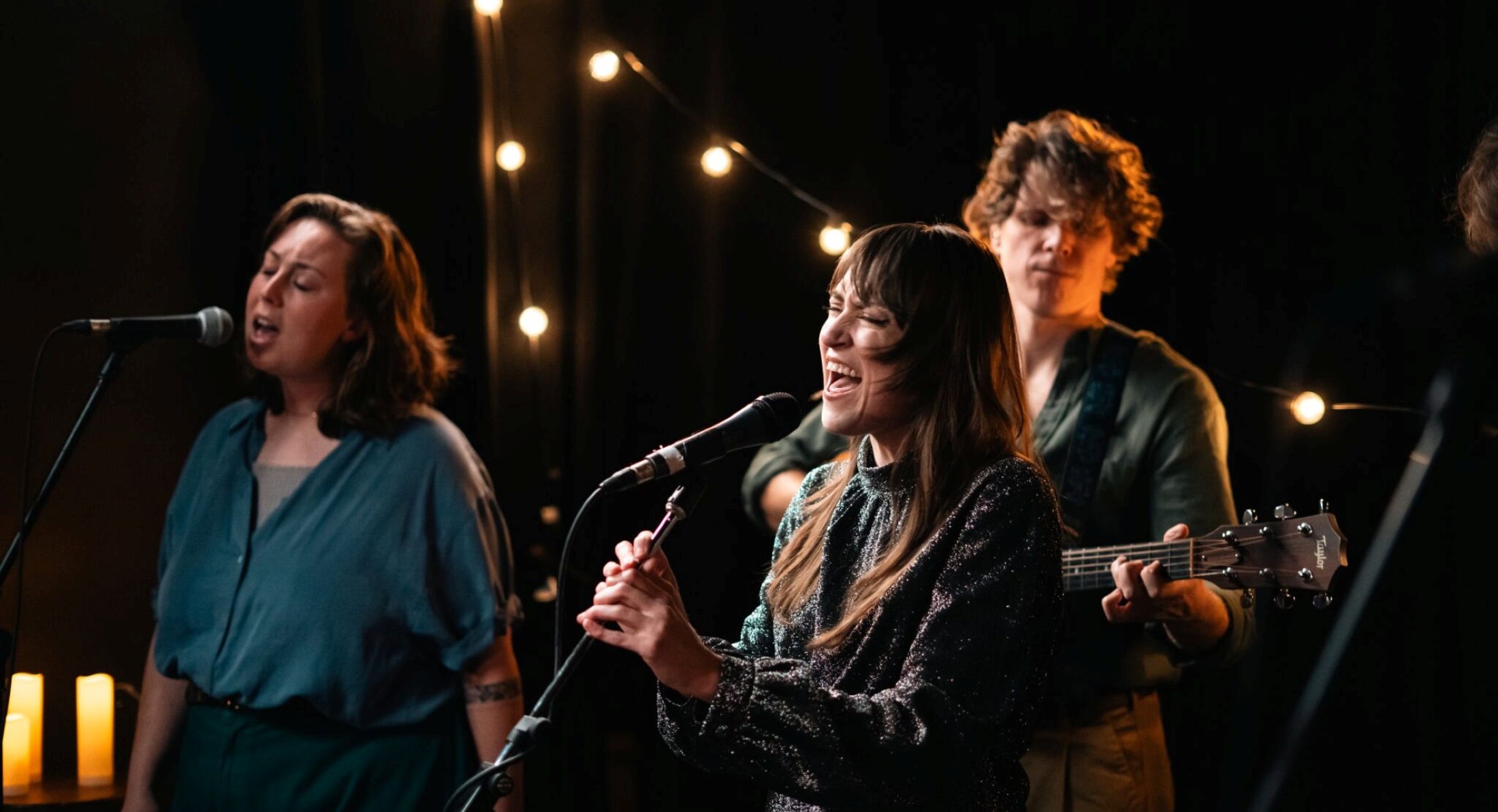
Hearse Chasing tracks Vancouver singer-songwriter Cassidy Waring’s decision to return to Calgary to contend with the defining family relationships of her upbringing. Her mother’s struggles with addiction form the narrative spine of the film.
When Waring was in her mid-teens, she and her brother Cooper were placed in the care of family friends because of violence in their family home. Their mother died shortly after, when Waring was 17. The profound effects of this experience lingered into Waring’s adulthood, manifesting as anxiety and substance abuse.
After being diagnosed with complex post-traumatic stress disorder, Waring embarks on a journey back to her point of origin. She revisits the apartment that she shared with her parents.
Through home videos, family photographs and memories, the film provides the time and space for brother and sister to work through their shared experiences.
In the process, a nascent form of healing, tender as a new leaf, begins to unfurl.
A Cree Approach, a documentary by Vancouver-based director Tristin Greyeyes screening at GEMFest on March 7, also centres the informing nature of family relationships. The film tells the life story of Freda Ahenakew, Greyeyes’ grandmother.
Ahenakew, a Nehiyaw, or Cree, woman, was instrumental in ensuring the survival of the nēhiyawēwin language. After her husband left her and their dozen children, Ahenakew turned her considerable will to getting a degree, writing the landmark text on Indigenous languages, and being awarded the Order of Canada. In that order.
Family memories of Ahenakew form the bulk of the narrative, but there are also fascinating tangents into Canadian history. The film traces not only the horrors of the residential school system, but also the troubling relationship between Indigenous people and Canada itself.
Born in 1932 in Ahtahkakoop, Saskatchewan, Ahenakew spent her formative years at the St. Alban’s Indian Residential School. After the end of her marriage, she returned to school and earned her high school diploma before continuing at the University of Saskatchewan.
Language preservation was a throughline in her academic work. Her master’s thesis, “Cree Language Structures,” undertaken while she was at the University of Manitoba, became the cornerstone text for Cree language education. In 1998, she received the Order of Canada, and in 2001, the National Aboriginal Achievement Award.
The woman at the centre of the story is resolute and brave. She built her life on a commitment to family, community and Indigenous culture. A Cree Approach is a fitting tribute to her extraordinary life’s work.
In addition to GEMFest, another film about the lives of extraordinary women is playing at the VIFF Centre this weekend on March 8, International Women’s Day.
Tough Old Broads, Stacey Tenenbaum’s documentary, profiles three remarkable women: Sharon Farmer, Siila Watt-Cloutier and Kathrine Switzer. Each is a fascinating character.
Taken collectively, their accomplishments, struggles and triumphs are a wonderful reminder that older women can be an unstoppable force for good.
Farmer was the first woman of colour to work as the official White House photographer under the aegis of Bill Clinton’s administration. With her neck encircled by the tools of her trade, Farmer makes for an arresting figure as she makes her way around her hometown of Washington, D.C.
After working in journalism, Farmer was hired to document the daily happenings in the White House, capturing on film many of the most significant moments of the Clinton years. Funny, blunt and plainspoken, she is an incendiary presence in Tenenbaum’s documentary. But the reality of living and working as woman of colour in Trumpian times makes for a rather depressing denouement to her remarkable career.
Watt-Cloutier spent her childhood in Nunavik, traveling by dog sled and living off the land. Her life in politics and activism began when she was elected the President of the Inuit Circumpolar Council. As an advocate for Inuk stewardship and knowledge preservation, Watt-Cloutier has fought for the rights of both the environment and Inuk people.
Switzer became the first woman to run in the Boston Marathon. In 1967, when the race was still an exclusively male affair, Switzer decided she would run. The moment that immortalized her in sports history came about when race officiator Jock Semple took off after Switzer, trying to rip the bib number 261 from her back.
Of the incident, Switzer wrote in her memoir Marathon Woman, “Instinctively I jerked my head around quickly and looked square into the most vicious face I’d ever seen. A big man, a huge man, with bared teeth was set to pounce, and before I could react, he grabbed my shoulder and flung me back, screaming, ‘Get the hell out of my race and give me those numbers!’”
Photographers documented the altercation, including the moment when Switzer’s coach and boyfriend physically removed Semple. Switzer went on to finish the race in four hours and 20 minutes at a time when women were thought incapable of completing a marathon-length run.
Switzer used her experience to advocate for the rights of women and girls, launching her 261 Fearless program that encourages women to use running as a means of facilitating independence and self-determination.
This collection of films is a reminder that the battles women and gender diverse people face are monumental. But so is their ability to overcome them.
GemFest runs March 5 to 8 at the VIFF Centre in Vancouver. Information on its films, industry events and other happenings are available online. Separate of GemFest, ‘Tough Old Broads’ screens at the VIFF Centre on March 8, International Women’s Day. ![[Tyee]](/design-article.thetyee.ca/ui/img/yellowblob.png)
Read more: Indigenous, Gender + Sexuality, Film







Tyee Commenting Guidelines
Please note that email notifications for replies are not currently working due to a software issue which may be resolved in a future update.
Comments that violate guidelines risk being deleted, and violations may result in a temporary or permanent user ban. Maintain the spirit of good conversation to stay in the discussion and be patient with moderators. Comments are reviewed regularly but not in real time.
Do:
Do not: