


 SHARE:
My children are obsessed with Sleeping Queens.
Invented by a six-year-old named Miranda Evarts, the family-friendly card game sees two to five players attempting to wake up 12 queens, all of whom appear to have ingested sleeping potions. To break the spell, you’ll need a Prince Charming — in this case, a king from a whimsical, fairytale kingdom: the Cookie King, Fire King or Bubblegum King, who looks quite a bit like me, I must admit. You can also raid neighbouring kingdoms with knights, steal recently-roused queens or put them to sleep once again with a fresh batch of potion. The player who wakes the most queens wins the game.
It’s impressively simple and silly. It’s fun, and it plays to the kids’ skillset: ensuring that the grown-ups in their lives get little rest. They want to play Sleeping Queens at all times, and it’s hard to say no, since it teaches them math and it isn’t an app on a screen.
Over Christmas, our family got way into games. Trapped at home for two rainy weeks, the kids needed something to do, and the iPads we used to rely on are long gone. I miss them sometimes for the silence they used to provide, but it came at a cost: when it was time to put the screens away (for breakfast, baths or bedtime, say), the children disagreed, in the same way that a dragon disagrees about the need for all that treasure. My kids are little monsters even at the best of times, but they only breathe fire when it’s time to say goodbye to Disney+. Whatever peace and quiet we enjoyed during Bluey was immediately offset by the violence and dysregulation inherent in transitioning to something less addictive.
These days, we try to stay away from screens. It’s decidedly more work for me and their mom, but it’s really cut down on the kicking and screaming, especially after we found a better way to spend our time. The iPads are gathering dust in the closet. Tabletop board games and card games have taken their place.
The kids are five and seven, so they aren’t quite ready for the heavy-hitters — Scrabble, Cribbage, Settlers of Catan — but all-ages classics like Uno and Guess Who are suddenly right up their alley. I never much cared for Guess Who as a kid, but the version they have is a card game. The plastic grid system of my day, it turns out, is not only needless, but weakens the game.
It’s been years, maybe decades, since I played or thought about some of these games, let alone plundered the modern-day treasures of tabletop gaming. What I’ve discovered is a new obsession I can share with my children, not unlike our quest last year to read nearly 300 new Canadian picture books. There’s a placid, tactile quality to tabletop gaming that offers a presence of mind and an absence of screens that I rarely enjoy otherwise in my life: a reprieve from the million tabs waiting for me on my Internet browser at work, from the haters that taunt me online and the headlines that haunt me long after I put down the phone. Tabletop games have provided a respite from screens for my children, as well as their father, whose brain can be equally scrambled by overindulging in screentime.
My children are obsessed with Sleeping Queens. I’m obsessed with the simple rewards of an analog life. Forget scrolling Bluesky. Have you ever spun a little wheel to win a bunch of teeth? That’s where it’s at, in my humble opinion.
As the iPads gather dust, another world opens up
A friend recommended another game spawned from the mind of a child and released only two years ago. It’s called I Want My Teeth Back. You play as a monster named Meef who has somehow misplaced all his molars, taking turns with a merciless spinner that only occasionally gives you a handful of teeth. It’s for young children, but it’s surprisingly fun for adults.
The same can be said about Rat-a-Tat Cat, in which players try to get the lowest score by swapping high cards (rats) for low cards (cats) without knowing what’s in their hand, or Taco Cat Goat Cheese Pizza, where players, while playing cards, shout these five words in succession and race to slap the central deck whenever the last card played matches the phrase in the sequence.
My seven-year-old daughter doesn’t like that one as much. You have to react much too quickly.
Her preference is games she can slow to a crawl or, if possible, not lose at all. She and her brother often play Sleeping Queens as a team, sharing cards and guaranteeing that they never lose. It’s not how you play, but it’s hard to discourage this sort of behaviour when mostly they fight until someone is crying.
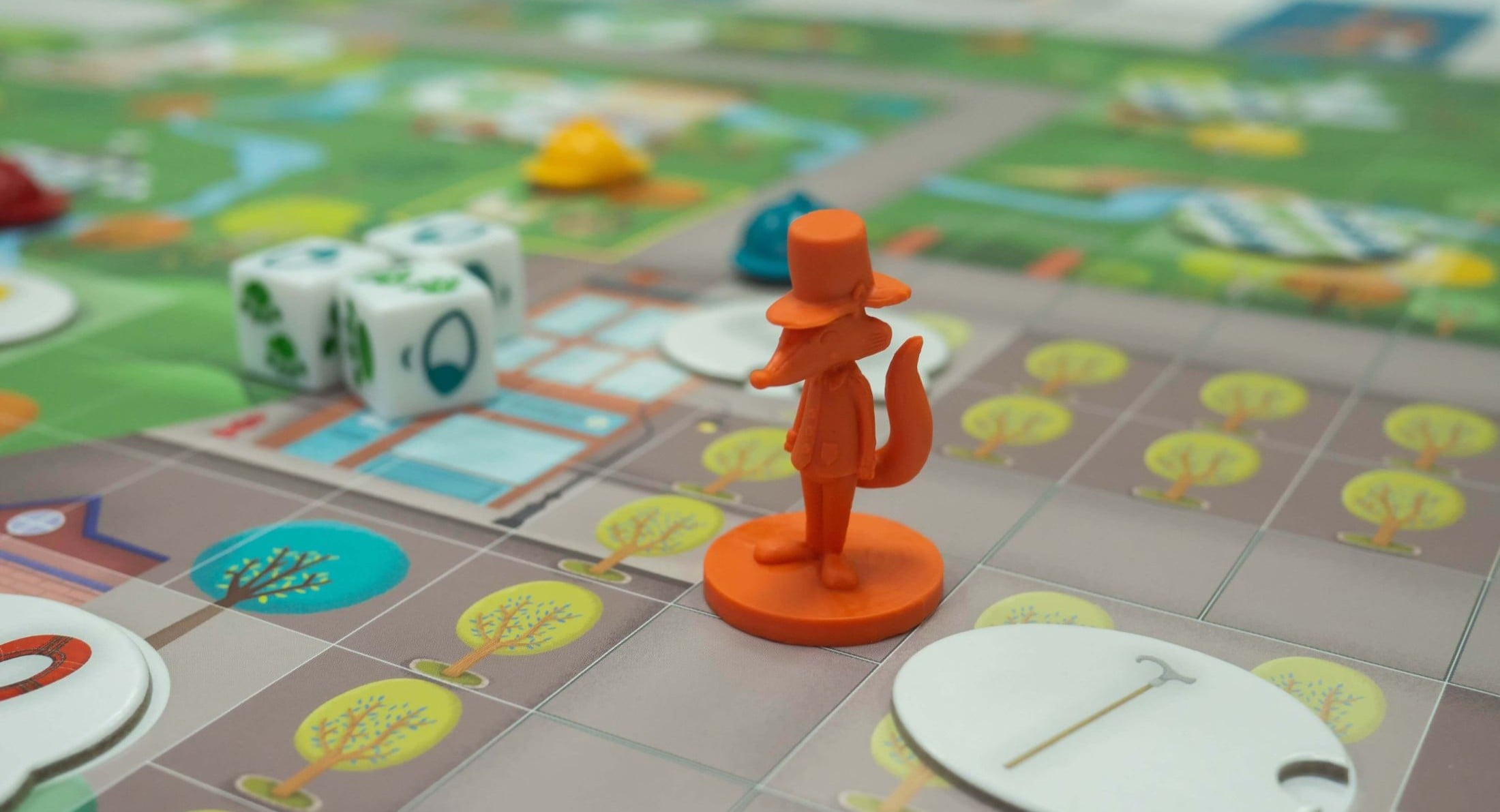
Co-operative games are a nice way to cut out the conflict. Their favourite such game is called Outfoxed!, where two to four players play chicken detectives who work to collect clues and, if all goes well, catch the fox who stole the prized pot pie from fellow chicken, Mrs. Plumpert. Outfoxed! is delightful. No scuffles or sore losers. Only a good time for all.
When games imitate life
A few games of Outfoxed! were all that it took to remind myself that co-op games can be thrilling. The day after cracking the case of the pie a few times, I went down to the game store to see about similar games for adults. This is how I found my new obsession, Kinfire Delve.
Released in 2023, Kinfire Delve is a tabletop card game for one to four people in which you play a dungeon-crawling fantasy character — or, in the game’s lingo, a Seeker delving into a well. The well is a deck of cards full of strange monsters and obstacles, puzzles and traps that you must overcome as a group to move forward.
Each time you complete a challenge, you delve ever further, discarding a handful of cards, then revealing a new challenge. Sometimes the cards work together to hem you in, costing you health points and valuable action cards, wearing you down as you work through the well. At the bottom of the well you meet the master, surrounded by monsters. Survive the last gauntlet, defeat the big bad and you all win the game. Simple stuff.
Kinfire Delve is harder than Outfoxed! You have a small hand of cards that you use to fight battles. Your teammates can use theirs to boost you. The dice, if they roll in your favour, should cover the rest. But sometimes they don’t and the team takes a hit. Even worse, you could run out of cards, making everything worse.
The genius of Kinfire Delve is that you don’t get to draw cards whenever you want. Every one is a precious commodity. When they’re all gone, you’re exhausted. There’s a separate deck for that. Before drawing a new hand, you first must admit your exhaustion, and suffer the penalty on your exhausted card, ranging from losing a handful of health points to losing the game, just like that.
If you don’t, you just try to keep going, availing yourself of whatever resources you still have left, just to get by.
It is perhaps the most apt metaphor for parenting I’ve ever come across.
By the end of the long winter break, I knew more about tabletop gaming than ever before, and I’m glad — this is better than screens — but I’d also arrived at the end of my patience.
In lieu of a potion to put me to bed, I guess I’ll have to settle for the knowledge that raising my children offline can be done, so long as I’m willing to play Sleeping Queens one more time. ![[Tyee]](/design-article.thetyee.ca/ui/img/yellowblob.png)
Read more: Media, Science + Tech












Notice about commenting changes
The Tyee’s commenting system will be moving to a new platform on Nov. 12. If you’re already a Tyee commenter you must register with the new system on or after Nov. 12 with your preferred username.More information can be found here.