


 SHARE:
It was, for a time, my favourite part of the week.
By late Saturday afternoon, I’d have completed some chores. I’d have gotten some exercise. I’d be coasting into the heart of my weekend puttering in the kitchen, perhaps processing the season’s harvest or preparing to host friends on a wintery evening.
In every case, there’d be jazz. It was always CBC’s Hot Air.
Based in Vancouver, Hot Air was the CBC’s longest-running program. It launched in 1947, just as the golden age of jazz was in its twilight years and before rock and roll took hold. As its early episodes aired, Mick Jagger and Paul McCartney were barely out of diapers. Elvis was still an unknown pre-teen in Tupelo, Miss.
In its 75 years, the show covered an incredible period in music history. It hosted jazz greats like Ella Fitzgerald and Duke Ellington, boosted Canadian musical icons like Diana Krall, and logged thousands of episodes examining jazz from a B.C. perspective.
And then it disappeared.
I was in my kitchen in late November 2022, wrapped in the warm glow of soothing jazz, when host Margaret Gallagher announced her move to CBC’s North by Northwest. My heart sank. But surely CBC would find a new host to carry the iconic show forward. Right?
The new year rolled around. Gallagher was quietly removed from the program’s webpage, which remained online. CBC inserted a placeholder show, BC’s Music Show, into the timeslot. I remained hopeful, occasionally checking the website for updates.
This summer, I finally reached out to the CBC, asking about Hot Air and pointing out the website proclaiming it CBC’s “longest running program” remained online.
I deflated at the news that the show “officially went off air in 2023.”
“I appreciate you sharing the link,” came the CBC’s crushing response. “We will pull it down as somehow it was missed.”
CBC strives to keep up with the times
When Hot Air abruptly left the airwaves in 2023, it felt like I was the only one who noticed. But I wasn’t alone.
Alex Waterhouse-Hayward got his first professional photography gig at the CBC in 1977. He went on to develop a prolific freelance career, shooting for a variety of magazines while remaining a regular at the CBC.
“The CBC started my career,” he says.
But it was more than that: “I became a Canadian because of the CBC,” he adds.
It was through the national broadcaster that Waterhouse-Hayward, an Argentine who moved to Vancouver after meeting his Canadian wife in Mexico, became acquainted with his adoptive country.
Through his work, he also become acquainted with folks at CBC Vancouver. It was through those contacts that, in early 2023, Waterhouse-Hayward learned that one of his long-time favourite shows had been cancelled. His March 2023 blog post commemorating Hot Air is the only public acknowledgement I could find of its demise.
The show had become “boring,” Waterhouse-Hayward wrote — and too focused on Vancouver.
“CBC’s jazz audience is sophisticated,” he reflected. “Jazz was an American invention and it became international. You cannot just feature Vancouver jazz musicians.”
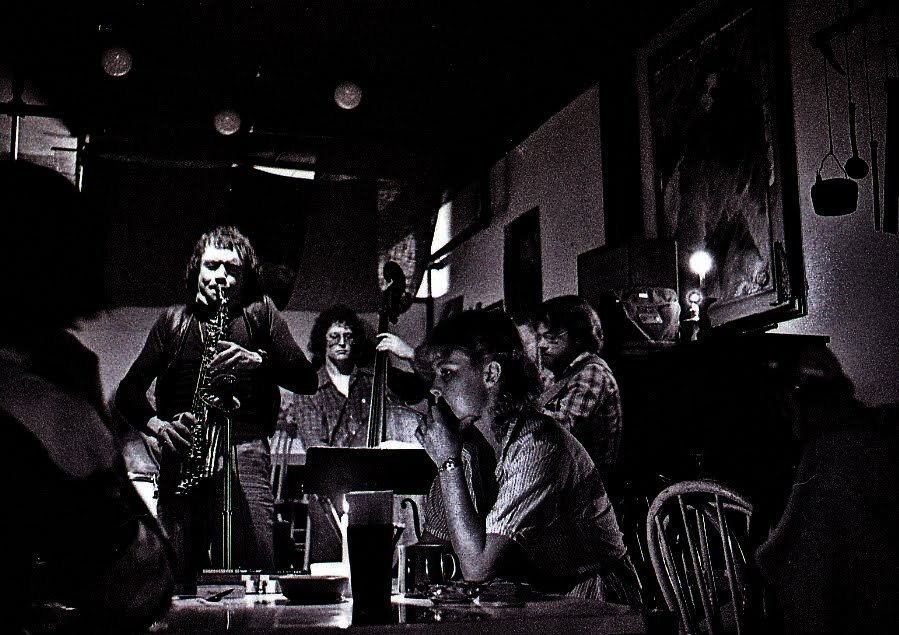
Thinking about Hot Air reminds Waterhouse-Hayward of his long-time friend, Vancouver jazz musician and CiTR radio host Gavin Walker, who died in July.
The pair met at Vancouver’s Classical Joint in the late 1970s, back when Waterhouse-Hayward was new to the city and the establishment was the beating heart of the local jazz scene. In the decades that followed, the friends would listen to Hot Air on Saturday evenings, calling each other up after the show to compare notes.
“We were old-fashioned kind of jazz people. We liked certain things, you know, and Hot Air played the music that we wanted to hear,” Waterhouse-Hayward says in a phone interview. “Hot Air was just an important part of my life.”
The golden age of jazz
Neil Ritchie — who spent 30 years as an associate producer at the CBC, working with each one of Hot Air’s six hosts — admits that he hadn’t noticed Hot Air’s disappearance until I contacted him.
“I don’t listen to CBC that much anymore,” Ritchie says, his voice coming over the phone line with the gentle lilt of an old-timey radio show host. “When I need news, I will turn it on at the top of the clock. But basically, that’s about it.”

Hot Air was launched in 1947 by host Bob Smith, who was described in a 2022 CBC article celebrating the show’s 75th anniversary as “a cigar-chomping football announcer with one of the largest private record collections in Canada.”
Smith hosted the show for more than 30 years. He was succeeded by Harvey Dawes, Bruno Cimolai, Gordon Hunt, Paul Grant and, finally, Gallagher, who became its final host in 2010.
Smith was “amazing,” Ritchie remembers. “He had an encyclopedic mind and he was there at the right time,” he says. “That’s when sort of the golden age of jazz was.”
Ritchie remembers Smith’s interview with Ella Fitzgerald.
“Ella was very shy and not known as a good interview. But Bob, he knew so much about her, he knew as much about her as she did. She just opened up,” he recalls.
Smith’s attempt to interview Miles Davis didn’t go as well.
“Miles just sort of glared at Bob,” Ritchie says. “He wouldn’t even talk. He was very aloof. That was what made him who he was.”
Then there was the time Hot Air’s third host, Bruno Cimolai, interviewed Peggy Lee. The American singer was “one of my faves,” Ritchie says. He wasn’t disappointed. “She had a good sense of humour. She was very intelligent. She just answered every question.”
But it was Hot Air’s fifth host, Paul Grant, who “could interview anybody,” he adds.
“Maybe he didn’t know as much about jazz as some of the others [but] he was a fabulous interviewer,” he says.
Ritchie remembers how Grant worked his magic on Cleo Laine, the celebrated British jazz singer who died this summer at age 97, as well as American jazz musician Pat Metheny.
He also recalls the time B.C.-born Diana Krall came on the show in the early 1990s, just before releasing her first album. In her early career, Krall was known primarily as a pianist. But Ritchie received a tip that she could also sing.
“I turned on the mic for two of her songs,” he says.
Hot Air was about so much more than spinning records, he says. The hosts would sometimes do “blindfold tests” with their guests, playing famous jazz musicians and having them guess the artist and explain how they had identified their music.
Ritchie had a budget to record Canadian musicians and produce a CD from their sessions. That budget dried up around the time he left the CBC in 2008, he says.
“I was so lucky,” he says whimsically, reflecting on his time at the CBC and how jazz has evolved.
“Music styles change. They have a peak and a valley and an in-between. People are used to having their favourite shows cancelled,” he says. “That [Hot Air] went as long as it did is extraordinary.”
‘Soft’ numbers, a new show
Shiral Tobin admits that Hot Air’s listener numbers were “soft” near the end.
As CBC News’ director of journalism and programming in B.C., she’s got the tough job of deciding what stays on the air and what gets cut.
“It’s never an easy decision to change programming,” she says over a video call, adding that the public broadcaster has a responsibility to reflect its audiences.
“If we have a regional music show in B.C., what does it look like today compared to 75 years ago?” she says.
“We looked at the range of music and people in British Columbia and thought we could use a reboot or refresh.”
Tobin says Hot Air’s final episode was announced “quite quietly” because its replacement hadn’t yet been found.
In the year that followed, CBC posted Gallagher’s position, inviting prospective hosts to pitch a vision for what Hot Air’s replacement might look like. At the same time, the broadcaster trialled a series of interim hosts on BC’s Music Show and sought feedback from the public.
Rohit Joseph, who worked as an associate producer at CBC Victoria, got the job. His new show, Vibin’, launched in January 2024.
In an unrelated scheduling change, the show’s timeslot shifted, too. Vibin’ airs at 4 p.m. on Saturdays, not 5 p.m., like its predecessor.
The new show still plays some jazz, Tobin adds.
“It really was an evolution looking at our largest potential audience, which is 29 to 50, and tapping into the diversity of British Columbia and of the role music plays in connecting people in community,” Tobin says. “We’re always gut-checking and making sure that we're relevant to Canadians.”
She says she’s pleased with the audience growth since Vibin’ went on air.
“It is an adjustment,” she consoles me over the call. “Change is hard in radio.”
BC musical history locked in a CBC vault
Tobin couldn’t say why Hot Air, unlike other recently cancelled shows Vinyl Tap and Spark, no longer appears on the CBC app or its website.
(Ritchie speculates it’s because Hot Air was a regional show, rather than national, but the CBC did not confirm.)
This means there’s no easily accessible library of the CBC’s longest running show.
While Tobin confirmed that the CBC retains past episodes in its “vast archive,” they’re only available to the public by request, for things like teaching purposes, a spokesperson said in an email. As a result, an entire chapter in B.C.’s musical history remains hidden in a vault.
By the time my Saturday afternoon routine finds me in the kitchen, Vibin’ has wrapped up. I could, as Tobin suggests, find the recently aired episode on my CBC app. Somehow it’s not the same as flipping on the radio and stumbling upon the collective joy of jazz music being piped into households across the province.
Instead, I reach for my records.
I can’t claim a long relationship with Hot Air. The show found its way into my kitchen during its final years. Nor can I claim a deep knowledge of jazz. My vinyl collection is equally slim. But it’s enough to fill that last hour of the afternoon, as day turns to dinnertime.
Fitzgerald’s fabulously flubbed live version of Mack the Knife hits differently knowing the singer’s self-effacing style. Davis’s mournful trumpet somehow makes sense after learning about his broody demeanour.
I imagine he’s also feeling kind of blue and playing a dirge, a quiet tribute to CBC’s longest running program, which never received the fanfare or formal send-off it deserved. Instead, it just quietly faded away. ![[Tyee]](/design-article.thetyee.ca/ui/img/yellowblob.png)












Tyee Commenting Guidelines
Please note that email notifications for replies are not currently working due to a software issue which may be resolved in a future update.
Comments that violate guidelines risk being deleted, and violations may result in a temporary or permanent user ban. Maintain the spirit of good conversation to stay in the discussion and be patient with moderators. Comments are reviewed regularly but not in real time.
Do:
Do not: