 SHARE:
[Editor’s note: ‘Upon a Midnight Clear’ is an essay collection edited by Vancouver author JJ Lee. The book features the work of regional authors sharing true stories of memorable holiday seasons. This essay, which appears in the book as ‘Our Book of Days,’ considers loss over the holiday season, and how the world is still full of miracles.]
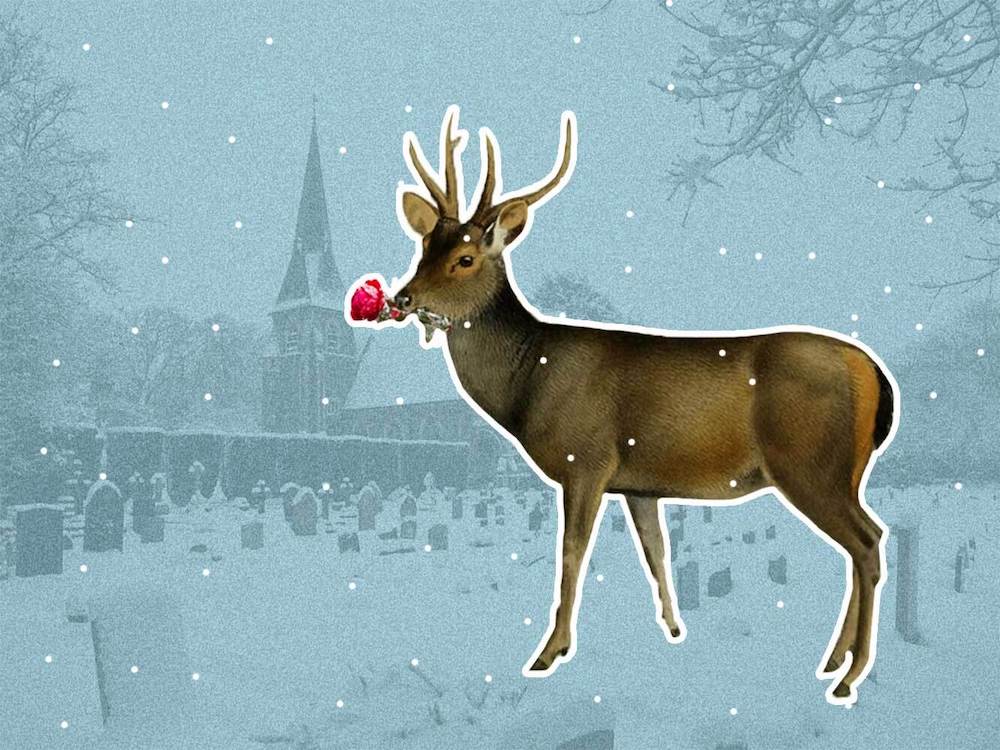
Some people think deer don’t belong in the cemetery because they eat the flowers. Not me. I bring roses to draw the mules and white-tails to the place where your body lies.
The deer are the guardians of the dead. They stay to walk among you after the groundskeepers go home — through all seasons, in good weather and bad. They never leave you alone for long, even if we who loved you get too busy to visit.
Only a blizzard can make the deer retreat temporarily from the prairie. I don’t know exactly where they go when the arctic wind comes storming over the mountains to whip up snowy whirls. Do you? Is it in the valley, nearer the river? Do they hide with the rabbits and magpies among the cottonwood trees and chokecherry bushes? Do you go with them?
We buried you five days before Christmas, in the middle of a blizzard when the polar vortex pushed thermometers to -40 C. It was not yet four in the afternoon when we got to your grave, but it felt like dusk. It was supposed to be the second-darkest day of the year. I think it was the darkest.
I didn’t see any deer the day we buried you. If they came, they kept their distance. But then again, I couldn’t see much of anything through the blizzard.
Your sister and brother kept me from falling while we waded to the chair in front of your grave. I did glimpse the oak-stained wooden urn your father and I picked out for you, and your picture propped on the bench beside it.
That picture was taken in a sunny mountain valley on a day when your smile lit up our world. But the afternoon we buried you, there was no sun.
It was so cold that the flower arrangements we ordered for your service froze the minute they were taken out of the hearse. White flakes landed on the wreath of yellow mums we brought from the funeral home, and the cold flash-froze the white roses piled in a heap beside you.
I sat. Everyone else stood. Your sister clasped her icy hands around my neck. She’d forgotten to bring her mitts. I wrapped my gloved fingers around her bare skin. “Let me warm you up,” I said. As if anything could keep away the cold that afternoon.
The priest prayed for you — ashes to ashes and dust to dust. The funeral director wrapped your urn in a purple velvet pouch before he placed it in the earth. I was comforted by that. I didn’t want you to be cold.
Somebody handed me a rose to toss on your coffin. I stood up and pointed the long stem toward you. It landed crossways and got stuck near the opening.
Your sister’s husband leaned over to push it into the pit. Your father tossed his rose, then your sister and your brother tossed theirs. They aimed better.
I wondered why the city crew made the hole so deep. I wondered why I hadn’t put my hand on the urn when your father and I lit your baptismal candle in the funeral home. Why had I waited until now to think of touching you again? Why didn’t I turn the camera on for our last Facebook chat? It was too late.
I wanted to hold my baby again.
The funeral director said the deer would eat the yellow flowers if we left them on the grave. I thought that was fine, but no one else did. I wanted to take some home, but your dad and brother said it wasn’t a good idea because they were frozen. Your father said to bury all the flowers with you. So that’s what we did.
I imagined your spirit standing a few feet back, laughing at us all for talking about what to do with flowers in the middle of a blizzard. I imagined you standing among the deer waving goodbye to us. I thought how beautiful this white garden was — like Narnia in winter.
The deer didn’t get their supper, but we did. We went to your father’s house where your stepmother laid out your favourite cold cuts on the dining room table beside overflowing vegetable, fruit and dessert trays.
She bustled around her kitchen making coffee and tea — trying to get everything right when nothing could be right. I sat in the living room like a block of ice, catching snippets of conversations floating around me. My flesh and blood were ashes and dust.
Your brother and his fiancée drove me back to my apartment. It took us nearly an hour to cross the ice-covered bridge in the storm. I was home by seven. It felt like midnight.
Your funeral was Tuesday. On Wednesday, it was too cold to go outside, so I ordered presents on Amazon, knowing some wouldn’t arrive until Boxing Day. On Thursday, I wrapped myself in my black fur coat, hat, mitts, scarf and boots. I stuffed shopping bags in my purse. I dug my walking stick into the ice and crossed the road to the bus stop.
Gasping for air and hanging on to the rail to stop the wind from throwing me into traffic, I watched the blasts spin twigs and wrappers along the street. I could have hidden my grief from store clerks, but these gusts brought me to tears. So, I went home. I ordered groceries and candles to be delivered on Friday night.
It warmed a bit by Sunday, Christmas Day. At dinner, we remembered you and we toasted spring.
Who put the Christmas wreath on your grave? Who trudged through six inches of snow in coldest December to get to you? It was not your father, your sister or your brother. Not your grandparents, your aunts or your uncle. It was not me.
I found the twisted pine boughs tied to your marker when I brought white roses for you and the deer in January. And there they stayed, fading to deep khaki, then earthy brown, until the city crews cleared away rubbish and mowed lawns just before Holy Week. They were expecting visitors. The cemetery is a busy place in the summer. You know that already, don’t you?
Do you remember when we used to hike behind the cemetery on our way to the river valley when you were a little boy? We were happy on those Sunday afternoons.
Do you remember how you, your dad, brother, sister and I delighted in foraging for wild chokecherries and saskatoon berries on our walks? Remember how we dipped our hands into the cold water when we finally made it to the river shore?
In those days we must have looked like a perfect family to the hikers we passed on our way down to the water. We weren’t, of course. You already knew that.
Still, on those magical Sundays we never thought much about the people in the graves as we passed by the cemetery on our hikes. Your dad and I never dreamed that we would have to visit you there someday. Our world had not yet fallen apart. Though we were already on the edge of disaster, we didn’t know it yet. We were luckier than we knew.
After you died, we picked Mountain View cemetery as your resting place, partly because the mountains you loved are visible on a clear day and partly because it’s in the centre of town, close to the house you lived in when you were little. We wanted to bring you to a place where you were happy, and you were happiest in that south-side neighbourhood that’s knitted together by the greenstrips where you once rode your bike, went tobogganing and hiked.
I never realized how truly busy the inside pathways of the cemetery were, though, until your stepfather died five years ago. That’s when I first moved from passing by on my way to other places and became a regular visitor inside its gates.
That’s when I discovered that the graveyard is filled with living hikers and bikers and dog walkers. Its paved and shaded pathways are a favourite haunt of joggers in the spring and summer. Indeed sometimes these recreational users outnumber the mourners.
Still, it’s mostly relatives of the dead who visit at Christmas. When the weather’s good in December, they bring tinsel and greenery to the cemetery. This discovery amazed me the first winter after your stepfather died, when I came with a bouquet in late December and noticed green wreaths, frozen flower petals and half-eaten foliage — remains of the deer’s holiday feast — dotting the snow.
Since then, I’ve noticed that one family usually leaves a six-foot Christmas tree with tinsel and ornaments on a grave in the block across the road from you, near where your stepfather is buried. Not this year, though.
It took a determined soul to put that wreath on your grave in the middle of the arctic freeze; someone who knows that Christmas is a blazing fire of relentless hope in the dead of winter; someone who defies darkness, affirms light, and knows that spring must return and that evil cannot win forever and that love is stronger than death.
It took someone who loved you, too. That made me smile and I wanted to cry, too, because you didn’t always feel love after you got sick, but for me you were the very definition of love.
It was always December when I found out I was pregnant. The first time I was 21 and wearing a wedding ring. But I looked 18 and I was nervous. So, maybe that’s why the nurse asked me if I was sure I wanted to have a baby when she gave me the test result.
I stared at her in disbelief. Couldn’t she see that you were the best Christmas present ever?
It is true that your father sat by the stereo and played Neil Young’s “Got Mashed Potatoes” over and over again before I left to go to the doctor.
But we knew we’d be able to feed you and keep you warm. We knew we were not alone.
When you were born, your dad’s mother helped us buy a house with blackberry bushes in the flower beds, a plum tree in the garden and peach saplings beside the fence. On your first Christmas and every Christmas after that, she arrived with suitcases full of presents, cookies and fruitcakes.
You called her “Knittin” instead of “Grandma” because she spent her afternoons making blankets, sweaters and mittens for you.
When you were 17 months old, I snapped a picture of you, rosy-cheeked and beaming, running towards me hugging a battery-operated Santa you found in Knittin’s suitcase.
You had sunlight in your hair and eyes, joy spread across your face. I kept that picture by my bed all the years that you were sick.
It was 2013. You came home for Christmas, clearly not well, too skinny for your tall frame. Fresh from a breakup with your live-in girlfriend.
You drank too much at dinner — something I had never seen you do before. I told the other kids I was worried. They said you would be fine now that you were home.
You stayed at your father’s house for six months, but I didn’t see you much. It wasn’t unusual for you not to call when you were with your dad. I knew the reasons why. So, I didn’t worry.
I didn’t hear about the conspiracies circulating in your mind until that Saturday morning in June when you texted me from Toronto. You talked about Nazis and stolen inheritances. You said you wanted to hurt people. Nobody but me knew that you were gone.
We soon learned that’s how it was when you got sick. You disappeared without a trace. Went silent for weeks. I tried to find you when I won a trip to Toronto for a writer’s conference, but you didn’t want to be found until you lost your job and had no place to live. You begged for help then. So did I.
I spent hours on the phone trying to get support for you when you were homeless, confused and afraid in that metropolis.
A Toronto cop told me that there were too many poor to help, that we had to leave them on the street.
I told him he should quit his job because he had no heart before I hung up on him.
I convinced a street ministry to help you, but you didn’t like what they were preaching.
A few days later, your old girlfriend sent you money for a Greyhound ride back to B.C. She still loved you. But you were sicker than she thought.
Not sick enough for the doctors to keep you in the psychiatric ward for 30 days, though.
That Christmas, you wound up alone, living in a hotel on social assistance, not getting better.
After you died, the front-desk clerk said you kept to yourself, that you liked climbing mountain trails and swimming at the outdoor pool.
When your things came home, I found your poetry in the old books you collected. Your handwriting was beautiful, even and clear. Some of the words didn’t make sense, but even when you were ill, there could be wisdom in your words.
We waited for a miracle for seven years.
You wouldn’t talk to your father, and sometimes you didn’t answer me, but I sent birthday and Christmas presents. Sometimes you’d thank me. Sometimes you’d say you loved me.
Sometimes you weren’t in the mood for talking, so I’d check in with the staff at the place you lived to make sure you were OK. They liked you. You always paid your rent on time, were polite, and you never made a ruckus. No one could believe you overdosed and died in your room.
The last Christmas you were alive, the courier didn’t deliver your presents, and you didn’t go to pick them up. So, I mailed you a gift card for your birthday. It got there late. But you were ready to talk to me again.
I told you I was sorry because the Christmas gifts never arrived and I hadn’t mailed your birthday present on time. I told you that I was late with everything these days, that I couldn’t walk without sticks, and the doctor didn’t know why. I sent you a photo of my grey cat because you loved grey cats. That made you happy for a moment or two.
Then you told me that you were getting older day by day and that you felt like you had run out of time. I told you it wasn’t true. That you were young enough to start again. I let you know that I loved you.
I still believed we would get you help and bring you home again. I didn’t understand that you were saying goodbye.
I watched the first passion-pink bloom open on my gnarled Christmas cactus on Nov. 18 — a week and day after the coroner said you died. It rarely blooms anymore.
But last year cascading flowers spilled out and pointed themselves toward the sunlight until mid-February.
I was almost ready for Christmas by the time the police came. I’d cleaned the house, put up the tree and thought of what to buy you. I’d polished your silver baby cup and moved your Santa picture to the foyer — tamping down the fear that woke me up every night.
Sure, you’d been silent before, but this time it felt like you had left the world.
On Thursday — the night they found you — I slept long and deep.
I didn’t wake up until after noon on Friday. I decided to bake bread.
As I placed the last loaves in the oven, the bell rang.
I don’t usually open the door unless I know who’s there, but on the 25th of November I buzzed the visitors in and ran to the lobby.
The tallest cop I ever saw and two women from Victims’ Services insisted on coming in. It was about 5 p.m.
We left an empty seat for you in the front row at your brother’s wedding in May. Did you come? Did you see the stag that stepped out of nowhere to stare into the window while we waited for the bride?
He was a mule deer, the black tuft on his tail gave him away, taller than any I had ever seen before, with newly sprung velvet-covered antlers, charcoal grey. They had grown enough to make his giant ears look like they fit his head.
I was transfixed by the ruddiness of his coat and the strength of his chest. Perhaps it was the greenness of the baby grass and emerging leaves behind him that made him look redder than most deer around here. The buck’s haughty gaze told us he wanted nothing from us, unlike the shivering does who come meekly, begging shelter on my patio in winter.
I wondered if his antlers would get as big as the rack I found in my grandmother’s attic when I was a little girl. Did I ever tell you about those antlers? They were from a stag my Swedish great-grandfather shot when he first came to this country. My brother has them now. Old Anders, so the family legend goes, was a wanderer — mad, addicted or maybe both. A dreamer whose adventures never turned out right. He died alone, too.
The stag had returned to the valley by the time your brother and the sister-in-law you will never meet began their married life dancing to Randy Travis’s “Forever and Ever, Amen.” We didn’t see the deer leave.
A few days later, the girl you brought to my second wedding emailed me to say that you used to sing that song over and over again to Wilson the cat when you lived with her.
She said hearing it gave her chills. She said you would have loved to hear that song again. Were you in the room with us when they played it?
Eastertide and the wedding both ended at midnight. The next morning, Pentecost Sunday, I brought you and the deer a bouquet of bright yellow lilies.
My parents and your aunt came, too. They took pictures of your grave and left an angel beside your marker. Then we returned to Ordinary Time without you.
Though I have been to the place you’re buried a dozen times, my mind still can’t grasp that you are dead. I want to undo time and bring you back. I want to release you from the trap. I want to find a way to make you well. I want to make you live again.
I want a miracle that my faith says cannot happen until the end of time. But tiny miracles are everywhere, if you look for them: the sweet ripe apples that fall onto my path in September, a poem that writes itself at 4 a.m., the sound of your voice inside my head, and the deer that seem to seek me out.
I saw a fawn in June, a few weeks after your brother’s wedding. It was the day after the summer solstice — the 10th anniversary of the unravelling of our lives — the second-lightest day of the year.
The newborn was nestled in the grass, waiting patiently for his mother, knowing she would return for him because that’s what mothers are supposed to do. Mothers are a little like God in that way.
Anyway, when I saw the fawn, I knew what I needed to say to you. It’s this: I will miss you forever, but I carry your memory everywhere. I will never leave you behind, but I am going to be OK.
Your brother and sister will be, too. So will you, until we meet again. I love you always and forever, amen. Love, Mum.
P.S. Another year has passed. I still wish I could undo time and bring you back to me. I still think about you every day, but I have amazing news. Maybe you know it already.
You are going to be an uncle, and the deer have started seeking out your brother. In mid-June — the week of the summer solstice — newborn twin fawns and their mother joined him on one of the walks he takes at lunch.
The next day, he and his wife got their first ultrasound, the one that confirmed that they are expecting twins sometime in late December. The twin fawns met him again in early July, much bigger and on their own this time, while their mother was feeding on the greenstrip.
A week later, on your birthday, the second ultrasound confirmed the human babies are strong, too, and growing quickly as the fawns. They will be here at Christmas, and we are happy again.
Somehow, I think you do know this already. I think maybe that’s what the deer and you have been trying to tell me for the past year and half: that after the mourning, comes new life. And babies still save the world at Christmas.
Missing and loving you always, Mum.
Excerpted from ‘Upon a Midnight Clear,’ edited by JJ Lee. Copyright 2024 JJ Lee. Published by Tidewater Press. Excerpted by arrangement with the publisher. All rights reserved.
Happy holidays, readers. Our comment threads will be closed until Jan. 2 to give our moderators a much-deserved break. See you in 2025! ![[Tyee]](/design-article.thetyee.ca/ui/img/yellowblob.png)