

 SHARE:
It bears remembering that the only superpower to threaten Canada has been not Russia or China but the United States.
Prime Minister Mark Carney makes no bones about it. Donald Trump, he said, is waging a trade war to “break us so that they can own us.”
The Carney government is responding in ways that will test perceptions of who Canadians are and how we see our role in the world. Here are three examples.
1. Choice of global investment partners
Carney is sending a strong signal with his investment summit to be held this week in Toronto. The event is made possible in part by Carney’s connections and the command he respects from banking and business. Canada also has great development potential in both energy and critical minerals, as well as transportation, digital technology, and advanced manufacturing.
As many as 250 senior financial executives are expected from the world’s largest investment groups such as Blackrock, Blackstone, Barclays and the mammoth Saudi Arabia Investment Fund. Some of these players face criticism from environmentalists and Saudi Arabia has a notoriously poor human rights record. But the group does oversee an incredible $120 trillion in assets.
Carney’s pitch will be that Canada is a safe and stable place to invest, boasting a AAA credit rating and a world-class banking system. Unlike Trump, if Carney signs a deal, it will be in ink, not pencil. He is a leader known to keep his word.
More than 160 projects are open for investment, including a planned $57 billion expansion of Port of Churchill, perched on the edge of an emerging, fast arctic sea lane to Europe. The first shipload of durum wheat to leave the port this year is bound for Italy, Antwerp, and the Mediterranean. Three more grain ship voyages are planned for the 2026 season.
2. Betting on Europe over the US
Those grain shipments represent Canada’s larger effort to turn away from Trump’s unstable America and forge closer ties with the European Union. So close that the EU’s ambassador to Canada says a “unique” partnership is in the works. Carney is reported to be pursuing EU “associate member” status for Canada, possibly higher than any other non-EU country.
It is an epic pivot that rejects the “Donroe Doctrine” — the Trumpist notion that by geographic proximity Canada must serve as vassal of the United States.
This week Carney will go to Strasbourg, France, to significantly deepen our strategic partner agreement and free trade deal already in place with the EU.
He’ll arrive with fanfare, having been offered a rare invitation to address the 720 members of the European Parliament on Sept. 17. While there he’ll not only pitch to the world’s third largest economy he’ll look to forge deeper military connections.
Under Carney, Canada already is the first non-European partner in an EU loan program fund for joint defense projects called Security Action for Europe, or SAFE.
3. Ramping up Canada’s military capacity
Signing on to SAFE fits a larger shift. Those who prefer to think of Canada as primarily a soft power peacekeeper are seeing a different vision from Carney. He makes no apologies about building a war fighter with expensively sharp teeth. That distresses isolationists, peace activists and anyone who asks why we are investing billions more in our military machine rather than social programs.
But it’s happening fast. As one Canadian robotics company CEO told the CBC, “defence was a dirty word” in Ottawa just a few years ago when federal “trade commissioners wouldn’t help.”
Now, using an approach some call “Keynesian militarism,” Carney says he’s boosting the economy by injecting tens of billions more public dollars into a Canadian defence industry that currently generates about $10 billion and supports about 81,000 jobs.
Meanwhile, the Canadian Army is revamping to be ready for the “future battlefield.” As Maj.-Gen. Wade Rutland put it, the point is to be “be more agile, more lethal, more relevant to defend Canada."
To prepare for major conflicts, the army has been reorganized into three divisions focused on home defence, infrastructure support, and foreign combat. Canada also showed up at the International Defence Industry Exhibition in Poland in full force — the largest Canadian delegation to a European trade fair ever. Military bagpipes could be heard from the Canadian Pavilion and a Mountie in dress uniform stood guard.
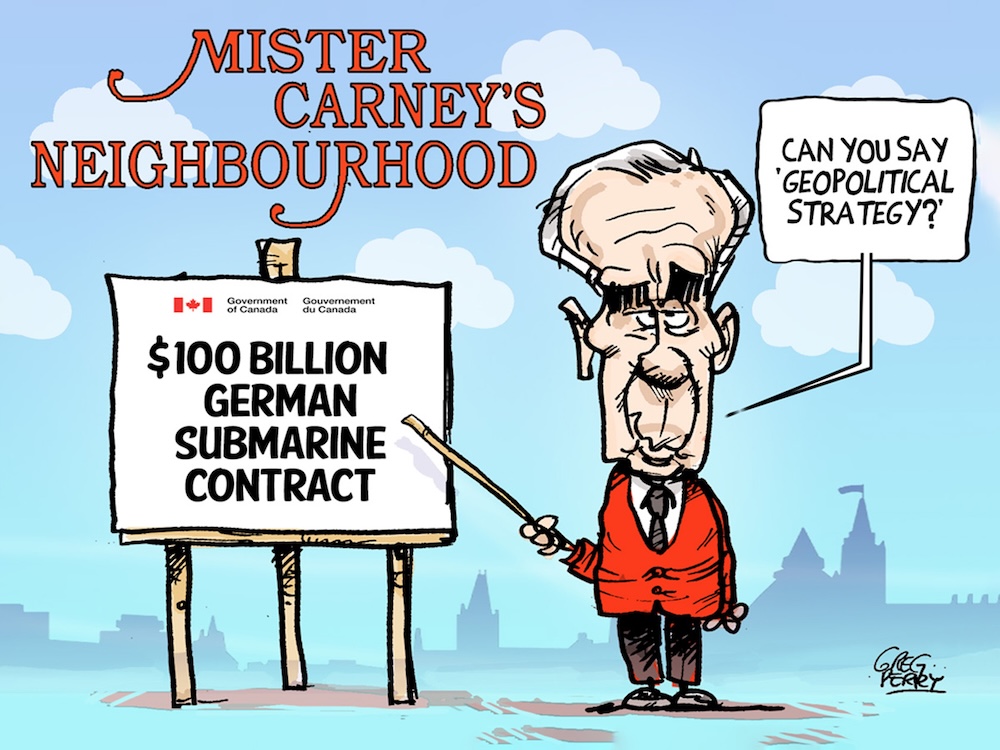
At the same time, Canada is lessening its dependency on U.S. defence companies. Ottawa recently bought its submarines from Germany, and Canadian firms will be in the supply chain when they are built. Membership in SAFE also allows Canada to bid on European defence contracts.
In a world bristling with weapons, what might Canada contribute? The war in Ukraine has changed the nature of warfare. As the U.S. has seen in the Middle East, if you use a multi-million-dollar missile to take down a small drone that is not cost effective.
Now Canada plans to produce millions of drones within the next two years in partnership with Ukrainian companies. “As a result,” Carney said, “Canadian industry will learn from the most battle-tested developers on Earth.”
This flows from a 100-year pact inked by Canada and Ukraine to defend both countries. At the signing ceremony in Calgary, Carney said, “Canadians understand in our bones the importance of your struggle. There is no qualification to our commitment because your cause — freedom, democracy, sovereignty — is our cause.”
Carney has assayed threats that Canada faces, including the machinations of great powers, climate change and new technological advancements. He is telling Canadians and prospective global partners that we face a “more dangerous and divided world” with new potential adversaries.
Note that Trumpists in the U.S. have cheered on the rise of far-right movements in Europe and around the world. Both U.S. Vice President JD Vance and tech tycoon Elon Musk have expressed support for the proto-fascist AfD in Germany, which recently won the most seats and 44 per cent of the vote in an election in the eastern state of Saxony-Anhalt. AfD is just three seats short of an outright majority, and the first far-right party to win in Germany since the Second World War.
The AfD supports “remigration” for immigrants at gunpoint, much like Trump’s plan to force immigrants into detention camps for deportation from the U.S. While most Germans are worried by the AfD’s hard-right agenda and electoral breakthrough, Trump gloated.
Against this backdrop, Ottawa is working to make Canada less reliant on the U.S. for either trade or defence.
When you live next door to a country that cheers on far-right movements while insulting your leaders, threatening to blow up your economy with crippling tariffs and vowing to “annex” you, that is not an over-reaction.
That is transformation borne of necessity and hard choices. ![[Tyee]](/design-article.thetyee.ca/ui/img/yellowblob.png)
Read more: Politics








Tyee Commenting Guidelines
Please note that email notifications for replies are not currently working due to a software issue which may be resolved in a future update.
Comments that violate guidelines risk being deleted, and violations may result in a temporary or permanent user ban. Maintain the spirit of good conversation to stay in the discussion and be patient with moderators. Comments are reviewed regularly but not in real time.
Do:
Do not: