


 SHARE:

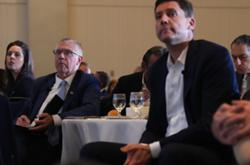
The event may have been held at the University of Ottawa, but it wasn’t casual chit-chat with students. It was a rollout.
The media had been called in. The audience was wall-to-wall suits. The staging was exact: a black velvet curtain, eight Canadian flags, a podium that read “Building Canada Strong.” Mark Carney was camera-ready, in full makeup. This wasn’t just another speech. It was choreographed. That’s how things work in Ottawa now, since Carney got elected.
Everything is staged. Everything is message-controlled. I mean, Ottawa always is — but it’s been extra.
I’ve had comms officers tell me it can take a week to get a single quote from a minister approved, because it has to pass through five departments before it can land in a journalist’s inbox.
We saw it again this week. Canada’s auditor general — an arm’s-length watchdog — delivered a blistering report. She spent an hour fielding every question the press could throw at her, then followed up with two full days of interviews across every outlet that asked.
It’s the kind of access politicians used to grant without flinching — but to young reporters on the Hill, it sounds like a campfire myth.
The ministers who responded? They came out in a pack, stood stiffly at a single microphone, gave the media about 10 minutes, then departed in polished lockstep.
And Mark Carney? Scrums with him are almost mythological.
So when this prime minister steps up to deliver an hour-long speech this choreographed and carefully stage-managed, you should ask yourself: what am I being set up for?
Because if there’s one thing Carney’s good at, it’s crisis management.
He brags about it as his strong point. Carney managed the financial crisis as Governor of the Bank of Canada and navigated the Brexit fallout during his time at the Bank of England in London. He addressed the COVID-19 pandemic at the tail end of his tenure and made the climate crisis a defining part of his public identity.
I saw the same instincts at play with Bill C-5 and its fast tracking of “national projects.”
He made a mess of things — excluding First Nations leaders from consultation. They were furious. They invoked Idle No More. Lawsuits were being floated.
Then Carney called a two-day summit (technically, a day and a half).
Officials did most of the talking, trying to calm fears.
Carney spent all day in the room, chatting, posing for selfies. Watching. Nodding. Making small jokes.
By noon on Day 2, the room had gone still. The anger didn’t vanish — but the energy drained out of it.
I’ve never seen anyone pull that off before. Carney’s the chief-whisperer.
On Wednesday, a colleague of mine asked me, What do you make of this speech? Given how rare it is for a prime minister to address all of Canada live on television, my colleague pointed out, Carney didn’t tell us anything we didn’t know.
But this was not about communicating new information. It was pre-emptive messaging. A containment strategy.
It began with the usual Carney pageantry: the hinge of history, Canada strong, Canada united. He leaned hard into economic nationalism.
“We used to build things in this country,” he said. “We can build again.”
Then talk of government cuts, because when hard times come, governments always start by cutting their own bureaucracy.
It’s the symbolic bloodletting that shows they’re “sharing the pain.”
Most governments do it badly — slicing politically, ideologically, or just chaotically. Just look to the south of the border.
Carney’s promising something cleaner.
He told us spending had been “growing faster than our economy,” and that the government had just completed a 60-day red-tape review that found “nearly 500 new ways to streamline government services, cut duplication and reduce costs.”
And that’s Carney getting ahead of the message. The Public Service Alliance of Canada, the union representing most federal employees, is, no doubt, ready to draft a response to cuts they know are coming. They’re waiting for the Nov. 4 budget to see how deep the cuts go. But Carney already knows, and he’s framing the pain. This is sensible. This is necessary.
At one point, he turned to the university president in the front row and said, “When we saw Canada Post was losing ten million dollars a day — Madam President, would you like ten million dollars a day? Imagine what you could do for the university.”
It wasn’t really about the university. It was about drawing the rest of us in. We are all imagining how we’d like to spend ten million dollars a day. And all this before the unions can get a press kit out.
It’s the same tactic Carney used when he echoed Poilievre’s tough-on-crime messaging, or when he swept away the carbon tax. Carney doesn’t wait for the opposition to build an argument. He pre-empts the argument and reframes it in a bid to make it irrelevant.
I’m not complaining. But as a journalist, I’m watching and thinking: Carney is very good at this.
The thing is that Carney has taken his crime-busting, bureaucracy-slashing, carbon-tax-axing ideas right out of Poilievre’s playbook. Unlike Poilievre, though, he’s not an angry populist. He’s a populist with dad vibes.
He promised some things would stay: the national child-care program, the dental plan, benefits for low-income Canadians. He acknowledged that housing is still too expensive, and more must be done.
And as always with Carney, there’s that odd mix of ill-fitting promises that are hard to puzzle together.
He nodded to climate change, calling it both “a moral duty” and “an economic imperative.” But it was thin gruel. One quick reference, folded between talk of oil, gas, critical minerals and a promise to build “in full partnership” with First Nations, Inuit, and Métis.
There were dad jokes too: “Our next tranche of nation-building projects will be announced by the Grey Cup. After the World Series — but by the Grey Cup.”
Then came the tone shift. The steady voice.
Time for Dad to sit you down and give you the straight truth moment.
“Even with such efficiencies and with better management, we will have to do less of some of the things that we want to do so we can do more of what we must do to build a bigger and better Canada.”
Every line lands on vision and hope, framed so softly, you almost miss the real message, that we must prepare for sacrifice.
The same smooth control — the calm tone, the reassurances, the fatherly cadence — that calmed a room full of angry chiefs is now being broadcast across Canada.
“We won’t transform our economy easily or in a few months. It will take some sacrifices. And it will take some time.”
Each word was carefully crafted, hand-picked for warmth and reason.
Translation: buckle up.
The country is about to change direction, and Carney intends to steer it hard.
This is Carney prepping Canadians — getting ahead of the message.
Because when a media-averse prime minister pops up like a groundhog and casts a long shadow — it means we should expect a long winter.
And a painful budget. ![[Tyee]](/design-article.thetyee.ca/ui/img/yellowblob.png)


Tyee Commenting Guidelines
Please note that email notifications for replies are not currently working due to a software issue which may be resolved in a future update.
Comments that violate guidelines risk being deleted, and violations may result in a temporary or permanent user ban. Maintain the spirit of good conversation to stay in the discussion and be patient with moderators. Comments are reviewed regularly but not in real time.
Do:
Do not: