


 SHARE:

In an industry where death knells are depressingly frequent, last week’s massive layoffs at Global News tolled particularly loudly.
Global News laid off 45 workers, including 26 journalists, in B.C. and Alberta. Those layoffs included “virtually all of the online team” in B.C., according to CBC’s Justin McElroy, who used to work at Global. Other laid-off employees worked in broadcast operations and other departments.
Global’s parent company, Corus, has been buried under a mountain of debt for years, and the layoffs are another short-term attempt to cut costs.
But the layoffs also speak to dwindling confidence that online content and advertising might save mass media and large-scale journalism.
The layoffs at Global follow massive cuts at Bell Media, the owner of CTV, last year. Other broadcast and online news organizations both in Canada and the United Stated have also slashed staffs — and entire publications — this year.
Last September, Kamloops’s longtime news radio station Radio NL laid off its reporters and started playing music instead. In February, Glacier Media closed three Lower Mainland outlets — the Tri-City News, the New Westminster Record and the Burnaby Now.
Over the past 20 years, cascading waves of layoffs and closures have left Canadians with just a fraction of the journalists they once had to cover their communities, institutions and politicians.
The Global cuts are just the latest sign that advertising-dependent media corporations have abandoned the hope that their situations might ever improve.
But it’s not quite time to declare advertising-funded media a bygone model. In fact, examples right here in B.C. hint at how media can survive by rededicating itself to core principles.
How we got here
For a century, advertising fuelled most of North American mainstream journalism. It began with the invention of the penny press in the 19th century — cheap daily newspapers aimed at mass audiences. By the early 20th century, large cities boasted multiple newspapers that competed for eyeballs — and local attention. When the owner of the Vancouver World finished construction of his paper’s new 17-storey headquarters in 1912, it became the tallest tower in Canada. The World became the Sun, which moved into an even larger building.

Even in 2006, as readers began turning to the internet for news, owning a newspaper was a licence to print money, with profit margins often exceeding 20 per cent.
Canada’s newspapers brought in more than $5 billion that year, distributed millions of copies to readers across the country and employed tens of thousands of journalists.
TV and radio news also enjoyed high ratings and large profit margins — again based almost entirely on the model of using journalism to attract audiences that advertisers hoped would buy their products.
While ad-funded journalism has well-chronicled issues — critics such as Noam Chomsky have highlighted how it can lead to skewed coverage that overlooks segments of the populace — it has also enabled vital public interest journalism. All that ad revenue facilitated everything from Walter Cronkite’s dispatches from Vietnam to Ma Murray’s community journalism across B.C. and Ella Cora Hind’s groundbreaking work on the Manitoba prairies.
The financial success of 20th-century newspapers enabled journalism at a massive, unprecedented scale, with newspapers employing staff reporters to cover everything from foreign wars and diplomacy to youth sports events and school plays.
And then the internet severed that relationship — first with newspapers, and now increasingly with radio and TV.
Printing and distributing a newspaper isn’t cheap. In 2006, Toronto’s many daily newspapers paid the municipality a combined $1.4 million just to place newspaper boxes on city sidewalks. Daily newspapers relied on subscription revenue to help cover the cost of distribution and printing. But the business was really built on advertising. In 2006, three-quarters of all newspaper revenue came from advertising.
Many communities, like Vernon, where I grew up, relied on local newspapers that didn’t charge anything and were entirely funded by advertising revenue. As readers moved to the internet and found information and entertainment in new locations, advertisers also found new places to hawk their products. Highly profitable classified sections disappeared, replaced by Craigslist and now Facebook Marketplace. At the same time, newspapers were left shouldering the costs of those expensive printing and distribution operations.
In 2022, Christopher Cheung wrote in The Tyee that the contingent of reporters at the Vancouver Sun and the Province had dropped from around 155 in 2001 to just 40 two decades later.
Outside of Vancouver, dozens of community newspapers across British Columbia have been shuttered or hollowed out.
When I started my career at a Vernon community newspaper in 2006, I was one of 11 journalists. It now has four news staffers. The newspaper I moved to, the Chilliwack Times, had four journalists in 2010; it no longer exists thanks to a wave of consolidations and closures. The former office is now a homeless shelter. In 2014, a merger led to my being shuffled to the Abbotsford News. A decade earlier, a dozen journalists occupied a crowded newsroom on the second floor of a large office and printing building. By the time I arrived, the staff was half the size and the top of the building was vacant. Today, the paper has four journalists and its old headquarters have been torn down to make way for condos.
News moves online
As newspapers belatedly moved online, hope remained that even though revenues were shrinking, they could sell enough ads online to offset costs that were also shrinking as they cut printing and distribution.
Few erected paywalls. Instead, most decided to continue allowing people to get their news for free online, banking on the hope that digital advertising placed next to the news stories would keep the lights on.
Digital-first operations prioritized stories that readers would share and discuss on social media — primarily, Facebook.
Encouraged by metrics and rhetoric that suggested audiences loved consuming video content, newspapers began demanding that print reporters create videos to accompany their stories — the notorious “pivot to video.”
Meanwhile, broadcasters with large radio and TV news operations also began to eye the web — and worry about their own financial sustainability.
As audiences started listening to podcasts, binging TV shows and otherwise drifting away from decades-old radio and TV habits, it seemed like a matter of time until newspapers’ advertising crisis spread to other forms of media.
Broadcasters saw the internet as an opportunity to break into a new business; Global, CTV, CityNews and CBC hired writers — like McElroy — to collect and repackage TV news reports for digital text audiences and source and write stories themselves. TV advertisers could then be sold online ads as well. The synergies seemed obvious.

The social media mirage
But audiences — and tech giants — are fickle beasts. Most news companies did not understand the risks they were taking when they created business plans that relied on social media and audience behaviour to remain fixed and predictable.
Following the election of Donald Trump in 2016, readers flocked to some news sites, especially the New York Times. But even as readers engaged with more news content, social media companies were re-evaluating their relationship with journalism. At the core of this shift was Facebook. The site was easily the largest source of news traffic and had already seized much of the advertising market from established media organizations.
As Charlie Warzel wrote in 2023, Facebook increasingly started seeing news as a risk. The media giant frequently found itself in the hot seat, facing questions about how its algorithms worked, whether they were fair and how they influenced society.
Facebook also got caught in a lie. News outlets had been hoodwinked by Facebook statistics that had vastly overstated how many users were watching videos.
As Facebook itself changed course, it tweaked its algorithms to reduce the number of people who would see news links. If you shared a news link, there was a much lower chance that it would appear at the top of your aunt’s news feed.
Audiences for many news websites began to dry up. In Canada, the federal government launched Bill C-18 to try to counteract the deleterious effects of tech companies on news media, demanding that those companies compensate news organizations for sharing links to their content.
Google settled, agreeing to pay out about $100 million each year.
Facebook took the opposite approach, instituting a blanket ban on Canadian news links — bad news both for audiences that had come to rely on the site to connect them with information, and for the news outlets that had come to rely on traffic from social media.
The last ad hopes
Canadians still say they value reliable sources of information about their communities. For news outlets, the challenge has been converting the public’s persisting desire for news into the money they need to actually pay journalists. Fortunately, there are signs that mission is not impossible.
Canada’s publicly funded broadcaster, CBC, has remained a critical player at the national, regional and local levels even as its private-market competitors have hit the rocks.
With its share of the Google money from Bill C-18, CBC is creating new bureaus in under-covered regions. But even with millions in new funding, it is hiring one and two reporters in places that have lost 10 to 20 journalists in recent decades.
News organizations such as The Tyee have managed to weather the volatility of the past two decades in journalism by establishing models that rely on reader-supported journalism rather than ads.
Among the largest outlets, the Globe and Mail has been the most successful at changing course. In 1999, more than two-thirds of the Globe and Mail’s revenue came from advertising. By 2022, the paper had 300,000 subscribers furnishing 62 per cent of revenue.
But this model is not a ticket to quick success. Reported news is expensive to produce, especially compared with opinion journalism, which is relatively cheap and quick to produce.
The Line, a Canadian commentary outfit, has written about how this dynamic has influenced broadcast news shows. It is the reason that panels have become the go-to feature of TV and radio news in recent years.
In short: building the audience necessary to support reader-funded news takes time, and it requires the production of high-quality, more expensive, consistent work over years. Growth is necessarily slow and incremental.
But it can happen.
In B.C. and elsewhere, there are advertiser-funded news organizations that have managed to find ongoing sustainability.
On Vancouver Island, the employee-owned CHEK News has managed to chart a course forward since 2009, when workers bought the station from Canwest.
The station has found audiences both online and over the airwaves. It has also kept enough advertising money coming in to continue to hire journalists — including reporters and broadcasters fleeing other ad-supported outlets.
Unlike broadcasters owned by corporate behemoths, CHEK can legitimately claim to be immersed in the community it covers. In a world in which businesses and audiences are trying to “buy local,” that comes with real financial upside. It is also unburdened by the business demands and costs that come with corporate ownership. It does not have to hit a certain profit margin, nor is it saddled with debt incurred from previous expansionary stabs. The limited business ambitions of its worker-owners — to keep their jobs — is a key part of its survival.
In the Okanagan, meanwhile, online news outlet Castanet has turned a relentless focus on breaking news and wildfire coverage into a massive audience and a healthy advertising business.
Castanet launched online in 2000 and has always been “digital first.” But it has refrained from chasing social media traffic. Instead, it has tried to train audiences to frequent its home page, in part by focusing on breaking news coverage of wildfires.
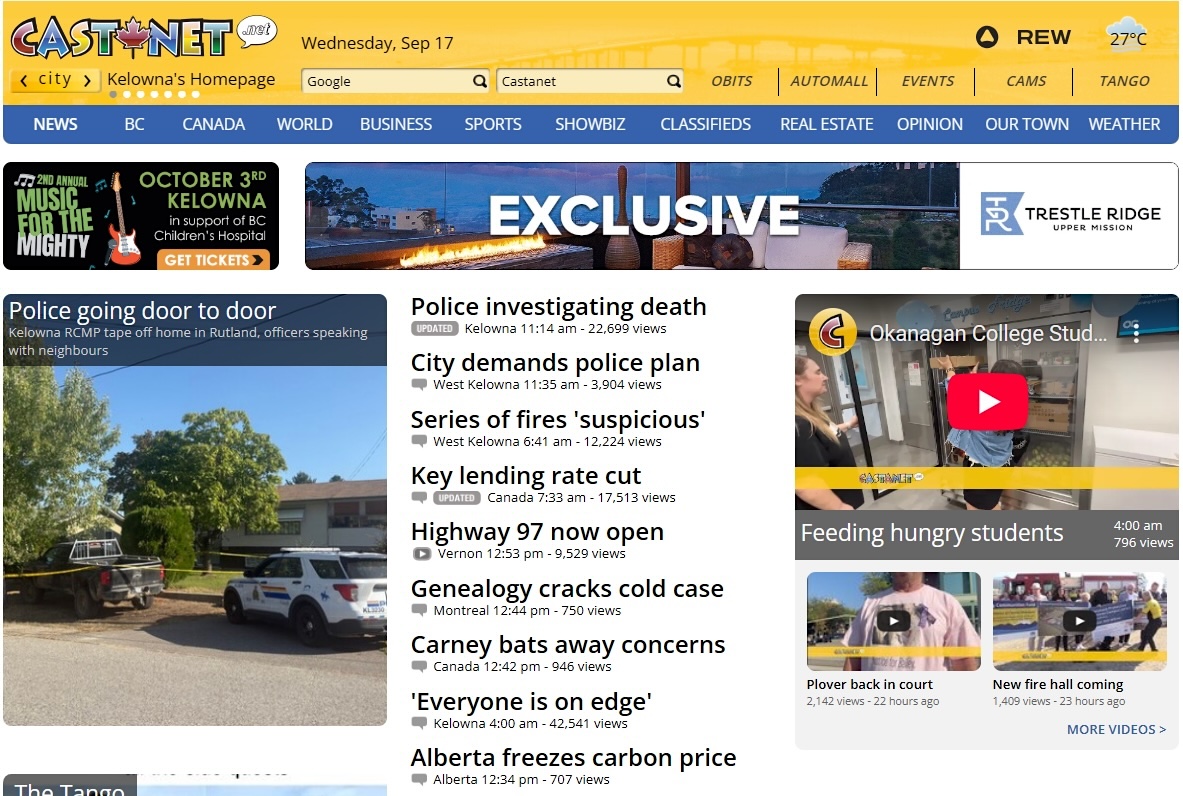
Castanet’s website is not particularly attractive. Some might say it’s downright ugly. But its plethora of brief daily articles and its popular free classifieds section encourage repeat visits.
Even after it has been bought by a larger company that once plowed huge amounts of money into an augmented-reality app, Castanet has kept doing the thing it has always done.
Sustainability has followed, and the outlet has expanded across the southern Interior, most recently opening a new bureau in Nelson. They even have robust competition in the Interior, where Infonews, a Yellow Pages-style business spinoff, has replicated the model, with its own sustainable success.
Castanet brass will tell you that their business model isn’t revolutionary. They are selling ads next to stories that people want to read.
If there’s a difference to be found between success and failure for ad-funded news in 2025, it might be located in the ambitions and local focus of the outlets that have made it work.
There was a time when it paid to be big, when salespeople in cities could book ad spots for TV newscasts and local papers in faraway places, when corporations would take their chunk, and there would be money left over to filter down to journalists and outlets in distant communities.
That model is busted. Journalism that relies on advertising has been enduring an extinction-level event.
But the smaller outlets closest to the ground — and their audiences — may prove adept at weathering the upheavals.
In the small town in which I live, a tiny newspaper called the Bridge River Lillooet News continues to publish every week, funded both by subscribers and by dozens of local advertisers.
You won’t find the paper online. But you can get it on main street. ![[Tyee]](/design-article.thetyee.ca/ui/img/yellowblob.png)
Read more: Media













Tyee Commenting Guidelines
Please note that email notifications for replies are not currently working due to a software issue which may be resolved in a future update.
Comments that violate guidelines risk being deleted, and violations may result in a temporary or permanent user ban. Maintain the spirit of good conversation to stay in the discussion and be patient with moderators. Comments are reviewed regularly but not in real time.
Do:
Do not: