News

A Tyee Series

What Really Killed Soviet Union? Oil Shock?

Red Empire just ran out of fuel, say growing number of experts.

By Andrew Nikiforuk, 13 Mar 2013, TheTyee.ca

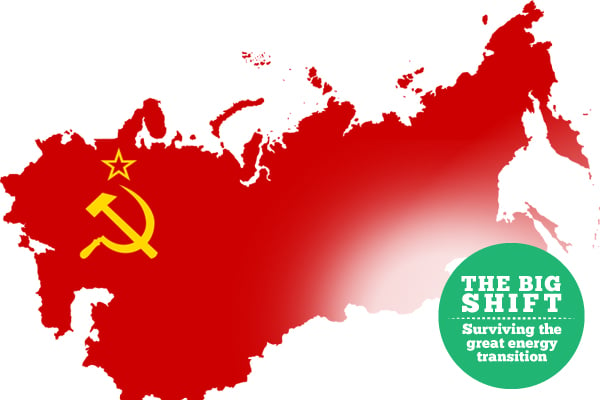
Soviet map, Nikiforuk series

Empire fueled by oil: The reach of the Soviet Union before its fall.

Related

Larry Hagman, the late U.S. actor that played the bombastic oilman JR Ewing, often quipped that the TV soap opera Dallas brought down the mighty Soviet Union.

"The opulence, the consumerism, the food, the cars -- these things made them want more than their governments provided them," claimed Hagman.

Academics, who had not foreseen or predicted the Soviet Union's rapid meltdown, now argue that the Reagan Doctrine probably forced the empire's demise. According to this theory, Moscow's inefficient centrally planned state just couldn't keep pace with U.S. military spending and went bankrupt.

But that's not how Doug Reynolds and an increasing number of analysts now view the Soviet collapse. The 52-year-old U.S. economist, who taught energy economics in the Republic of Kazakhstan during the fall, says the Red Empire just ran out of fuel.

CUBA AND NORTH KOREA: ENERGY ORPHANS

With the official collapse of the Soviet Union in 1991, both North Korea and Cuba became energy orphans.

The Soviet Union once shipped vast amounts of oil and fertilizer to both oil starved nations. In turn they exported their political allegiance and waves of anti-imperialist rhetoric.

When this energy system fell apart, North Korea and Cuba suddenly became global laboratories for how nations might respond to peak oil or massive disruptions in oil deliveries, writes Oxford history professor Jorg Friedrichs.

Their response is also a study in dramatic contrasts. North Korea's one per cent resorted to vicious repression coupled with nuclear threats while Cuba tapped into 19th century agricultural traditions and demonstrated much resilience.

For decades North Korea used its Soviet oil subsidies to build a highly industrial agricultural system. In order to grow enough grain in an unseasonable climate, it heavily invested in machines and irrigation systems as well as cheap fertilizer to restore depleted soil resources.

North Korea poured so many fossil fuels into its industrial farming system that the nation's per capita energy use in 1990 was twice that of China's, says Friedrichs.

When oil imports stopped in 1991 along with cheap fertilizers, Korea's elites directed scarce fuel supplies towards the military and heavy industry, effectively starving agriculture. Korea's one per cent, in other words, saved fuel for tanks to defend the regime but not for tractors to feed its hungry peasants.

While the Hermit Kingdom's well-fed rulers proclaimed a "Let's Eat Two Meals A Day" campaign, rice and corn production dropped by 50 per cent between 1991 and 1998.

A calculated political famine then swept away nearly a million peasants or three to five per cent of the population. For ordinary people, the trains stopped and homes went cold in the dead of winter. Children grew thin and sick.

North Korea's poor still live with recurring food shortages and a menu of endless political repression.

North Korea survived economic collapse and the disappearance of cheap oil by investing its remaining energies in protecting the status quo and dabbling in nuclear experiments.

As one observer noted, North Korea remains a land of two solitudes: "depressing poverty, pervasive food and medicine shortages, and crushing manual labour. Defending this grim reality is frightful military might in the form of ballistic missiles, hordes of armoured vehicles, long range artillery and one million soldiers."

Or as Freidrichs concluded, "Korean-style totalitarian retrenchment is without doubt one possible response to a severe energy supply disruption."

Cuba, however, replied much differently to a 70 per cent drop in oil imports, which precipitated massive wage losses and unemployment. Cuban economists compared the oil shock to an airplane falling from the sky and called it "the special period."

Without Soviet oil, fertilizers and food imports, the caloric intake of most Cubans dropped from 2,600 to a lean 1,000 a day.

In response, Cuba abandoned state-owned farming (the Soviet equivalent of agribusiness in North America) along with its attendant tobacco and sugar monocultures.

Faced with a grave emergency, the government turned to small farmers and "organicos" (small urban plots) to re-energize its agriculture with human muscle, clever thinking and small open markets. (Farmers are well paid in Cuba.)

Dire necessity and not "ecological consciousness" drove Cuba to develop the world's largest organic farming movement largely supported by the island's barrios or tightly knit neighbourhoods.

People raised rabbits on rooftops and planted organic gardens on empty lots. Compost centres provided soil while traditional knowledge provided ways to combat pests with natural products instead of oil-based chemicals.

So energy transitions driven by shortages can come with different political faces. North Korea's elites choose to starve its people and protect the powerful. In contrast, Cuba's rulers abandoned Soviet rhetoric and sought solutions among their own people and in a restoration of small farms and a relocalization of food markets.

Concluded Friedrichs: "Countries with a strong authoritarian tradition may follow a North Korean path of totalitarian retrenchment. Countries with a strong community ethos may embark on Cuban-style socioeconomic adaptation, relying on their people to mitigate the effects of peak oil. It is of course possible to imagine other reactive patterns, such as the mobilization of national sentiment by populist regimes." -- Andrew Nikiforuk

When oil production, and its all-important revenues peaked, the Soviet Union lost the energy mojo that glued its empire together. The empire's collapse was, in other words, another curious tale about energy transitions.

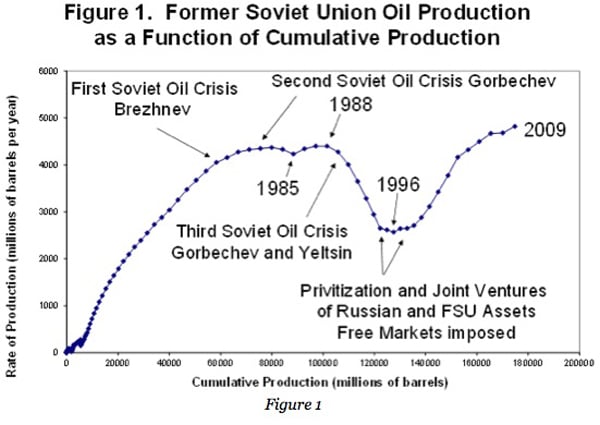
The numbers alone are convincing. Soviet oil production dropped an astounding 50 per cent between 1988 and 1995 from 12 million barrels to seven million barrels. (Under Putin it has returned to 10-million barrels.) As oil drained from the Soviet machine, the nation's stability morphed into Russian chaos and a temporary political renewal.

Satellites of the Soviet Union also went into energy descent. Deprived of cheap oil and subsidized fertilizers made from cheap natural gas, North Korea experienced a famine and Cuba fell into an economic and agricultural crisis known as "the Special Period."

Now, Reynolds is no crank or gadfly. The energy economist, who also worked as a mechanical engineer in the U.S. military, teaches at the University of Alaska. In his view energy, not money, makes the world go around. He also believes that the Soviet collapse holds valuable lessons for every modern economy dependent on imported oil.

The Soviet collapse, for example, demonstrates that "alternative energy technology has too little potential and takes too long to institute through an economy to be of any use during an oil crisis," says Reynolds.

Nor is Reynolds the only thinker looking at the empire's failure from an energy looking glass. Yegor Gaidar, director of the Moscow-based Institute for Economies in Transition, argues that both oil and grain played key roles in the fall of the Communist empire.

When flows of gold and silver to 16th century Spain dried up, it lost an entire empire. And when flows of oil and gas revenue dropped dramatically for the Soviet Union, it lost control over eastern Europe without "losing on the battlefield for 50 years."

Soviet downfall

The fall of the Soviet Union, wrote Gaidar in a 2007 paper, "should serve as a lesson to those who construct policy based on the assumption that oil prices will remain perpetually high."

Engineer, blogger and author Dmitry Orlov would mostly second that conclusion. He experienced the collapse first hand and attributes much of the chaos to peak oil.

"The Communist regime was so corrupt and stealing as much as they could that they didn't pay attention to the system. It was on autopilot," said Orlov in a recent talk.

Yet the story of how peak oil in a closed society precipitated the financial and geographical undoing of a major superpower remains a largely untold energy tale.

Like the United States, Russia was a global oil pioneer in the 19th century. While U.S. entrepreneurs such as John D. Rockefeller turned Pennsylvania's black gold into a refining monopoly in the 1870s, Sweden's Nobel brothers (yes of that Nobel fame) put their straws into the fields of Baku in Azerbaijan.

(The great French essayist Alex de Tocqueville noted as early as 1835 that Russia and the United States would some day ("by some secret design of Providence") hold in their hands "the destinies of half the world." He had no idea that the "secret design" would be their singular petroleum luck.)

But the Soviet Union didn't really begin to spend its oil in a concentrated way until after the Second World War. That's when communists began to burn petroleum, well, like Americans by building cars, tractors, MIG jets and concrete cities.

Just like U.S. petroleum joyriders, the Soviets also invested their oil surplus in Big Education (math and science), Big Medicine, Big Science (space programs) and a sprawling military-industrial complex.

"The same things that worked for us in the United States worked for them," says Reynolds. "They had incentives and big bonuses. It wasn't a dead economy. It was a unified state economy."

(Orlov sarcastically compares the two superpowers to two quarrelling oil rich brothers that wanted more or less the same stuff -- "things like technological progress, economic growth, full employment, and world domination -- but they disagreed about the methods. And they obtained similar results, each had a good run, intimidated the whole planet, and kept the other scared. Each eventually went bankrupt.")

Empire glue

Oil, however, shackled the whole damn empire together. Cheap petroleum kept eastern Europe under communist control while oil export revenue paid for essential grain imports along with bottles of vodka for state elites.

The union's oil abundance also saved it from two global oil price shocks in 1973 and 1981. Those volatile events sent most of the western world (including the United States) into recession, debt and as well as an ever increasing dependence on foreign oil.

As oil prices rose in the 1980s, the Soviet Empire behaved like any incompetent petro-state: it pumped more oil to generate more revenue in order to build more infrastructure to consume more oil. It also wasted an enormous amount of petroleum, men and rubles in a vain attempt to conquer Afghanistan.

At the same time it subsidized the energy needs of North Korea, eastern Europe and Cuba. Europeans of all stripes flocked to East Berlin to catch the cheapest flights to India in the 1980s and all thanks to Soviet fuel subsidies.

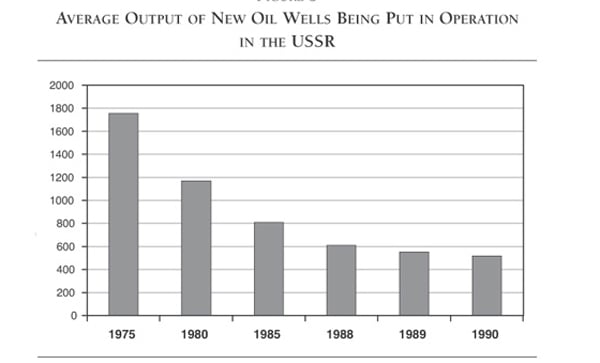
But in the mid-1980s, Soviet oil production topped off at 12 million barrels a day due to poor management, old technology and lack of investment. And then oil production started to drop. As oil fields ran dry, the authorities spent more cash to coax more petroleum from aging reservoirs with massive water flooding programs.

But these technological fixes didn't put much of a dent in the nation's oil depletion rates.

After Soviet oil peaked

Just before Soviet oil production peaked in 1988 (the event walked hand in hand with a major drop in oil prices), the empire realized that it no longer had enough black gold to pay its bills.

In full panic mode, "the dynamically developing world superpower" (as experts then called it) started to borrow heavily to prevent a bread famine due to oil-spending industrialization schemes that pushed 80 million farmers into Soviet slums. "But peak oil pushed the Soviet Union into an abyss," says Reynolds.

To save oil for its own needs, Moscow even started to charge eastern Europe hard currency for its oil and at global prices. "Without the free oil, the eastern European economies went into a tailspin," says Reynolds. Shortly afterwards the whole Soviet machine disintegrated as well.

So oil scarcity lead to debt, which feed an economic down turn (and lower GDP) that eventually resulted in currency devaluation along with a dramatic drop in oil consumption of 50 per cent from 1988 to 1995.

"Oil production managed to go up as long as oil reserves were relatively abundant," wrote Reynolds in one paper.

"However, once scarcity increased substantially, the communist system saw declining oil production which in turn could have caused their inefficient economic system to finally decline... They experienced peak oil in the system they had and they collapsed."

To Reynolds the collapse of the Soviet Union offers a variety of disquieting lessons for the United States, Europe and Japan.

All now face economic stagnation and rising debts associated with rising oil prices due to the depletion of light oil reserves around the world.

The first lesson, says Reynolds, is that an oil price shock will stop an economy the same way an empty fuel tank will stall a car. "There are not a lot of substitutes for oil," says Reynolds.

At the same time, big complex structures tend to fall apart when energy flows contract, adds Reynolds.
Oil output chart

The Soviet Union broke up; eastern Europe crumbled; and the Warsaw Pact dissolved as energy drained from the system like blood from a wound. Reynolds wonders if the European Economic Union and the United States can survive peak global oil without dissolving into smaller entities.

Slow to adapt

Another hard lesson has to do with alternative energy sources. None could replace the power density and versatility of oil. The Soviets researched solar and wind but couldn't scale them up fast enough to make any difference during an oil shock.

"Change is going to have to come from a collapse in energy demand. People will have to change their lifestyles."

Fourth, free markets can play a role in revitalizing the energy sector. In response to the collapse Russia privatized its energy assets and added new technologies that temporarily revived oil production.

But then Vladimir Putin nationalized the nation's oil wealth to consolidate his hold on power. Russia remains a petro-state dependent on its oil and gas revenues.

But free markets did not change the nation's energy system by inviting more renewables or by encouraging sound energy conservation.
FSU oil peak graph

"The former Soviet Union did not solve its energy crisis by using alternative energy, but by simply reducing its use of energy. This bodes badly for our own ability to depend on alternative energy," adds Reynolds.

Last but not least, oil shocks promote social inequality. "The Russians had hyperinflation and massive unemployment. You also had the enrichment of the rich."

To Reynolds, volatile and higher oil prices have thrust the world into an uncertain energy transition.

"A likely road map for the future can be discerned by studying events before and after the collapse of the Soviet Union."  [Tyee]

Read more: Energy, Labour + Industry,

20  Comments:

Login or register to post comments

  • Fiat lux

    9 weeks ago

    Having spent 45 years

    Having spent 45 years fighting Soviet dictatorship, I would suggest that their 1% collapsed because they ran out of lies, the same way and reason the rule of the capitalist 1% is running out and collapsing now.

    Which has been and is the fate of all empires in history.

    The unconscious of people can and will put up with systems based on lies only for so long and then the inevitable collapse happens, time after time and unstoppable.

    All empires and ruling systems have always been based on "faith", the way ours is based on imaginary monetary games now, and can only last for a limited time.

    What pleasantly surprised most of us at the time that the Soviets collapsed with a whimper, instead with violence, and can only hope that the capitalist empire will go the same relatively peaceful way and rebuilding, based on realities, democracy and human rights can start right away.

    Ed Deak.

  • SharingIsGood

    9 weeks ago

    Canadian oil - cheap

    Thank you, Andrew Nikiforuk.

    Rather than use the oil at home to build an infrastructure that does not require oil, our conservative governments (BC Libs Alberta and Harper) are hell-bent on getting the filthy tar sands oil out of the ground and shipped anywhere they can as quickly as possible. Rather than follow the Hugo Chavez model of spreading the oil wealth to the people, the owners and controllers of international corporations are taking the profits. Those corporations have no loyalty to Canada.

    Let us remember Halliburton. It built its wealth on North American oil and North American sweat. Halliburton and its spin-off mercenary company, Blackwater, continue to profit hugely from the US war in Iraq. Even while they were making untold billions from the Americans in the no weapons of mass destruction war with Iraq, Halliburton moved its corporate headquarters to Dubai. No loyalty!

    http://newsjunkiepost.com/2011/12/18/iraq-war-us-troops-are-out-but-blackwater-and-halliburton-will-stay/

    This is what our children have to look forward to with the natural gas and tar sands "developments" in Canada. The energy comes out, a few coins go to the feds and the provinces, some workers make some quick cash, and the real money flows into the pockets of the corporate elite. Nothing for the future gets built but a useless network of pipes and power lines. And if tar oil spills into an ocean or in a watershed, the corporation will spend decades fighting paying for the unfixable environmental damage.

    Let us remember the Exxon Valdez. Let us remember what Andrew has shown us with this review of Doug Reynold's work.

  • Van Isle

    9 weeks ago

    The Soviet Empire was brought

    The Soviet Empire was brought down by old fashioned greed and corruption, pure and simple. Greed and corruption brought down the Roman, Chinese, Greek, British, and other European Empires. And it is happening now with the American Empire and the present New Chinese Empire.

  • Booker

    9 weeks ago

    Causes

    All now face economic stagnation and rising debts associated with rising oil prices due to the depletion of light oil reserves around the world.

    If this is Reynolds's argument, I have to say that it is demonstrably incorrect. The current economic crisis had nothing to do with energy markets. It was due to financial chicanery by the financial sector. That lead to a huge rise in public debt. The depression continues because the economic geniuses in Europe (and some in the U.S.) have forgotten the lessons of Keynes.

    The argument is made in many places that our current economic woes are due to energy issues, and there is just no evidence of that. Similarly, Conservatives argue that the crash was caused by unaffordable social programs (ask Lehman Bros. or AIG if they collapsed because of too much health care spending). Both are wrong.

    While it's true that the Soviet Union was not able to transition from an oil economy, I'm not sure it's a particularly instructive example for us today. It's not clear that they made any great effort to do so. Their collapse in oil production and oil consumption seems to be (give the timing) more of a symptom than a cause of their empire's collapse. The collapse was extremely advanced by the time they reached peak oil production in 1988. It is now known, as stated in the article, that the collapse was not due to the arms race, though Americans still claim credit for that. But, while the oil shortage after 1988 no doubt helped the collapse along, I'm not sure there is a direct causal relationship. Solidarnosc had more to do with it than oil shortages.

    I don't think we can look to Russia as a "roadmap for the future" as Reynolds says. We know that the energy transition is going to be hard, but we have a lot more cards to play than Russia ever did. He would have done better to simply point to the actual, huge, oil shock that hit the west in 1973. That, I think, is what we are going to face.

  • miguel

    9 weeks ago

    It was a one - two punch.

    The Afghan debacle, coupled with the fall of the Shah of Iran, and an OPEC managed oil crisis, sucked away the revenue, before peak oil was a notion.
    There was a 20 year decline in the oil prices, that rocked the world.
    Saudi dominated OPEC, with the Carter Doctrine, played havoc, by design.

  • Fiat lux

    9 weeks ago

    The Soviets would have

    The Soviets would have collapsed much sooner if Hitler & Co. hadn't attacked them in search of "Lebensraum", but the war gave them a patriotic awakening that kept them going for another 40 plus years, before the inevitable collapse happened.

    When the Germans invaded Russia, whole armies just capitulated and went over, some 4 million to the best of my recollection, until they realized that it was worse slavery that their own homemade kind.

    Ed Deak.

  • Lawrence

    9 weeks ago

    Um, no

    At the time of the Soviet collapse the country was going broke trying to keep up with the arms system called ''Star wars ''.
    Then Reagan's recession hit and that was all she wrote.
    Reagan's's recession was far worse than Bush's but they were deliberate and designed to do the same thing which is to rob the baby boomers.

    It worked both times and that's why they will try it again.This article is incorrect.

  • Booker

    9 weeks ago

    Myth of the arms buildup

    At the time of the Soviet collapse the country was going broke trying to keep up with the arms system called ''Star wars ''.

    That's the myth of Saint Reagan. Though military spending was indeed a drain on their economy, it did not increase overall in the 1980's after Reagan arrived on the scene. From the Atlantic;

    The Soviet Union's defense spending did not rise or fall in response to American military expenditures. Revised estimates by the Central Intelligence Agency indicate that Soviet expenditures on defense remained more or less constant throughout the 1980s. Neither the military buildup under Jimmy Carter and Reagan nor SDI had any real impact on gross spending levels in the USSR. At most SDI shifted the marginal allocation of defense rubles as some funds were allotted for developing countermeasures to ballistic defense.

    http://www.theatlantic.com/past/politics/foreign/reagrus.htm

    While their spending on missiles increased, overall spending did not. It remained at the high level it had been for decades.

  • andsbc

    9 weeks ago

    I'm with Ed

    "The Russians had hyperinflation and massive unemployment. You also had the enrichment of the rich."

    Inequality and economic instability go hand in hand.

  • gilbert marks

    9 weeks ago

    Once again - not a problem

    In 1974 after the first oil crisis France decided to build nuke and over 15 years built up to 80% of electricity from nuke an average of 4 nukes a year - no sweat. Ontario did much the same through the 1980's - again no sweat.

    Modern GTL plants like Shell's $30 bbl Qatar facility can easily use nuke hydrogen to make diesel and gasoline.

    Here's how to git er done.

    In 1941 America had a fraction of today's industrial capacity producing 3.7M automobiles compared to 2007 when it produced 10 million vehicles. In 1941 American tank production was almost zero and yet by 1945 it had produced 80000 tanks weighing in at 30 tons each.

    While perhaps only part of the solution, a total fossil fuel elimination with the hot tub size factory produced 30 Mwe Hyperion unit weighing in at about 15 tons illustrates the small amount of industrial capacity required. Two units - made almost 100% of steel with a few pounds of enriched uranium weigh about the same as 20 automobiles or a Sherman tank and are lot less complex. 50000 of them would be needed to convert American from fossils to nuclear about the equivalent of a half million vehicles - .5% of American's 2007 auto production per year for 10 years.

    There is a lot of unemployed autoworkers and mothballed auto factories just waiting for orders.

    Not a trivial thing certainly but well within our capacity. What would work best is a giant public national power authority like the Bonneville (Grand Coulee) Power Commission or TVA one time national technical and environment certifications - no lawyers allowed - charged with replacing all the nations coal plants efficiently on budget and on time just like Asian countries are doing.

    My way:

    10000 nukes worldwide costing $10 trillion is well within our industrial/financial capacity to build within the next ten years. It is paid for by and ends fossil fuel use, saves a million lives every year from toxic radioactive waste from coal plants and ends global warming. Reasoning progressives (most I hope) and almost all Deniers will go along with this at least part way as momentum builds.

    Andrew's vision

    Thirty years from now some new tech renewables we've been waiting for are now less than 10 times the cost of nuclear. Apparently attaching a microprocessor making them "smart" helps with the cost.

    Unfortunately, the "opinions" of those silly scientists were right and most of the worlds coastal cities are flooded, the gulf stream has stopped, billions are dead and starving from toxic radioactive coal plant emissions flooding and bad weather. Europe and eastern North America are frozen solid. Deniers and still refuse to spend on renewables because the treasury is empty feeding the starving, CO2 is plant food and we need lotsa that. The new age renewable "religion" with High Priest Al Gore wants to start culling humans because we produce too much CO2.

    Jesus and Mohammed have been seen walking together.

    You Pick

  • ModestyBlaise

    9 weeks ago

    If we look back farther...

    Japan was cut off from US oil and therefore needed oil from the European controlled Dutch East Indies the "Southern Resource Area". This led to the bombing of Pearl Harbour. The following day the United States declared war on Japan and three days later declared war on Germany.

    Britain declared war on Germany, when Germany ignored the promise that Britain would protect the Poles and invaded Poland. The USA joined in after Japan attacked because of oil.

  • trylogic

    9 weeks ago

    Chernobyl...

    was certainly also an important part of the collapse. To physically deal with this catastrophe was an enormous drain on the economy. The Sovjets took it on and did it, unlike the corrupt Japanese who haven't really dealt with Fukushima yet, probably because of the expected devastating economic impact.

  • prokop

    9 weeks ago

    Soviet Union collapse

    The inability to pay for its many commitments (by the high price of oil) was but one of MANY factors leading to the SU collapse. There were too many other reasons to set down here but they were numerous.

  • metacomet

    9 weeks ago

    The reasons the Soviet Union

    The reasons the Soviet Union collapsed:
    Gorby foolishly doubled the price of vodka, their national lubricant, mother's milk and pickling agent---and twice as foolishly halved it when the people whined (in short, he blinked). Yeltsin had the perfect issue with which to beat Gorby.

    Second, Gorby (I'm sorry, I don't mean to pick on Gorby; I actually think he is an honourable man who couldn't make lemonade)...Mr Gorbachev failed to recruit the trucking industry; as soon as local cadres started shaking down truckers, the transport system disintegrated and, inevitably, production withered.

    Finally, what the Soviets took by force they failed to keep, the more sophisticated the weaponry, the less retainable the territory (the Russians took Siberia when the aboriginals there had only bows and arrows, so they kept it; not so their attempted annexation of Afghanistan.)

    State corruption became warlord corruption became criminal corruption became Ivan Doeskov corruption. Baku (former Azeri Soviet Republic) is awash in parasitized oil. Nowadays all the petro-tapeworms are capitalists. Without them the meagre would fatten.

    My two ruble's worth.

  • freewilly

    9 weeks ago

    simplified further

    Under Gorbachev's leadership the tight grip on people's freedoms were relaxed, reforms were implimented and the worst aspects of Capitalism crept in. Gorbachev gave his people an inch, they took a mile.
    Gorbachev frustrated gave up and went to hollywood.

  • snert

    9 weeks ago

    Two Indicators that never get mentioned

    First is the education program that the USSR embarked on which allowed it to enter the space race. When you give people a more advanced education system it is pretty difficult to prevent the spread of new ideas.

    Second is the easing up of foreign travel restrictions within Russia itself. This was documented, most likely unintentionally, by the National Geographic Society in several articles that they were able to produce at a time that the rest of the US still had their nickers in a knot about Communism.

    These two indicators were very subtle but if you noticed them it was no surprise when the tern glasnost popped into existence.

    In 1985/86 I was working a passenger train and had the opportunity to chat with a teacher from West Berlin who shook her head sadly when I suggested that Germany would once again be reunited. The wall came down in 1989.

    It's very difficult to run a totalitarian state if the population is well educated. Educated people have a tendency to figure out when they are being brain washed and also they are usually smart enough to realize that you can't make changes overnight, at least if you value your life.

    As shipyard workers in Poland got the ball rolling it became time for everyone else who cared to climb on board with the exception of all the die-hard commies.

    ........Then there's the Beatles.

    You want to bitch about Harper just thank your lucky stars you don't have Putin to deal with. The one man that could make Russia a great nation, won't

  • Fiat lux

    9 weeks ago

    I have seen Harper's eyes

    I have seen Harper's eyes under Totenkopf and Red Star caps. He, Boehner in the US and Putin in Russia could be, and are, brothers.

    Some people are just born that way and psychologists have written books on their symptoms

    Ed Deak.

  • Hakuin

    9 weeks ago

    Things finally fell apart

    Because they rigged the game so much most everybody quit playing.

    Something you will eventually see here too.

  • bluerev

    9 weeks ago

    Of Course it's energy

    Energy is always the culprit that brings down empires. Energy is the basis of the entire economy. Very simply, without energy, no empire. It is the control of the energy that keeps empires, well empires, nothing else. The type of energy changes, bio fuels (wood, grain, livestock) to fossil fuels (Coal, Oil), but when they cease to continue to grow with the expanding empire, the empire starts to decline.

    Currently the arab spring is about energy. It's no-coincidence that when oil prices skyrocketed the following year there were revolts across the middle east. Fuel price goes up, food prices go up. When you can't afford the new prices, you revolt, very simple.

  • RickOshea

    9 weeks ago

    We're In The Same Boat

    <quote>
    The Communist regime was so corrupt and stealing as much as they could that they didn't pay attention to the system. It was on autopilot...
    </quote>

    Replace Communism with Capitalist (e.i. Wall Street/Fed/Too Big To Fail Banks etc) and you describe the current situation in the 'west' perfectly.

    I do not predict a 'soft landing' for civilization as the two major components of the life support system that sustains 7 billion humans - cheap energy and a stable/benign climate - collapse in unison.

    • The discussion for this story is closed. No more comments can be added.