
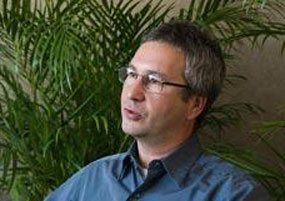
With the American economy teetering, Dmitry Orlov sees similarities in another 'superpower collapse.' Is he just a doomsayer?
Dmitry Orlov: A 'clear recipe' for social unrest in the U.S.

-
Your chance to spend a bit of quality time with the world's foremost doomer.
-
Author Thomas Homer-Dixon on the coming crisis, new opportunities and more. A Tyee interview (part one).
-
Why Canadians must fight 'deep integration' with US.
- Reinventing Collapse: The Soviet Experience and American Prospects -- Revised & Updated
- Dmitry Orlov
- New Society Publishers (2011)
It's all too easy to make jokes about our neighbors to the south for their dramatic weight problems, generally poor understanding of geography and that stretch of coastline now famously known as the Jersey Shore.
Yet we're seriously reliant on the economic health our southern neighbours. In British Columbia, 45.9 per cent of our total exports went to the U.S. last year. The Canadian economy exports over 70 per cent of its products to the States, forming the world's largest trading relationship between two nations. The case could be made that no other sovereign economy is tied to the U.S. more than Canada's.
So when someone deeply familiar with the collapse of the Soviet Union writes about how the States is headed in the same direction, we might wish to pay attention. Even greater cause for concern is that he has been doing so since 2005, and his predictions have been proving true at alarming accuracy. That, combined with a crushing national debt hovering over Washington D.C., means there is a prescient need for people to hear from those experienced with "superpower collapse."
Dmitry Orlov writes not for fame or fortune, but to provide a book with which you can smack your friends across the head when they state, "No one could have seen this coming." He moved with his family from the USSR to the U.S. as a kid, but his career allowed many opportunities to travel back home and catch glimpses of growing collapse. Though the USSR had been falling apart slowly, it wasn't until Yeltsin uttered the words "Former Soviet Union" that it seemed to happen all at once. The world's first superpower collapsed because its founding myths of technological progress and "bread for all" had failed to match reality.
Moving past the 'iron triangle'
In the newly revised version of Reinventing Collapse, first published in 2008 before the financial crisis began later that year, Orlov expands on his attempt to convince you that the U.S. is much less prepared for collapse than the Soviet Union ever was. Though headlines declaring the end of America won't appear anytime soon, Orlov forecasts that collapse will happen for each person individually, as they are rudely awakened from the American Dream. And while his propositions can be frightening at times, he understands that forecasts of superpower collapse will either frustrate or alienate most people, or end up largely ignored -- until it's too late.
Many of Orlov's forecasts from the previous edition have proven accurate. Orlov's America is a system barely able to sustain itself, ruined by a population bent on a hardened mythology: an iron triangle of home, car and job that is out of touch with the reality of rapidly depleting cheap energy, which made vehicle ownership and suburban home life a gateway to the goal of being middle class. Orlov predicted that as the steady stream of money from employment dried up, the country's depleted social infrastructure would be exposed and the American standard of living would plummet. His forecasts are lived out by the people who have their home in the underground corridors of Las Vegas and in cars across the nation.
Orlov argues that there is a clear recipe for social unrest in the U.S., with approximately 350 million guns, a consumption rate of two-thirds of the world's anti-depressant drugs and a national homicide rate that could be equaled by a 9-11-sized event every month. The can-do American spirit and career-oriented mindset may have served its residents well in the past, but it will be particularly vulnerable in the transition to a post-growth economy. Contrasted to the Russian work ethic during the latter stage of Soviet decline, Orlov says that someone who worked hard and played hard was considered a fool. American career ethics and economic dynamics have lead to patterns of migration that uproot people from communities, something we're witnessing in Canada now -- though this can be a positive in times of collapse, as it makes us more open to strangers and varied living situations than the tightly knit Russian communities Orlov witnessed. Vancouverites know how difficult affordable housing can be, and openness is an asset as living affordability becomes more precarious.
Orlov contrasts the U.S. and the USSR in areas as diverse as housing policies, health care, food production and core societal myths. His explanation of the difference between Soviet and American expectations for education particularly resonated with me. While Soviet schools had far fewer resources, they produced children that knew much more general information and had better conceptual understanding, rather than a focus on exams. At my university in North Carolina, I experienced that exact dynamic. When a professor made a point to avoid specific outlines of what to study, students squirmed with discomfort. In classes with Russian professors, students complained that exams didn't follow homework problems, testing concepts instead. Orlov concludes this is because schools in the U.S. aren't about learning, they are about institutionalization; merely biding the time while kids enter the institution of the workforce, government, a corporation or prison.
Age of opportunity?
While the updated Reinventing Collapse retains many of its first edition's ideas, it reads smoother and makes the case stronger for the collapse of the U.S. But it's not all doom and gloom. Orlov presents very clear and surprisingly optimistic recommendations, revealing an age of opportunity for those willing to adjust their expectations. Orlov thinks black market economies in scavenged material will become the norm in the near future -- and evidence of that is booming, as witnessed by the rapid growth industry of copper and air conditioner theft in the U.S. Orlov explains that expensive health care will become out of reach for the majority, and alternative medicine will grow in popularity as the complex networks that enable pharmaceuticals wither away. He says that instead of building an electric car no one can afford, products and services can be designed to serve the huge and untapped market segment of the permanently unemployed. There will be a need, he says, for low-cost housing opportunities like dormitories, GPS devices for retrieving and locating stashes of gear, or campgrounds that provide garden plots.
The American economy is deeply tied to oil consumption at incredible levels, made possible by the world's reserve currency. Orlov explains that as oil prices increase, the economy will decline, leading to shortages of serviceable equipment and an inability for citizens to consume -- hurting economic activity further, weakening the U.S. dollar and making more oil even further out of reach. Once shortages appear, much of the spare gasoline is wasted idling at the few gas stations still open and hoarded by those with ambition and foresight. Reinventing Collapse explains how even a relatively minor temporary disruption in gasoline could lead to a dramatic shift to a black market economy for fueling vehicles. Another advantage lies herein for Canada as the value of the loonie has been closely tied to oil prices for over a decade.
So where does that leave Canada? While our debt-to-GDP ratio is among the healthiest of the G20, economic ties to the U.S. means we should pay attention. By understanding where the U.S. is headed, perhaps the argument for greater resilience and sustainability here in Canada can be made anew. ![[Tyee]](http://thetyee.cachefly.net/ui/img/ico_fishie.png)
Justin Ritchie counts himself among the first refugees from the U.S. to Canada. He covers sustainability and sociological issues as co-host of the Extraenvironmentalist podcast at http://extraenvironmentalist.com. He is the sustainability coordinator for the UBC Alma Mater Society and is working on energy materials as a Master's of Materials Engineering student at the University of British Columbia.
11
Login or register to post comments
OwlRol
1 year ago
Empires peak and decline ever more quickly
My pappy and I discussed the fall of the two superpowers, barring nuclear obliteration, long before Gorbachev came to power in the former Soviet Union. After it fell, we knew that a single "Hyperpower" "World Police Force" was little more than a myth. We speculated on how it would take place at the time, predicted social and environmental disruption, but didn't see "peak oil" as a possible cause until a few years later.
Maybe we should thank Pierre Trudeau for opening up relations with China during the Cold War and Jean Cretien for his Asian business junkets during the 90s, or we might still be 95% dependent on U.S. trade.
Fiat lux
1 year ago
I wrote about the coming US
I wrote about the coming US bankruptcy on World Bank economic forums over 10 years ago. Their debt is not $14.3 trillion, but close to $70. trillion, thanks to the deregulated money creation powers of the banks.
Personal debt is also part of the national debt, which means that the $1.3 trillion personal debt in Canada should also be included and accounted, but our governments and miseducated economists, in service of the multinational corporate mafia, would never allow it.
The reason is the fraudulent economic system being taught in the world's universities, with an accounting system that has no debits, or liabilities and accounts destruction as part of the GDP.
As Herman Daly wrote over 30 years ago: "Everything goes on, nothing comes off" and so huge liabilities are accounted as "growth".
Canada is no better off, with the exception of the low population density and still large resource base, which can be sold from under the people's feet and recorded as "income".
As long as imaginary monetary figures are used for economic calculations, instead of physical realities, and the stock and money markets are permitted to have a stranglehold on real economies, not only the USA, but the whole world will be going downhill to self destruction.
In any case what is "trade" and how much is needed, when we have the resources to supply the vast majority of our needs for ourselves?
We've seen this mess coming with the acceptance of the criminal neoclassical market economic theory and built a good degree of self sufficiency for ourselves, where we can produce and provide for much of our own needs and live very well on an income way below the official poverty levels.
Communities and countries should and could do much of the same and become physically efficient, ensuring their survival.
There's no such thing as GDP, monetary efficiency, or "cheap". These are the frauds that ruin the world an kill millions every year with starvation, cancers and other horrors.
The vast majority of our exports and imports are not needed and are suicidal economics, causing great damage to humanity and the ecology.
Ed Deak.
Fiat lux
1 year ago
Interesting kissing games
Interesting kissing games between the idiotic twins of communism and capitalism to maintain the power of their predator ruling classes with the perceived power of imaginary money, while preparing to go to war against each other.
Ed Deak.
====================================
China could theoretically reexamine its management of the yuan, and Hong Kong might look more seriously at dropping its peg to the U.S. dollar, though it’s still “too early to say what would happen,” he said.
Certainly, China has been encouraging its state-owned firms to acquire assets overseas to hedge against losses in their dollar portfolios, and this could increase.
http://www.marketwatch.com/story/chinas-hands-tied-on-us-debt-threat-2011-07-27?siteid=rss&rss=1
NeverGiveUp
1 year ago
Thank you, Ed Deak!
I really enjoy your comments and wisdom.
OwlRol
1 year ago
The warnings are there but few paying attention
The Nazi system of self dependence, labelled as autarchy, ultimately did not work, probably because their elites wanted luxuries beyond a basic (yet healthy) lifestyle, but also an expanding, expensive military in order to compete in world empire building, as well as the funds to show off how great they were (eg. the 1936 Olympics).
Ultimately, they had to obtain resources elsewhere, despite their indoctrinated and hard working population, in order to maintain this twisted facade of superiority.
How different is that from modern consumerism and leaders who want to erect structures in their own personal, political or corporate names?
We truly do need some interregional and international trade, but not to the maximizing level we are trying to achieve today in order to support rather decadent lifestyles.
Natural limits push back. Regardless of climate change and other environmental crisis, unless we find and develop new, non fossil fuel, energy sources for transportation (nuclear is not feasible for autos or flight), movement will become ever more expensive.
Living in the burbs will become unaffordable, food shortages could become endemic, jobs scarce and local resources and entrepreneurship will become more and more necessary.
Why are we still paving over our best agricultural land as population growth, especially in urban centres, has long past the carrying capacity of the surrounding regions? Blind, profit driven insanity?
Import costs will surely increase or become more unavailable with scarcer and pricier energy inputs. (Some Asian plants that export to N. America, have already moved back to Mexico as transportation costs increase above labour costs.)
Limit our consumer desires, military expenditures, monuments and coliseums, and maybe, just maybe, we can thrive in a self sustaining fashion.
Of course the elites would have to find real, but more humble work.
don quixote
1 year ago
Empires falling
A few years ago I had the good fortune to visit Budapest. My impression of Hungary to that point had largely been negative, as I remember large numbers of refugees arriving in Canada following the Hungarian Uprising of 1956. I suppose I was also influenced by the propaganda of the Cold War. But here was a city of great, if crumbling, beauty, a world capital in 1900, the site of the first subway system in continental Europe, a flower of the Secession movement. How could a nation fall so far in one person's lifetime? If you had raised the possibility on the streets of Budapest in 1900, you would probably have been laughed at. Could the same thing be happening here?
Fiat lux
1 year ago
That's why I never go back
That's why I never go back anywhere. When I look at the places I used to live at in 4 countries, on Google Earth, they turn my stomach. Especially the human zoo of Europe.
Used to live in Vancouver from 1955 to 79, 24 years, and had some good times and good friends. My wife hasn't been back since 1980 and I since 1988, when I had to deliver something.
Don't even recognize the place in the news any more.
Ed Deak.
Van Isle
1 year ago
When the great Soviet Empire
When the great Soviet Empire fell apart in the early 90's I wondered then when will it be our (the capitalist's west) turn. Will it happen with in my life time I thought? To be honest, I thought it was going to take longer, boy, was I wrong. Main reason for both systems to fail; greed and corruption.
Bailey
1 year ago
True value
In 1918 open season was declared on the Deutchmark. The powers of Europe felt quite justified in looting their own central manufacturing district, which is what Germany amounted to. Greed unregulated led to an inflationary event that needed a reissue of the Mark at a rate of one trillion to one to cure. After the reissue, it was again the strongest currency in Europe, and manufacturing resumed.
Rearmament, it was.
But the lesson was that the true value in any currency has nothing to do with the things, usually exotic foriegn goods the elite love to flaunt. It rests in the contributions of labour and creativity made by people who are living their lives.
Even the metals that currency used to be based on were nothing but an unexpandable standard that would serve to prevent variations in unit value when quantities of value varied from season to season
Even then the value in the currency was really the labour performed for it.
The whole history of the democracy movement in all its forms is a history of proper regulation of greed while simultaneously regulating the minimum standards of labor and wages.
All the true wealth of nations flows from labour, applied to resources in local industries and enterprises.
It is essential that the dollar currencies be scrapped and reissued in such a way that the value of labour be considered as a major element in the value of each dollar. I'm aware that this will limit the amount the elite owner class can deviate from the average wage, but I regard this as essential to the future prosperity of all our social cultures.
If the owner of a plant can make 1,000 times what a worker in that plant make, the instability produced by that imbalance will sooner or later be fatal to the currency. If he makes 50 times the average, that might be sustainable, while still allowing self interest and the desire for status to create incentive.
Humans will always seek reward, that is not changeable. But if the reward gained by the few leave the many starving and hopeless, unable to gain a decent life for their societies by applying their labour to their world, then democracy must fail.
Thoughts of what might replace it give me nightmares.
anarcho
1 year ago
No reform, no revolution, what are you left with?
If reform is impossible, as it is in the US and most countries now with the incorporation of social democracy into neliberalism, if revolution is highly unlikely, this leaves only one option - collapse. But the possibility of collapse does not mean that what we must do is that much different than if we were pushing for reform or working toward revolution. The solidarity, mutual aid, community-building, networking, and organizing that we do now, if anything, will be more important than ever.
Bailey
1 year ago
Is reform impossible?
I understand your point, but there has been a lot of recent activity in North Africa and the Middle East. Ordinary people using the new media to promote what really looks like reform.
It's not revolution, since nobody seems to be proposing any major changes to the nominal systems of government, It seems from the reporting I've seen to be mostly a matter of tossing out the corrupt leaders and hoping that their replacements will have learned something from the exercise.
All driven by ordinary people impoverished and disappointed by the misuse of power by the people they needed to be highly ethical and to protect their rights to proper governance. A sort of loose coalition of students with hope and religious interests who require moral behaviour in their leaders, rather than some change in the nature of the societies they are growing.
I suppose it's really not complete, so it may not be possible yet to say it has been a successful reform, but I think reform is the right word.
If political corruption and bribery can be properly tried and punished in people of any level of status, even heads of state, that would be real reform. Wouldn't you say?