Books

A Tyee Series

William Gibson Hates Futurists

The author of 'Spook Country' on how Osama Bin Laden was handed victory, how to really fight terrorists, the appeal of retro-virtual reality, and why Vancouver is like a video game.

By David Beers, 18 Oct 2007, TheTyee.ca

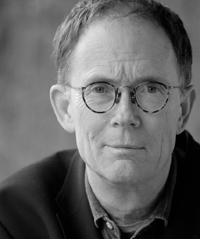
WilliamG.png

Gibson: 'One news cycle away'

  • Spook Country
  • William Gibson
  • G.P. Putnam's Sons (2007)

Just don't call William Gibson dystopian. The author of the cyberpunk classic Neuromancer, and eight novels since, admits his invented worlds aren't altogether pleasant places to imagine. But "someone stuck in Darfur right now might be happy to live in them. People who say I'm dystopian are middle class pussies!"

Gibson is loosening up this morning in his favourite noisy café on South Granville Street in his home city of Vancouver. He doesn't want to be called a futurist either, primarily because "I don't know what will happen in the future and I know that I don't know." Spook Country, his latest book, like Pattern Recognition, his previous one, is set in the current day, and gives us a post-9-11 America spooked by terror threats, manipulated by marketing, and mesmerized by digital artifice. As one of his characters declares, cyberspace is "everting," meaning that it is less a destination we choose, and more and more an environment that envelops us.

The plot is a knot from several threads: a Cuban/Chinese crime family in New York working a shadowy exchange, an ex-punk rock star exploring the limits of virtual reality art, and rumoured rogue arms traders on the high seas. Readers of Pattern Recognition will note the return of a creepy genius of advertising named Hubertus Bigend, who Gibson defends as "more Luciferian than Satanic."

After a grueling book tour, Gibson clearly is happy to be back home (and speaking tonight at the Vancouver International Writers' and Readers' Festival). Vancouver's essence, he says, is its young age, barely 100 years old. "Even 30 years ago, it was astonishingly thin on the ground." As a result, Vancouver is "sort of a video game," unencumbered by obsolete infrastructure that "you've got to repurpose. There's relatively little to repurpose here." And that, he likes.

During our conversation, here's what else Gibson had to say:

On being confused with being a 'futurist'

"The slot in culture that I'm most closely associated with is one in which charlatans declare that they know the future. My job is to sit near that slot and when people approach me I say: 'Only charlatans say they really know the future.' I sit near the tent where they give out bullshit and offer people a different sort of dialogue. My role is to raise questions."

On whether people will prefer life inside the screen to the real world

"I think that we're already there. And that is the nature of our experience of emergent technology and new media. A friend of mine was mining YouTube last month and he came up with footage shot in the street in New York on a particular day, in the evening. And he knew that this footage was shot the day before broadcast television began in New York. So this footage is of the last night that streets in New York were the way they were before everyone started staying home to watch television. All the footage that he's been able to find afterward is dramatically different. It changed. It changed the night they turned it on. The night they started to broadcast television in New York, New York ceased to be what it had been before. Because everyone stayed home to watch television.

"It's not that we prefer it, it's not even that conscious. It becomes the nature of our experience. If it's going to happen at all, it becomes the nature of our experience. If it doesn't happen it just becomes one of those iconic retro-future images."

On retro virtual reality

"There's some ironic stuff going on in Spook Country, for me anyway, around the virtual reality gear. Virtual reality was one of our most recent experiences of a future that didn't happen. The one before that would have been interactive television, on which millions of dollars were spent. Nobody wanted it. Nobody wanted it at all. But the Internet wasn't here yet, and people were saying, it would great if people could go back and forth with media, but it turns out the medium they wanted to do it with is one that presents the world, rather than a bunch of entertainment -- the Internet."

On the seamless net being woven

"There's some enormous number, millions and millions, of Iranians who are about to get their first cell phones. The infrastructure has been built. That's an interesting side of Iran we don't hear so much about. And you know, they're not just getting cell phones, they're getting Internet. What is that going to do to that country? The government is not going to be able to control what those people are watching. I just find that amazing, really.

"We've grown up thinking: 'Over here is the Internet, over there is cellular telephony, and here are iPods.' It's not going to be like that. That stuff is all just one cloud of stuff and it works together and you can't just get a little piece of it. The kids being born today will grow up finding the quaintest thing about the past was that people had these different devices that had discrete functions."

On whether we care less and less about what is authentic

"Doesn't that question imply an assumption it was different previously? And I'm not convinced of that. I think a lack of concern about virtual and real maybe telling us as much about what we used to call real as it is about what we now call virtual. I think that everything we've been doing since we sat around camp fires telling stories and started making cave paintings, everything we've been doing as a species seems to me to be part of this [desire and ability] to create prosthetic aspects of the self that are capable of surviving the death of the individual or indeed the death of an entire society. Other animals don't do that. And we've been doing it forever."

On how much 'new' is really old

"One of the things that I've found through whatever loosey goosey reading of human history I've managed through my life, is that very little is really new. You know, the Internet, for the first 25 years of its existence, has been almost exclusively text based. And so [people] are writing with frequency unseen since the Victorian heyday of the British Empire, when there were three mail deliveries a day, and people wrote and communicated constantly. We went back to it. It wasn't new. Very few things in the last 45 years have caused me to go 'Whoa! That's new!'"

On whether he enjoys conspiracy theories

"Conspiracy theories are popular because no matter what they posit, they are all actually comforting, because they all are models of radical simplicity. I think they appeal to the infantile part of us that likes to know what's going on."

On whether he believes 9-11 might have been an inside job

"Absolutely not. It makes no sense. I mean how could incompetents, particularly incompetent at keeping secrets, have done this? But that's a perfect example. People want to believe a simple version, a radically simplified, actually imbecilic version of complex and largely incomprehensible reality."

On whether some new terrorist attack will make 9-11 look small

"Eventually, I would say it's almost inevitable. Not immediately, because there is no need. The last one is still working. In some strange way, [for terrorists] anything that was less than 9-11 won't do. Anything less spectacular just won't do.

"How terrorism works in the broadest sense really is the inversion of the psychology of the lottery. The paradigms of asymmetrical warfare are such that one of the defining and unchanging characteristics of the terrorist is that he has very, very little in the way of stuff to work with. He can't really do much. He can kill a few people. He can knock down a few buildings in New York. But if he does it in a terroristically effective way, and if the society he does it to responds in what to the terrorist is the optimal way, everybody in society feels threatened. In spite of the fact that the odds of any given individual being done in by a terrorist's bomb are about the same odds of that individual winning the lottery.

"Terrorism is a con game. It doesn't always work. It depends on the society you are playing it on. It certainly has worked with the United States."

On why the 9-11 attacks 'worked'

"I think that if I were Osama Bin Laden, I can't really imagine what more I could ask for. The strafing of Mecca, possibly. But we've done everything we could wrong. It's not only America. It's like Thomas Kuhn's thinking on the structure of scientific revolutions, how we have these deeply held cultural paradigms, for instance about what we do when we are attacked. And we have these huge structures, armies and air forces and all of that, and they can be triggered by an event. But in this case, the event they were triggered by was a criminal act. It wasn't a military invasion of the island of Manhattan.

"But emotionally, I think it caused an understandable infantilization of society. Not just American society. I think there was a bubble right after 9-11 when the whole world seemed quite labile. Myself included. As we moved through that, all these existing mechanisms in our various societies moved forward to do what they believed they were there to do. Things that we sort of have in our immediate cultural mindset. What do we do when we are attacked? We invade countries. What do we do to countries that won't do what we want them to do? We use air power.

"Invade countries. Use air power. Well, it turns out, those are the two things not to do. The old paradigm is the wrong paradigm."

On the best way to fight terrorism

"The new paradigm is about degrading your opponent's trust networks. There would be a lot of money spent on training translators in Middle Eastern languages. So how is that going to play in Alabama. The people in Alabama are not going to be impressed and they aren't even going to know about it because it would all have to be done in secret.

"The assumption that the enemy is some sort of monolithic manifestation of whatever, that's also a losing assumption. Your enemy always consists of lots of different groups of people, and your first job, apart from deciding that those people are the enemy, is to start sorting them out and pitting them against one another. It worked in the Cold War."

On whether he is hopeful

"The present zeitgeist, now, is only one news cycle long. Something could happen tomorrow that would throw everything into a cocked hat."

William Gibson will be appearing at this year's Vancouver International Writers' and Readers' Festival tonight at 8 p.m. at "The Purpose of Fiction" with Liam Durcan, Claire Keegan, A.L. Kennedy and Alessandro Piperno; and on Friday October 19 at 8p.m. at "The Literary Cabaret" with Jacqueline Baker, Barry Callaghan, Sal Ferreras, Barbara Gowdy, Elizabeth Hay and Benjamin Zephaniah.

 [Tyee]

21  Comments:

Login or register to post comments

  • G West

    5 years ago

    Thanks David

    I never tire of hearing from former residents of the USA who've decided to bring their talents and their lives here to share our life in Canada. I think Gibson's correct too. Right after 9/11 there was a 'real' opportunity for sincere and thoughtful leadership, the kind of leadership that could have made a real difference. Sadly, the leadership just wasn't there.

    Even more perplexing is the apparent fact that 6 years of this (based upon the current Democratic front runner) appears to have taught our American neighbours so very little.

  • GJW

    5 years ago

    The song remains the same

    Great interview David, Gibson is one of my favourite authors. I re-read Neuromancer every couple of years and the ideas and characters he presents seem more relevant each year. The same goes for the sequels, Count Zero and Mona Lisa Overdrive.

    Gibson might hate futurists but he certainly has a knack for taking an idea, stretching it to a logical conclusion in an entertaining futuristic yarn and years later have elements of his vision come true.

    But my favourite part is that no matter how much technology they are surrounded by (or even a part of) his characters are always relentlessly human. While the world changes around humanity, humanity has changed little, swapping primitive gods of the caves and campfires for technological gods of the matrix and cyberspace.

  • Dermot

    5 years ago

    Prosthetic self

    The immortality of the prosthetic self: Amazing metaphor! The dual "communities" offered by television and the Internet provoke further comments on aspects of the self: while one, the internet and particularly Web 2.0 actually offers an opportunity, or portal into global or local communities, creating an affirmation of the self; the other, as described by New York pre and post television depopulates the street community and offers a false, and un-real community - TV Land which negates the self. Who knows, maybe the virtual communities offered by Face-book etc. can counter the dystopian world offered by network TV and its un "reality."

  • Lefty

    5 years ago

    Thanks for the update

    Haven't heard much lately from William Gibson missed the news of the recent books glad to read the interview, I have been a big fan since wayback. Will be looking to make some additions to the bookshelf.

    About the 911 thing????

    Silverberg said on tv they were going to pull it, we all heard the countdown to detonation, then building seven was brought down in a controlled demolition. Witnesses galore. We saw the video of that. How did they get it wired for demolition so fast???? What gives????

  • zalm

    5 years ago

    Haven't read the latest one,

    Haven't read the latest one, nor Pattern Recognition, but from the previous ones - Count Zero, Burning Chrome, Idoryu etc. I got a vision of the future that was more dégagé than enthralling. A little too much reliance on a fast pace and jargon than good writing to make the characterization believable. Interesting worlds, certainly, but....

    Now Neal Stephenson, on the other hand, especially in Diamond Age, postulates a microscopically-detailed world (literally) that supports the most interesting characters, while the plot slowly builds. Had to read it three times to get past the amazing sequences and understand the twists and turns that Stephenson wrote into the plot.

    Anybody who's read both can advise me whether Spook Country is worth it. But I don't have time for more than a book a month now, so I won't waste my time without that sincere recommendation.

  • Cynic

    5 years ago

    Terrorism certainly is a con

    Terrorism certainly is a con game, and part of the con is that the elite are incompetent. Seems Gibson is into fiction in more ways than one...

  • Booker

    5 years ago

    More to read

    I embarrassed to say that I've never gotten around to reading any of Gibson's books, but I hope to soon. I've always been impressed by his interviews -- his calm common sense shines through, and he doesn't put on airs. Can anyone recommend which novel to start with?

  • Contrasoma

    5 years ago

    eternal present

    zalm: Gibson's extended his actual nuts n' bolts writing technique by leaps and bounds since those books, and I'd say handily trumps Stephenson (although that's just personal preference). Pattern Recognition is masterfully sparse and evocative, and I would say is hands-down his best book. To paraphrase from another interview, Gibson's now writing about the present and how it's fundamentally weirder than any imagined/constructed future. Give it a try, then move on to Spook Country, which looks to be the second book in a loose trilogy (much like his previous Sprawl and Bridge trilogies).

  • G West

    5 years ago

    Booker and/by extension/ Zalm

    Much agree with Contrasoma's recommendation(s).

    Start with Pattern Recognition.

    By the way, 'Contrasoma', that's an interesting handle.

  • Booker

    5 years ago

    Off to the local independent

    Thanks for the recommendations.

  • James Burns

    5 years ago

    Neuromancer was more of a

    Neuromancer was more of a computer geek sci-fi fantasy. Outlaw hacker gets laid by super hot super powered hit woman, and has 007 adventures in between. If it were a movie the latter part would be played these days by Angelina Jolie (actually I think one of her first roles was in the movie Hackers). Judging from an interview I heard of Gibson's many years ago, Neuromancer is far from his favorite work.

    Many of the ideas in it, like Gibson's concept of cyberspace, did have considerable influence on software development, not to mention the genre of science fiction in general. It's an interesting case because Gibson apparently knew virtually nothing about computers at the time he wrote the novel.

    I haven't read Pattern Recognition yet, although I have it at home. I should probably give it a read.

  • laukev7

    5 years ago

    Stance on 9/11

    As good points as Gibson makes on how 9/11 affected American society, his stance on the 9/11 Truth Movement unfortunately reads like a n official textbook of propaganda.

    Contrarily to his pseudoscientific psychological analysis, a government that would be ready to sacrifice the lives of its fellow citizens as an excuse to massacre more people in wars is nothing to be reassured about. It is a threat far closer to home than terrorists living in a cave on the other side of the planet. If anything, this would make people avoid the theory like the plague because it is far too discomforting regardless of how simplistic it supposedly is.

    Although the US government certainly got the results it wanted from the crime it committed, it was by no means competent in covering it up, as the onslaught of evidence and the explosion of the 9/11 Truth Movement coming out every week will tell.

    If the 9/11 events were so complicated as claimed by Gibson, then why would a group of 19 Arabs, far less competent and without state resources, have been succesful where a government wouldn't have been? On the other hand, if allegations that the attacks were sponsored by the government were so simplistic, then why would the US government have been incapable of it?

    Anyone who would study the non-official theories of 9/11 would find that it involves many complexities, such as compartmentalisation of the actors involved in the conspiracy, and explanations of why the media has been complicit with government, not only for 9/11 but also for the war in Iraq, and in promoting a war against Iran.

    Is it not far more simplistic, on the other hand, to claim that 19 arabs would plot in a backwards country to smash airplanes in buildings because 'they hate our freedoms'?

    Gibson's comments on conspiracy theories have nothing original about them; those are propaganda talking points repeated over and over by the US media. Gibson should have known better than blindly believing those assumptions. I am the co-author of an article that addresses them, many of which originate directly from a CIA memo:

    http://www.gatecreepers.com/entries/exclusive-debunking-myths-on-conspiracy-theorie/

  • Alan Miller

    5 years ago

    Reconsidering 9/11

    Mr. Gibson is clearly a thoughtful and intelligent person. However, I would recommend reading the Sept. 23 article, Seven CIA Veterans Challenge The 9/11 Commission Report before concluding that anything other than the official account of 9/11 represents an imbecilic version of reality.

    These seven CIA Veterans refer to the official account of 9/11 as "a joke", "a coverup", "a pretext for war", and full of "serious shortcomings," "omissions," and "major flaws".

    They all have called for a new investigation of 9/11.

    These individuals played significant roles in the USA national security apparatus from the 1960's through the 1990's. In particular, Raymond McGovern, William Christison, and Melvin Goodman, served at the highest levels of the CIA and each for more than 25 years.

    They were relied on to collect vital information and provide critical analysis for decades, during which time America faced much more real and far more serious threats than anything today.

    We must not now ignore their stunning condemnation of the official account of 9/11.

    The article can be found at http://www.opednews.com/articles/genera_alan_mil_070922_seven_cia_veterans_c.htm

  • G West

    5 years ago

    Ah yes, the CIA is definitely the place

    The CIA is definitely THE place to start when someone wants the 'straight' goods about anything.

    I was wondering how long it would be before the 9/11 conspiracy truth squad would discover this column and start to weigh in.

    I'm with Gibson.

  • Alan Miller

    5 years ago

    Architects, engineers, professsors, military, etc

    Discount these seven CIA officials, if you wish. They are far from being the only credible critics of the official account of 9/11.

    Consider the 800 other people listed at http://patriotsquestion911.com/ who have criticized, questioned or contradicted the official account of 9/11.

    * 110+ Senior Military Officers, Intelligence Services and Law Enforcement Veterans, and Government Officials
    * 230+ Engineers and Architects
    * 50+ Pilots and Aviation Professionals
    * 160+ Professors
    * 190+ 9/11 Survivors and Victim Family Members
    * 100+ Entertainment and Media Professionals

  • zalm

    5 years ago

    Contrasoma

    Thanks for the tip. Stephenson can be irritating when he gets lost in minutiae that you're not sure if you should pay attention to, so a spare style would suit me. I'll try it.

  • Bobb999

    5 years ago

    TV emptied the streets?

    I doubt the streets of NYC changed almost overnight when TV arrived, as WG suggests!

    I bet very few people were prepared for the first TV broadcasts by already having a newly purchased TV ready to go.

    He forgets people were already staying home in droves to listen to favourite radio comedies, soaps and music programs.

    People didn't stop going to out the movies or Broadway plays, just 'cause they had a novel new box in their house that showed fuzzy black and white video images.
    They just stopped listening to the radio as often.

    There've always been at home entertainments
    that kept people off the streets: card, board and other games...Pianos and sheet music gave way to Victrolas and radio, then regular B&W TV, then colour, now the net and large screen, flat screen, and HD TV - and still folks enjoy going out for movies, music, plays, meals, jogs, hikes, visiting, etc.!

  • Truman Green

    5 years ago

    Reviewer and reviewee maybe forgot

    to mention that both Osama and Al Queda are for the most part, inventions of the 911 perps, who are NOT, (by the way) a pack of cave-dwellers, but rather a sophisticated bunch of traitorous Americans and spies from a surrogate middle east nation of 6.9 million people. Any guesses, folks?

  • Truman Green

    5 years ago

    Not to mimick Bill Cosby's new book, but

    "Come on, people."

    Who benefitted from 911? The 'terrorists'?

    The Taliban? (who got ousted) Surprise!

    Here's my reasoning.

    Why would the terrorists purposefully bring down the wrath of the world's most powerful nation on their heads, and why would the leadership purposefully confine themselves to a lifetime of smelling their own excrement in Afghanistan caves?

    Revenge? I don't think so. Nobody's this stupid.

    Come on, people. You have brains. Use them!

    Answer: The America-changers. See, was that so hard?

    Not to mention the fact that the buildings were obviously blown up by explosives and the airplanes (which only hit 2 of them, by the way, not three){Building number seven must have fallen by some kind of sympathetic empathy, or something. I know--a tautology. It wasn't hit by an airplane.} were just part of the "trompe l'oeil" charade.

    And this: I challenge anyone to complete a serious study on whether (or not) there were people in the neocon and New American Century movement who were advocating a new "Pearl Harbour" as a method of achieving the militarist goals of the Military Industrial Complex and the Israel protecting advocacy, notably AIPAC and the Christian-Israel coalition in the United States.

    Look there for your perpetrators, not in these smelly caves, eh.

    Come on, people!

  • Truman Green

    5 years ago

    Gibson says, when asked about

    whether 911 was an inside job:

    "I think they (conspiracy theories) appeal to the infantile part of us that likes to know what's going on."

    Sense when is it "infantile" to want to know what's going on?

    Come on people, is this guy really doing sensible commentary, or is he just being silly and disinformationalist?

    "...the infantile part of us that likes to know what's going on," eh.

    This is just more "Crazy 911 talk."

  • Truman Green

    5 years ago

    laukev7, I just reread your comment.

    You really DID say it all. Gibson's arguments are not sincere and noone with a half-decent intellect would be writing such gobblygook, unless they were trying to dissemble information about 911.

    Gibson knows very well that millions of serious (unimbecilic) people are much less than satisfied by the official 911 explanations.

    And one doesn't have to be a master of predicate calculus to understand that his sentences are uniquely devoid of logic and reason.

    Therefore, I conclude that Gibson is just gatekeeping for the true perpetrators of 911.

    The man's just not THIS stupid.

    • The discussion for this story is closed. No more comments can be added.